 Back
Circulation and Gas Exchange in Animals
Study Guide - Smart Notes
 Tailored notes based on your materials, expanded with key definitions, examples, and context.
Circulatory Systems and Gas Exchange
Overview of Circulatory Systems
Animals require efficient systems for transporting nutrients, gases, and wastes to and from cells. The structure and complexity of these systems vary widely among animal groups, reflecting evolutionary adaptations to different environments and body plans.
Diffusion is effective only over short distances; thus, larger or more complex animals require circulatory systems to overcome this limitation.
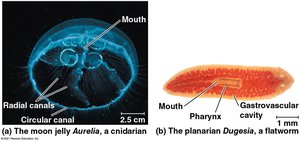
Simple animals (e.g., cnidarians, flatworms) rely on direct exchange with the environment or gastrovascular cavities.
Most animals possess a circulatory system that links exchange surfaces with body cells.
Gastrovascular Cavities
Some animals lack a true circulatory system and instead use a gastrovascular cavity for both digestion and internal transport.
Cnidarians (e.g., Aurelia, the moon jelly) have elaborate gastrovascular cavities with a body wall only two cells thick.
Flatworms (e.g., Dugesia, the planarian) have a branched gastrovascular cavity and a flattened body to minimize diffusion distances.
Open vs. Closed Circulatory Systems
Circulatory systems can be classified as open or closed, each with distinct structural and functional characteristics.
Open circulatory system: Circulatory fluid (hemolymph) bathes organs directly; found in arthropods and most molluscs.
Closed circulatory system: Blood is confined to vessels and is distinct from interstitial fluid; found in annelids, cephalopods, and vertebrates.
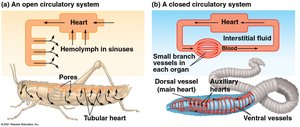
Open systems are energetically less costly but less efficient for rapid oxygen delivery.
Closed systems allow for higher metabolic rates and more precise regulation of blood flow.
Organization of Vertebrate Circulatory Systems
Vertebrates possess a closed circulatory system, known as the cardiovascular system, consisting of the heart and blood vessels (arteries, veins, capillaries).
Arteries carry blood away from the heart; veins return blood to the heart.
Capillaries are the sites of exchange between blood and interstitial fluid.
Single and Double Circulation
Circulatory systems in vertebrates are further classified based on the number of circuits and heart chambers.
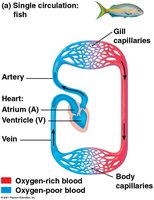
Single circulation: Found in fishes; blood passes through the heart once per circuit (two-chambered heart).
Double circulation: Found in amphibians, reptiles, and mammals; blood passes through the heart twice per circuit (separate pulmonary and systemic circuits).
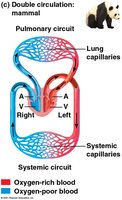
Amphibians have a three-chambered heart and a pulmocutaneous circuit (lungs and skin).
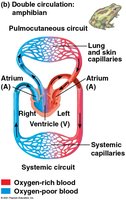
Mammals and birds have a four-chambered heart, allowing complete separation of oxygen-rich and oxygen-poor blood.
The Mammalian Cardiovascular System
Blood Flow Through the Mammalian Heart
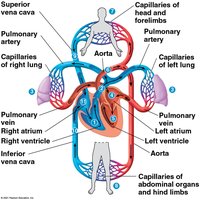
The mammalian heart is a muscular organ with four chambers: two atria and two ventricles. It ensures the separation of oxygenated and deoxygenated blood, supporting high metabolic demands.
Right side: Receives oxygen-poor blood and pumps it to the lungs (pulmonary circuit).
Left side: Receives oxygen-rich blood from the lungs and pumps it to the body (systemic circuit).
Heart Structure and Cardiac Cycle
The heart's structure supports its function as a dual pump. The cardiac cycle consists of alternating periods of contraction (systole) and relaxation (diastole).
Atria have thin walls and serve as collection chambers; ventricles have thick walls for forceful contraction.
Valves prevent backflow: atrioventricular (AV) valves and semilunar valves.
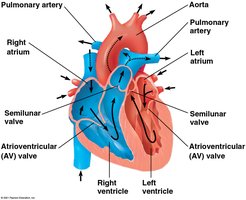
The "lub-dup" sound is caused by the closing of heart valves.
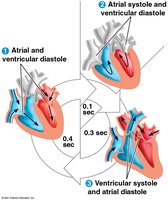
Cardiac output is the volume of blood pumped per minute:
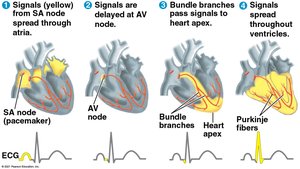
Electrical Control of the Heart
The heart's rhythmic contractions are coordinated by specialized cardiac muscle cells.
The sinoatrial (SA) node acts as the pacemaker, initiating electrical impulses.
Impulses spread to the atrioventricular (AV) node, then to the ventricles via bundle branches and Purkinje fibers.
Heart rate is regulated by the autonomic nervous system, hormones, and temperature.
Blood Vessels and Circulation
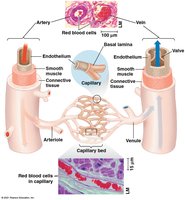
Structure and Function of Blood Vessels
Blood vessels are specialized for their roles in circulation, with structural differences reflecting their functions.
All vessels have a central lumen lined by endothelium.
Arteries have thick, elastic walls to withstand high pressure; veins have thinner walls and valves to prevent backflow.
Capillaries have thin walls to facilitate exchange.
Blood Flow Velocity and Pressure
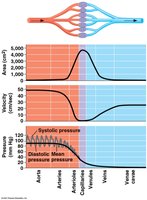
Blood flow and pressure change as blood moves through the circulatory system.
Blood slows in capillaries due to increased cross-sectional area, allowing time for exchange.
Blood pressure is highest in arteries and drops in capillaries and veins.
Measuring Blood Pressure
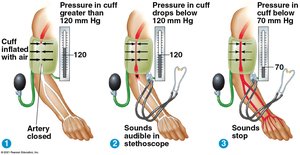
Blood pressure is measured using a sphygmomanometer, typically at the brachial artery.
Systolic pressure: Pressure during ventricular contraction.
Diastolic pressure: Pressure during ventricular relaxation.
Venous Return and Gravity
Blood returns to the heart through veins, aided by valves and muscle contractions, especially important in overcoming gravity.
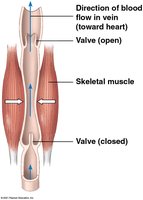
Capillary Exchange and the Lymphatic System
Exchange of substances between blood and tissues occurs in capillaries. The lymphatic system returns excess fluid to the circulatory system and plays a role in immune defense.
Blood Composition and Function
Components of Blood
Blood is a connective tissue with a liquid matrix (plasma) and cellular elements.
Plasma: Contains water, ions, proteins (albumin, immunoglobulins, fibrinogen), nutrients, hormones, and waste products.
Cellular elements: Erythrocytes (red blood cells), leukocytes (white blood cells), and platelets.
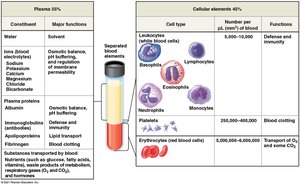
Erythrocytes transport O2 via hemoglobin.
Leukocytes function in defense and immunity.
Platelets are involved in blood clotting.
Gas Exchange and Respiratory Systems
Respiratory Media and Surfaces
Gas exchange involves the uptake of O2 and release of CO2 across specialized surfaces. The efficiency of gas exchange depends on the medium (air or water) and the structure of the respiratory surface.
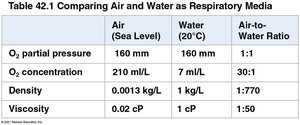
O2 is less soluble in water than in air, making aquatic respiration more challenging.
Air (Sea Level) | Water (20°C) | Air-to-Water Ratio | |
|---|---|---|---|
O2 partial pressure | 160 mm | 160 mm | 1:1 |
O2 concentration | 210 mL/L | 7 mL/L | 30:1 |
Density | 0.0013 kg/L | 1 kg/L | 1:770 |
Viscosity | 0.02 cP | 1 cP | 1:50 |
Respiratory Structures in Animals
Gills: Outfoldings of the body surface in aquatic animals; use countercurrent exchange for efficient O2 uptake.
Tracheal systems: In insects, a network of tubes delivers O2 directly to cells.
Lungs: Infoldings of the body surface; found in terrestrial vertebrates.
Breathing Mechanisms
Amphibians: Use positive pressure breathing to force air into lungs.
Birds: Use air sacs and unidirectional airflow for highly efficient gas exchange.
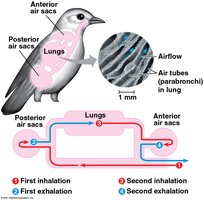
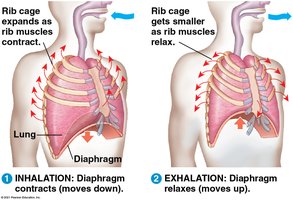
Mammals: Use negative pressure breathing; diaphragm and rib muscles expand the thoracic cavity to draw air in.
Control of Breathing in Humans
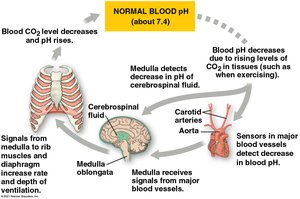
Breathing is regulated by the medulla oblongata, which responds to changes in blood pH (related to CO2 levels).
Coordination of Circulation and Gas Exchange
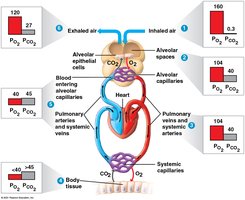
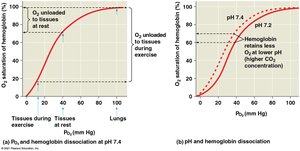
O2 and CO2 are exchanged in the lungs and tissues according to partial pressure gradients. Hemoglobin in red blood cells binds O2 cooperatively, and its affinity is affected by pH (Bohr shift).
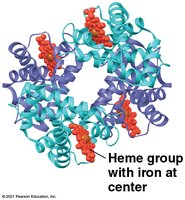
The Bohr shift describes how increased CO2 (lower pH) decreases hemoglobin's affinity for O2, facilitating O2 release in tissues.
Additional info:
Cardiovascular diseases such as atherosclerosis, heart attack, and stroke are major health concerns and are influenced by cholesterol levels, inflammation, and blood pressure.
Diving mammals have adaptations for oxygen storage and conservation, allowing extended periods underwater.
