 Back
Circulation and Gas Exchange in Animals
Study Guide - Smart Notes
 Tailored notes based on your materials, expanded with key definitions, examples, and context.
Circulatory Systems
Overview of Circulatory Systems
The circulatory system links exchange surfaces with all body cells, enabling the transport of gases, nutrients, and wastes. Oxygen (O2) and carbon dioxide (CO2) move between cells and the environment primarily via diffusion, but circulatory systems are required for efficient transport in larger or more complex organisms.
Open Circulatory System: The circulatory fluid (hemolymph) is not entirely contained within vessels and directly bathes organs. There is no distinction between circulatory and interstitial fluid. Found in arthropods and some mollusks.
Closed Circulatory System: Blood is confined to vessels and is distinct from interstitial fluid. Found in annelids, cephalopods, and all vertebrates.
Vessel Types in Closed Circulatory Systems
Arteries: Large-diameter vessels that carry blood away from the heart.
Arterioles: Smaller branches of arteries leading to capillaries.
Capillaries: Smallest blood vessels where exchange with interstitial fluid occurs.
Venules: Small vessels that collect blood from capillaries and transport it to veins.
Veins: Large-diameter vessels that return blood to the heart.
Evolution of Vertebrate Circulatory Systems
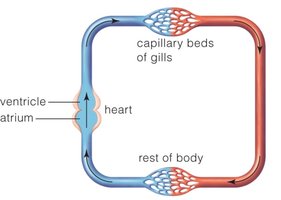
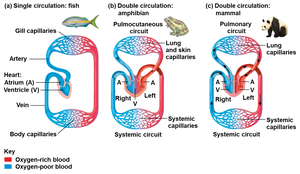
Vertebrate circulatory systems evolved from a single-chambered heart to a double-circuit heart with separate pulmonary and systemic circuits.
Pulmonary Circuit: Blood flows from the heart to the lungs (or gills) and back.
Systemic Circuit: Blood flows from the heart to the rest of the body and back.
Mammalian Circulatory System
Structure of the Mammalian Heart
The mammalian heart is a four-chambered organ with two atria and two ventricles. Valves ensure unidirectional blood flow:
Atrioventricular (AV) Valves: Between atria and ventricles.
Semilunar (SL) Valves: Between ventricles and major arteries (aorta/pulmonary arteries).
Pulmonary and Systemic Circuits
Pulmonary Circuit: The right ventricle pumps blood to the lungs, where it loads O2 and unloads CO2. Oxygen-rich blood returns to the left atrium.
Systemic Circuit: The left ventricle pumps oxygen-rich blood to the body, where it unloads O2 and loads CO2.
Cardiac Cycle and Heartbeat Control
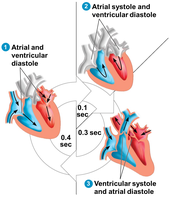
The heart contracts and relaxes in a coordinated cycle:
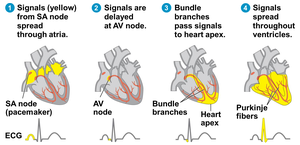
Sinoatrial (SA) Node: The pacemaker that sets the timing and rate of heart contractions.
Autorhythmicity: The heart contracts without signals from the central nervous system.
Contraction (Systole): Pushes blood out of the chambers.
Relaxation (Diastole): Allows chambers to fill with blood.
Blood Flow Velocity
Blood flow velocity is slowest in capillaries to facilitate efficient exchange of materials with tissues. Vessel diameter influences flow rate.
Blood Cell Types
Erythrocytes (Red Blood Cells): Most numerous; contain hemoglobin for O2 and CO2 transport.
Leukocytes (White Blood Cells): Function in immune response; found both inside and outside the circulatory system.
Platelets: Cell fragments that aid in blood clotting (coagulation).
Respiratory Systems and Gas Exchange
Cellular vs. Physiological Respiration
Cellular Respiration: Metabolic process by which cells use O2 to produce ATP and generate CO2 as a waste product.
Physiological Respiration: The process by which animals obtain O2 from the environment and expel CO2.
Respiratory Media and Surfaces
Respiratory Medium: The environment where gas exchange occurs (air or water).
Respiratory Surface: The layer of epithelial cells across which gases are exchanged; must remain moist for diffusion.
Respiratory Surfaces in Aquatic Animals
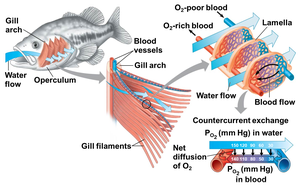
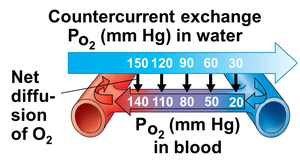
Gills are specialized evaginations that provide a large surface area for gas exchange in water. Fish use countercurrent flow to maximize O2 uptake.
Respiratory Surfaces in Arthropods
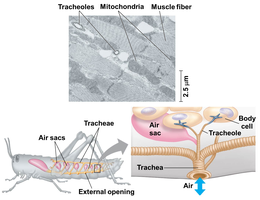
Insects possess a tracheal system of branched air tubes that deliver oxygen directly to body cells, independent of the circulatory system. Ventilation is achieved by abdominal movements.
Respiratory Surfaces in Vertebrates
Lungs: Invaginations of the body surface for gas exchange; found in most terrestrial vertebrates.
Amphibians: Use both skin and lungs for gas exchange.
Birds: Have air sacs that ensure a continuous flow of fresh air through the lungs.
Mammals: Inhale fresh air that mixes with residual air in the lungs.
Mammalian Respiratory System
Air passes through the pharynx, larynx, trachea, bronchi, and bronchioles to reach the alveoli, where gas exchange occurs. Cilia and mucus line the respiratory epithelium to trap and move particles out of the system (the "mucus escalator").
Alveoli and Gas Exchange
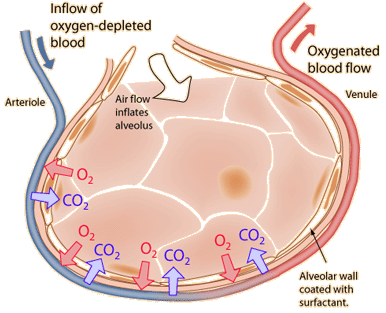
Alveoli are tiny air sacs at the ends of bronchioles where O2 diffuses into capillaries and CO2 diffuses out. Alveoli lack cilia and are susceptible to contamination.
Ventilation Mechanisms
Positive Pressure Breathing: Used by amphibians and birds; air is forced into the lungs.
Negative Pressure Breathing: Used by mammals; air is drawn into the lungs by expanding the thoracic cavity.
Control of Breathing in Humans
The medulla oblongata in the brainstem regulates respiratory rate via negative feedback, responding to changes in blood pH and O2/CO2 ratios to match metabolic demands.
Coordination of Circulation and Gas Exchange
Gas exchange is driven by concentration gradients: O2 diffuses into blood where its concentration is higher in the respiratory medium, and CO2 diffuses out where its concentration is lower. The process is reversed at the tissues.
Summary Table: Comparison of Circulatory and Respiratory Systems
System | Open | Closed |
|---|---|---|
Circulatory Fluid | Hemolymph | Blood |
Vessel Structure | Not fully contained | Fully contained in vessels |
Examples | Arthropods, some mollusks | Vertebrates, annelids, cephalopods |
Respiratory Surface | Example Organisms | Key Features |
|---|---|---|
Gills | Fish, aquatic invertebrates | Evaginations, countercurrent exchange |
Tracheal System | Insects | Branched air tubes, direct delivery |
Lungs | Vertebrates | Invaginations, alveoli in mammals |
