 Back
BackCirculation and Gas Exchange: Structure and Function of Circulatory Systems
Study Guide - Smart Notes
 Tailored notes based on your materials, expanded with key definitions, examples, and context.
Circulation and Gas Exchange
Gastrovascular Cavities
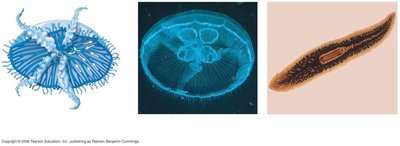
Simple animals such as cnidarians and flatworms rely on a gastrovascular cavity for both digestion and distribution of substances throughout the body. Their body wall is only two cells thick, which allows for efficient exchange with the environment due to a large surface area to volume ratio.
Cnidarians: The body encloses a central gastrovascular cavity, facilitating direct exchange of gases and nutrients.
Flatworms: Possess a branched gastrovascular cavity that reaches throughout the body, maximizing exchange efficiency.
Open and Closed Circulatory Systems
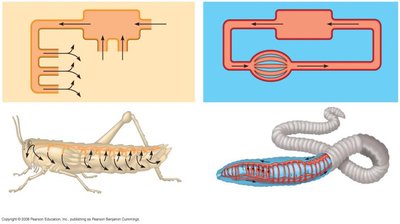
More complex animals have evolved circulatory systems to transport fluids, nutrients, and gases efficiently. These systems are classified as open or closed, each with three basic components: a circulatory fluid, a set of tubes (vessels), and a muscular pump (heart).
Open Circulatory System: Found in insects, other arthropods, and most molluscs. The circulatory fluid, called hemolymph, bathes organs directly, with no distinction between blood and interstitial fluid.
Closed Circulatory System: Found in annelids, cephalopods, and all vertebrates. Blood is confined to vessels and is distinct from interstitial fluid, allowing for more efficient transport to tissues and cells.
Organization of Vertebrate Circulatory Systems
Vertebrate circulatory systems are closed and consist of a heart with two or more chambers (atria and ventricles), arteries, veins, and capillaries. Blood flows in a circuit, passing through capillary beds for exchange with tissues.
Arteries: Carry blood away from the heart to capillaries.
Capillaries: Sites of exchange between blood and interstitial fluid.
Veins: Return blood from capillaries to the heart.
Single and Double Circulation
Vertebrates exhibit either single or double circulation, which affects the efficiency of oxygen delivery and blood pressure maintenance.
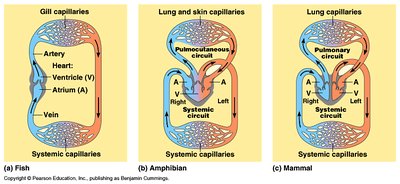
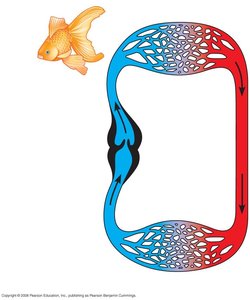
Single Circulation: Seen in bony fishes, rays, and sharks. Blood passes through the heart once in each complete circuit, moving through two capillary beds (gill and systemic), resulting in lower pressure after the gills.
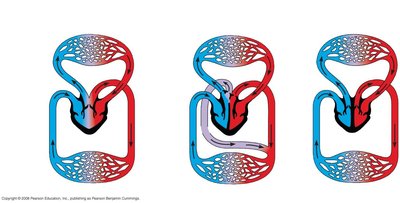
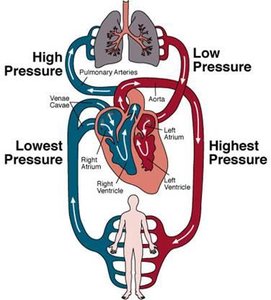
Double Circulation: Found in amphibians, reptiles, birds, and mammals. Blood passes through the heart twice per circuit—once for oxygenation (pulmonary or pulmocutaneous circuit) and once for delivery to tissues (systemic circuit). This maintains higher pressure and more efficient oxygen delivery.
Amphibian and Reptile Circulatory Systems
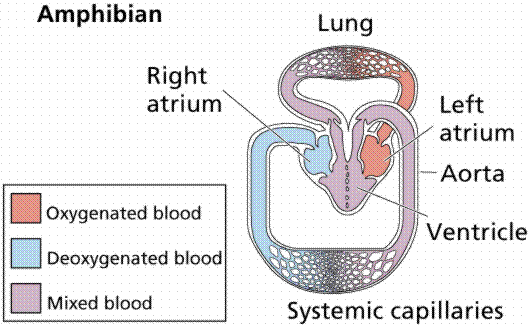
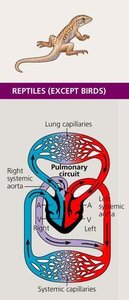
Amphibians have a three-chambered heart (two atria, one ventricle) that pumps blood into a forked artery, splitting output between the pulmocutaneous and systemic circuits. Reptiles (except birds) also have a three-chambered heart, but some (e.g., crocodilians) have a septum that partially or completely divides the ventricle.
Mammalian and Bird Circulatory Systems
Mammals and birds possess a four-chambered heart with complete separation of oxygen-rich and oxygen-poor blood. The right side pumps blood to the lungs (pulmonary circuit), while the left side pumps oxygenated blood to the body (systemic circuit). This separation supports high metabolic rates in endotherms.
Capillary Beds and Blood Flow Regulation
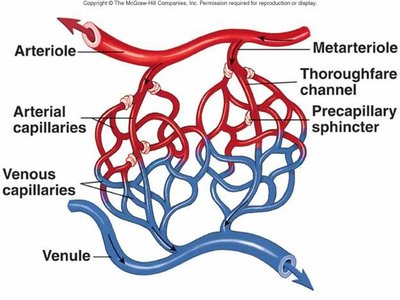
Capillary beds are networks of capillaries where exchange of gases, nutrients, and wastes occurs. Blood flow through capillary beds is regulated by arteriole constriction and precapillary sphincters, allowing precise control of tissue perfusion.
Summary Table: Comparison of Circulatory Systems
Animal Group | Heart Chambers | Circulation Type | Key Features |
|---|---|---|---|
Fish | 2 (1 atrium, 1 ventricle) | Single | Blood passes through two capillary beds per circuit; low pressure after gills |
Amphibians | 3 (2 atria, 1 ventricle) | Double | Mixing of oxygenated and deoxygenated blood; pulmocutaneous circuit |
Reptiles (except birds) | 3 (2 atria, 1 ventricle, partial septum in some) | Double | Some separation of blood; pulmonary and systemic circuits |
Mammals/Birds | 4 (2 atria, 2 ventricles) | Double | Complete separation of oxygenated and deoxygenated blood; supports high metabolism |
