 Back
BackCirculatory Systems: Linking Exchange Surfaces with Cells
Study Guide - Smart Notes
 Tailored notes based on your materials, expanded with key definitions, examples, and context.
Circulatory Systems and Exchange with the Environment
Overview of Exchange in Animals
Animals must exchange nutrients, gases, and wastes with their environment. In unicellular organisms, this exchange occurs directly across the plasma membrane by diffusion. However, in most multicellular organisms, direct exchange between every cell and the environment is not possible due to the limitations of diffusion over long distances. To overcome this, animals have evolved adaptations that ensure efficient exchange for all cells.
Diffusion Limitation: The time for diffusion increases with the square of the distance, making it inefficient for large or thick-bodied organisms.
Adaptations: Two main adaptations exist: (1) simple body plans that place most cells in direct contact with the environment, and (2) circulatory systems that transport fluids between exchange surfaces and body cells.
Gastrovascular Cavities
Simple Body Plans and Direct Exchange
Some animals, such as cnidarians and flatworms, have body shapes that allow many cells to be in direct contact with the environment. These animals use a central gastrovascular cavity for both digestion and distribution of substances throughout the body.
Gastrovascular Cavity: A central cavity with a single opening that functions in both digestion and distribution of nutrients.
Examples: Aurelia (moon jelly, a cnidarian) and Dugesia (planarian, a flatworm) utilize this system.
Exchange Mechanism: Fluid in the cavity bathes both inner and outer tissue layers, facilitating exchange of gases and wastes. The thin body wall ensures short diffusion distances.
Surface Area: Flatworms maximize surface area and minimize diffusion distance by having a flattened body.
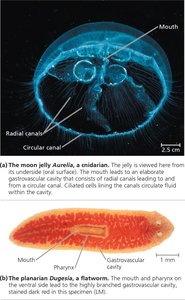
Example: In Aurelia, radial canals distribute nutrients from the gastrovascular cavity, while in Dugesia, a highly branched cavity ensures all cells are near a source of nutrients and oxygen.
Open and Closed Circulatory Systems
Basic Components and Functions
Most animals with complex body plans have a circulatory system composed of three main components: a circulatory fluid, a set of interconnecting vessels, and a muscular pump (heart). The heart generates hydrostatic pressure to move the fluid through the vessels, connecting exchange surfaces with body cells.
Open Circulatory System: The circulatory fluid (hemolymph) is also the interstitial fluid bathing body cells. Found in arthropods (e.g., grasshoppers) and some molluscs (e.g., clams).
Closed Circulatory System: The circulatory fluid (blood) is confined to vessels and is distinct from interstitial fluid. Found in annelids (e.g., earthworms), cephalopods, and all vertebrates.
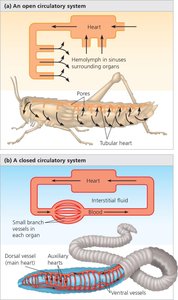
Advantages: Open systems use less energy due to lower pressures and can serve additional functions (e.g., movement in spiders). Closed systems allow higher pressures, supporting more active lifestyles and efficient delivery of oxygen and nutrients.
Table: Comparison of Open and Closed Circulatory Systems
Feature | Open System | Closed System |
|---|---|---|
Circulatory Fluid | Hemolymph | Blood |
Fluid Location | Sinuses and body cavities | Confined to vessels |
Organisms | Arthropods, some molluscs | Annelids, cephalopods, vertebrates |
Pressure | Low | High |
Energy Cost | Low | High |
Organization of Vertebrate Circulatory Systems
Cardiovascular System Structure
Vertebrates possess a cardiovascular system, consisting of the heart and a network of blood vessels. Blood flows in one direction through arteries (away from the heart), capillaries (sites of exchange), and veins (toward the heart).
Arteries: Carry blood from the heart to organs.
Capillaries: Microscopic vessels where exchange with tissues occurs.
Veins: Return blood to the heart.
Heart Chambers: Vertebrate hearts have two or more chambers—atria (receive blood) and ventricles (pump blood out).
Single and Double Circulation
Single Circulation
In fishes, blood passes through the heart once in each complete circuit (single circulation). The heart has two chambers: one atrium and one ventricle. Blood is pumped to the gills for gas exchange, then to the rest of the body before returning to the heart.
Limitation: Blood pressure drops after passing through the gill capillaries, slowing circulation to the rest of the body.
Double Circulation
Amphibians, reptiles, and mammals have double circulation, with two circuits: pulmonary (or pulmocutaneous in amphibians) and systemic. The heart acts as a double pump, maintaining higher blood pressure and more efficient delivery of oxygen and nutrients.
Pulmonary Circuit: Right side of the heart pumps oxygen-poor blood to the lungs (or skin in amphibians) for gas exchange.
Systemic Circuit: Left side of the heart pumps oxygen-rich blood to the rest of the body.
Heart Structure: Amphibians have three chambers (two atria, one ventricle); mammals and birds have four chambers (two atria, two ventricles) for complete separation of oxygen-rich and oxygen-poor blood.
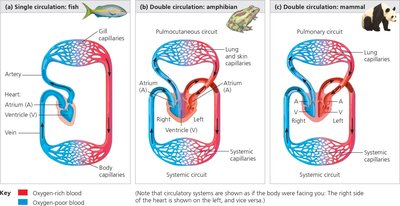
Example: In mammals, the left side of the heart handles only oxygen-rich blood, and the right side only oxygen-poor blood, supporting high metabolic demands of endothermy.
Evolutionary Variation in Double Circulation
Adaptations in Vertebrate Hearts
Double circulation varies among vertebrates, reflecting adaptations to different respiratory strategies and metabolic needs.
Amphibians: Three-chambered heart allows some mixing of blood, but a ridge in the ventricle helps direct most oxygen-rich blood to the body and oxygen-poor blood to the lungs/skin. When underwater, amphibians can bypass the lungs and rely on cutaneous respiration.
Reptiles (except birds): Three-chambered heart with an incomplete septum allows control over blood flow to lungs and body. Crocodilians have a four-chambered heart but can shunt blood away from the lungs when submerged.
Birds and Mammals: Four-chambered heart completely separates oxygen-rich and oxygen-poor blood, supporting high metabolic rates required by endothermy.
Concept Check
How is the flow of hemolymph through an open circulatory system similar to the flow of water through an outdoor fountain?
What advantage of three-chambered hearts with incomplete septa was overlooked by earlier viewpoints?
What would be the effect if a hole between the left and right atria in a human fetus did not close before birth?
For suggested answers, see Appendix A.
