 Back
BackColonization of Land and Vascular Plant Structure & Growth
Study Guide - Smart Notes
 Tailored notes based on your materials, expanded with key definitions, examples, and context.
Colonization of Land
Evidence of Algal Ancestry
Land plants evolved from photosynthetic algae over 470 million years ago. Both plants and algae share key features, such as chlorophyll a and b, multicellularity, and cellulose-based cell walls.
Photosynthetic autotrophs: Organisms that produce their own food using sunlight, water, and CO2.
Chlorophyll a: Main pigment for capturing light energy.
Chlorophyll b: Accessory pigment that broadens the spectrum of light absorption.
Cellulose: Structural carbohydrate in plant cell walls, providing rigidity.
Additional info: Circular rings of proteins for cellulose synthesis and flagellated sperm are traits shared with certain green algae.
Movement to Land: Opportunities and Challenges
Transitioning to terrestrial life offered brighter light, abundant CO2, and rich soil nutrients, but also posed challenges such as gravity, water scarcity, and desiccation.
Ecological niche: The role and position of an organism in its environment.
Challenges: Gravity, reliable water source, risk of drying out.
Derived Traits Facilitating Land Colonization
Land plants possess several key adaptations absent in their closest algal relatives (charophytes):
Alternation of generations: Life cycle alternates between haploid gametophyte and diploid sporophyte stages.
Multicellular, dependent embryos: Embryos develop within and are nourished by parent tissue.
Walled spores in sporangia: Spores have tough walls (sporopollenin) to prevent desiccation.
Apical meristems: Regions of active cell division at root and shoot tips, enabling growth.
Important Definitions
Gametophyte: Haploid (n) generation producing gametes by mitosis.
Sporophyte: Diploid (2n) generation producing spores by meiosis.
Multicellular, Dependent Embryos
Plants are classified as embryophytes because their embryos are retained and nourished within the female gametophyte tissue, providing protection and nutrients.
Spores Produced in Sporangia
Sporophytes produce spores in multicellular sporangia. Spores are protected by sporopollenin, allowing them to survive harsh conditions and disperse through air.
Apical Meristems
Apical meristems are localized regions of cell division at the tips of roots and shoots, enabling plants to grow taller and deeper into the soil.
Additional Derived Traits
Cuticle: Waxy layer preventing water loss.
Stomata: Pores for gas exchange, regulated to minimize water loss.
Fungi and Mycorrhizal Relationships
Fungi form mutualistic relationships with plant roots (mycorrhizae), aiding nutrient absorption. Fungi are heterotrophs with chitin-based cell walls and absorb nutrients via hyphae.
Arbuscular mycorrhizae: Hyphae penetrate root cortex cells.
Ectomycorrhizal: Hyphae grow between root cells.
Vascular Tissue and Plant Groups
Vascular tissue enables efficient transport of water, minerals, and sugars. Bryophytes lack vascular tissue and are found in moist habitats. Seedless vascular plants have xylem and phloem, with sporophyte as the dominant stage.
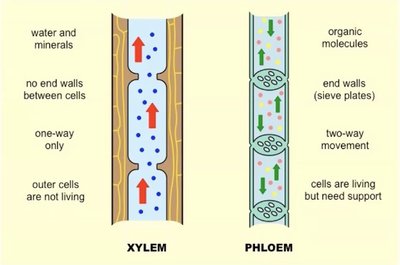
Xylem: Conducts water and minerals upward.
Phloem: Transports sugars and amino acids.
Roots and Leaves
Roots anchor plants and absorb water/nutrients. Leaves are the primary site of photosynthesis and come in two types: microphylls (single vein) and megaphylls (branched veins).
Seed Plants: Gymnosperms and Angiosperms
Seed plants are divided into gymnosperms (naked seeds, no flowers) and angiosperms (seeds in fruits, flowers present). Adaptations include reduced gametophytes, ovules, pollen, and seeds.
Gymnosperms: Wind pollination, lack flowers/fruits.
Angiosperms: Flowers and fruits for reproduction and dispersal.
Vascular Plant Structure & Growth
Cells, Tissues, and Organs
Plants are organized into cells, tissues, and organs, each with specialized functions.
Parenchyma: Flexible, undifferentiated cells for storage and photosynthesis.
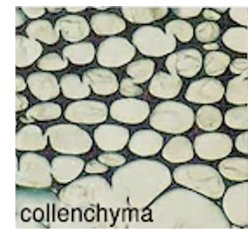
Collenchyma: Cells with unevenly thickened walls, providing flexible support.
Sclerenchyma: Rigid cells with thick lignified walls, providing structural support.
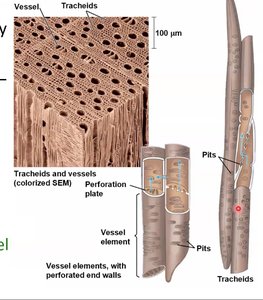
Water-Conducting Cells of the Xylem
Xylem consists of dead, lignified cells at maturity, including tracheids and vessel elements, which transport water and minerals.
Tracheids: Long, thin cells with pits for water movement; found in all vascular plants.
Vessel elements: Wide cells with perforated plates; primarily in angiosperms.
Sugar-Conducting Cells of the Phloem
Phloem is composed of living cells at maturity, including sieve tube elements and companion cells, which transport sugars and nutrients.
Sieve tube elements: Move sugar-rich fluid; have porous sieve plates.
Companion cells: Support sieve tube elements.
Tissues and Organization
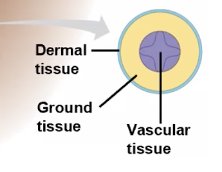
Plant organs are composed of three fundamental tissue types: dermal, vascular, and ground tissue.
Dermal tissue: Outermost protective layer (epidermis, cuticle, periderm).
Vascular tissue: Transport system (xylem and phloem).
Ground tissue: Functions in photosynthesis, storage, and support (pith, cortex).
Organs and Organization
Key plant organs include roots, stems, leaves, and flowers, each with specialized roles in growth, support, and reproduction.
Roots: Anchor, absorb water/minerals, store carbohydrates.
Stems: Support and elevate leaves/flowers; contain nodes, internodes, buds.
Leaves: Main site of photosynthesis and gas exchange; adaptations include tendrils, spines, storage, and reproductive leaves.
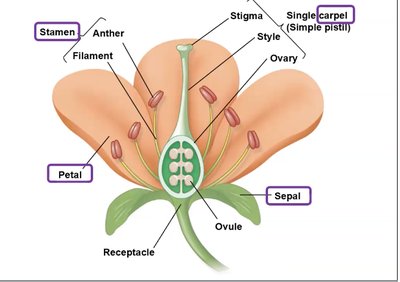
Flower Structure (Angiosperms)
Flowers are reproductive organs of angiosperms, consisting of sepals, petals, stamens, and carpels.
Stamen: Male reproductive part (anther and filament).
Carpel: Female reproductive part (stigma, style, ovary).
Petal: Often colorful, attracts pollinators.
Sepal: Protects the flower bud.
Meristems and Plant Growth
Meristems are regions of active cell division, enabling plants to grow throughout their lives (intermediate growth). Apical meristems drive primary growth (length), while lateral meristems drive secondary growth (width).
Apical meristems: Located at shoot and root tips.
Lateral meristems: Vascular cambium (secondary xylem/phloem) and cork cambium (protective cork cells).
Primary and Secondary Growth
Primary growth increases length via apical meristems; secondary growth increases diameter via lateral meristems, especially in woody plants.
Root cap: Protects root tip during growth.
Zones of growth: Cell division, elongation, differentiation.
Tree rings: Indicate age and environmental conditions.
Root Cross Sections: Monocots vs. Eudicots
Monocot roots have vascular tissue in rings, while eudicot roots have a central vascular cylinder with a star-like xylem configuration.
Monocot: Epidermis, cortex, endodermis, stele, vascular bundles.
Eudicot: Epidermis, cortex, endodermis, vascular cylinder (xylem, phloem, no pith), pericycle.
Summary Table: Comparison of Xylem and Phloem
Feature | Xylem | Phloem |
|---|---|---|
Transported Material | Water & minerals | Organic molecules (sugars) |
Cell Status | Dead at maturity | Alive at maturity |
Direction | One-way (upward) | Two-way |
End Walls | None between cells | Sieve plates present |
