 Back
Communities and Ecosystems: Energy Flow and Nutrient Cycling
Study Guide - Smart Notes
 Tailored notes based on your materials, expanded with key definitions, examples, and context.
Communities and Ecosystems
Notes from Jensen's yap
Heat energy can also be known as disordered energy
All biological molecules include a fair amount of carbon. Plants can take carbon and put in a usable form. The usable form of carbon gets eaten by other organisms. When you are living, the Co2 that u release can get picked up by plants. Chemical nutrients cycle through an ecosystem.
Abiotic reservoirs = stuff that goes back into the world (Co2)
%70 of the air u breath in is nitrogen, you cant use the nitrogen that u breathe in, other organisms can.
Nitrogen is released into the world by humans, by the way of peeing.
Carbon is fixed by photosynthesis
Fixed - means taking it from a gas form and making into something that is biologically useful
Detritus is a fancy word for dead stuff
Not every dead thing is picked up by decomposers, some things can fossilize, meaning the carbon can become part of the geologic record and the energy is stuck in that carbon.
The carbon cycle is facilitated primarily by photosynthetic organisms.
Nitrogen makes up about %70 of the atmosphere.
We get our nitrogen from other organisms as we eat them.
Contrary to the carbon cycle, the nitrogen cycle is facilitated primarily by bacteria. No organisms in the world that are not bacteria can fix nitrogen.
Farmers will often grow these plants in fallow fields, farmers often plant culvers there.
When organisms such as humans urinate, we release nitrogen back into the soil.
Nitrogen does a similar cycle to carbon but it is facilitated by bacteria.
If you go into a forest and there is no black stuff (nutrients) on the ground, that means the dead is getting decomposed a lot quicker. Means nutrient cycling is fast.
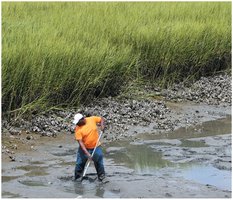
Oysters do a lot of nutrient cycling in salt marshes. You can't collect them for May, June, July, August.
Oysters are a keystone species in South Carolina.
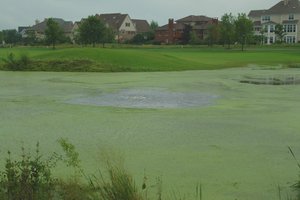
Eutrophication - As the algae live, they photosynthesize and as they die, other organisms come in and try to decompose them. So oxygen levels end up dropping which leads to the decomposers dying, which leads to more algae growth.
Energy Flow in Ecosystems
Energy enters ecosystems primarily as sunlight and is transformed by producers into chemical energy, which is then transferred through various trophic levels. Unlike nutrients, energy flows in one direction and is eventually lost as heat.
Producers (autotrophs) convert light energy into chemical energy via photosynthesis.
Consumers (heterotrophs) obtain energy by eating producers or other consumers.
Decomposers break down dead organisms, returning nutrients to the environment.
Energy is lost as heat at each trophic level due to metabolic processes.
Energy flow can be represented as a food chain or food web.
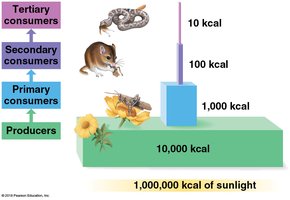
Only a fraction of energy is transferred from one trophic level to the next (typically about 10%).
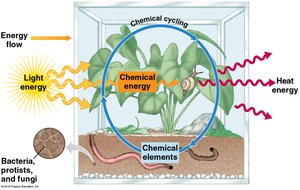
Nutrient Cycling in Ecosystems
Nutrients such as carbon and nitrogen are cycled within ecosystems, moving between biotic and abiotic components. This cycling is essential for sustaining life and ecosystem productivity.
Chemical elements are recycled through biotic (living) and abiotic (non-living) reservoirs.
Decomposers play a critical role in recycling nutrients by breaking down organic matter.
Geologic processes contribute to the movement of nutrients between reservoirs.
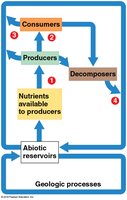
Food Webs and Trophic Structure
Food Chains and Food Webs
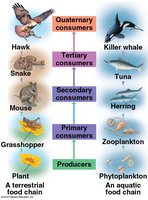
Food chains show the linear flow of energy and nutrients from producers to various levels of consumers. Food webs are more complex, illustrating interconnected feeding relationships within a community.
Primary producers form the base of the food web.
Primary consumers eat producers; secondary and tertiary consumers eat other consumers.
Quaternary consumers are at the top of the food web.
Food webs provide stability and resilience to ecosystems.
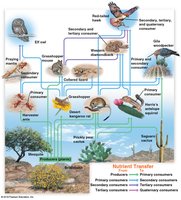
Energy and Biomass Pyramids
Energy and biomass pyramids illustrate the distribution of energy and biomass among trophic levels. They highlight differences between terrestrial and aquatic ecosystems.
Energy pyramid: Shows the decrease in available energy at higher trophic levels.
Biomass pyramid: Shows the amount of living matter at each trophic level.
Terrestrial ecosystems typically have larger producer biomass; aquatic ecosystems often have larger consumer biomass due to rapid consumption of producers.
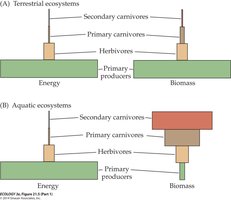
Biogeochemical Cycles
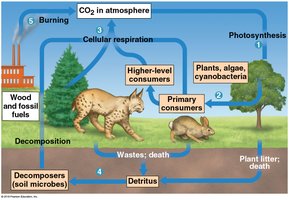
The Carbon Cycle
The carbon cycle describes the movement of carbon among the atmosphere, biosphere, and geosphere. It is essential for life and is influenced by both biological and human activities.
Photosynthesis by plants, algae, and cyanobacteria removes CO2 from the atmosphere.
Cellular respiration by organisms returns CO2 to the atmosphere.
Decomposition releases carbon from dead organisms.
Burning of fossil fuels adds CO2 to the atmosphere.
The Nitrogen Cycle
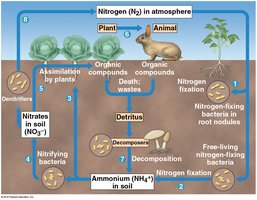
The nitrogen cycle involves the transformation and movement of nitrogen through the atmosphere, soil, and living organisms. Nitrogen is essential for proteins and nucleic acids.
Nitrogen fixation: Conversion of atmospheric N2 to ammonia (NH3) by bacteria.
Nitrification: Conversion of ammonia to nitrates (NO3-).
Assimilation: Uptake of nitrates by plants.
Decomposition: Returns nitrogen to the soil.
Denitrification: Conversion of nitrates back to N2 gas.
Nitrogen Fixation in Root Nodules
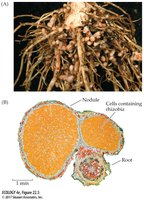
Certain plants, such as legumes, form symbiotic relationships with nitrogen-fixing bacteria in root nodules. These bacteria convert atmospheric nitrogen into forms usable by plants.
Root nodules contain bacteria (e.g., Rhizobium) that fix nitrogen.
This process enhances soil fertility and supports plant growth.
Rapid Nutrient Cycling in Estuaries and Salt Marshes
Estuary/Salt Marsh Ecosystems
Estuaries and salt marshes are highly productive ecosystems with rapid nutrient cycling. They support diverse communities and play a crucial role in nutrient exchange between land and sea.
High rates of decomposition and nutrient turnover.
Support large populations of plants and animals.
Important for water purification and coastal protection.
Nutrient Cycle Disruption: Eutrophication
Eutrophic Aquatic Systems
Eutrophication occurs when nutrient cycles are disrupted, often due to excess nutrient input (e.g., fertilizers). This leads to overproduction of producers, anoxic conditions, and loss of consumers.
Oligotrophic systems: Healthy, balanced nutrient levels, high production, most producers eaten quickly.
Eutrophic systems: Excess nutrients, overproduction of producers (algae), oxygen depletion, reduced consumer populations.
Can result in harmful algal blooms and dead zones.
Energy and Biomass in Ecosystems
Energy Transfer Efficiency
Energy transfer between trophic levels is inefficient, with most energy lost as heat. This limits the number of trophic levels and the biomass supported at higher levels.
Only about 10% of energy is transferred to the next trophic level.
Energy loss limits the length of food chains.
Producers have the largest energy input; tertiary consumers have the least.
Food Chain Structure
Food chains illustrate the flow of energy from producers to various levels of consumers. Terrestrial and aquatic food chains differ in their structure and dominant organisms.
Terrestrial food chain: Plant → Grasshopper → Mouse → Snake → Hawk
Aquatic food chain: Phytoplankton → Zooplankton → Herring → Tuna → Killer whale
Biomass vs. Energy Pyramids
Biomass and energy pyramids differ between terrestrial and aquatic ecosystems. In terrestrial systems, producers have the largest biomass; in aquatic systems, consumers may have greater biomass due to rapid consumption of producers.
Terrestrial ecosystems: Large producer biomass, most production not consumed.
Aquatic ecosystems: Large consumer biomass, producers consumed quickly.
Additional info:
Biogeochemical cycles are fundamental to ecosystem function and sustainability.
Human activities can disrupt these cycles, leading to environmental issues such as eutrophication and climate change.
