 Back
Community Ecology: Competition, Symbiosis, Diversity, and Succession
Study Guide - Smart Notes
 Tailored notes based on your materials, expanded with key definitions, examples, and context.
Q13. Contrast species richness and relative abundance.
Background
Topic: Community Ecology – Species Diversity
This question is testing your understanding of two important components of biodiversity within ecological communities: species richness and relative abundance (also called species evenness).
Key Terms and Concepts
Species Richness: The number of different species present in a community.
Relative Abundance (Species Evenness): The proportion of each species in the community, showing how evenly individuals are distributed among the species.
Step-by-Step Guidance
Start by defining species richness: Count how many different species are present in the community, regardless of how many individuals of each species there are.
Next, define relative abundance: For each species, calculate the proportion of individuals that belong to that species compared to the total number of individuals in the community.
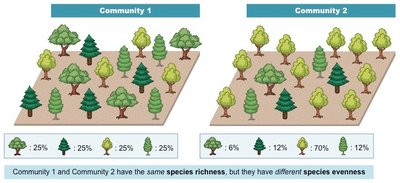
Compare the two communities in the image. Both have the same number of species (species richness), but look at the proportions of each species (relative abundance) in each community.
Notice that in Community 1, all species are equally represented (evenness is high), while in Community 2, one species dominates (evenness is low).
Think about how these differences in evenness might affect the stability and resilience of each community.
Try solving on your own before revealing the answer!
Final Answer:
Species richness is the same for both communities because they each have four different species. Relative abundance (evenness) is different: Community 1 has equal proportions of each species (25% each), while Community 2 is dominated by one species (70%), with the others much less common. This means Community 1 has higher evenness, while Community 2 has lower evenness.
Species richness tells us how many types of species are present, while relative abundance tells us how evenly individuals are distributed among those species.
