 Back
BackCommunity Ecology II: Biodiversity and Ecosystem Function
Study Guide - Smart Notes
 Tailored notes based on your materials, expanded with key definitions, examples, and context.
Community Ecology II: Biodiversity and Ecosystem Function
What is Biodiversity?
Biodiversity refers to the variety of life in all its forms and at all levels of organization, from genes to ecosystems. It encompasses the diversity within species, between species, and of ecosystems. Biodiversity is a central concept in ecology and conservation biology, as it underpins ecosystem function and resilience.
Genetic diversity: The variety of genetic information within and among individuals of a population, species, or community.
Species diversity: The number and relative abundance of species in a biological community.
Ecosystem diversity: The variety of ecosystems in a given place, including their communities and nonliving environments.
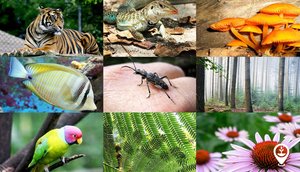
Genetic Diversity and Species Diversity
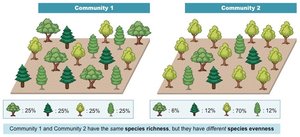
Genetic diversity provides the raw material for evolution and adaptation to changing environments. Species diversity is often measured by two main components: species richness (the number of species) and species evenness (the relative abundance of each species).
Species richness: The total number of different species present in a community.
Species evenness: The relative abundance of each species in a community.
High genetic diversity increases a population's ability to adapt to environmental changes.
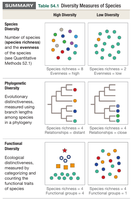
Beyond Simple Species Counts: Measuring Biodiversity
Biodiversity can be measured and compared using several metrics beyond just counting species. These include phylogenetic diversity and functional diversity.
Phylogenetic diversity: Measures the evolutionary relationships among species, often using branch lengths on a phylogenetic tree.
Functional diversity: Assesses the range of different biological traits or functions present in a community.
Measure | High Diversity | Low Diversity |
|---|---|---|
Species Diversity | Many species, even abundances | Few species, uneven abundances |
Phylogenetic Diversity | Species from distant branches | Species from close branches |
Functional Diversity | Wide range of traits/functions | Narrow range of traits/functions |
Ecosystem Diversity and Function
Ecosystem diversity refers to the variety of ecosystems in a region. High ecosystem diversity supports a greater range of species and ecological processes, contributing to overall ecosystem stability and productivity.
Ecosystem function: The biological, geochemical, and physical processes that take place within an ecosystem, such as nutrient cycling, energy flow, and primary productivity.
High ecosystem diversity often leads to increased ecosystem services and resilience.
Global Patterns of Biodiversity
Biodiversity is not evenly distributed across the globe. Several patterns are observed, including the latitudinal diversity gradient, endemism, and the identification of biodiversity hotspots.
Latitudinal diversity gradient: Biodiversity tends to be highest near the equator and decreases toward the poles.
Endemism: Species that are found only in a specific geographic area.
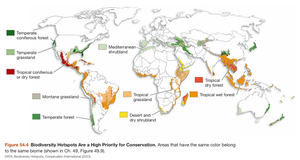
Biodiversity hotspots: Regions with exceptionally high levels of species richness and endemism that are under threat from human activities.
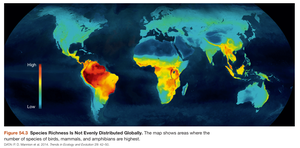
Biodiversity Hotspots
Biodiversity hotspots are areas that are especially rich in species, particularly endemic species, and are prioritized for conservation due to their high risk of habitat loss.
Hotspots are often located in tropical and Mediterranean-type ecosystems.
Protecting hotspots can maximize conservation outcomes with limited resources.
Biodiversity and Ecosystem Function: Productivity, Resistance, and Resilience
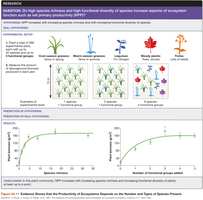
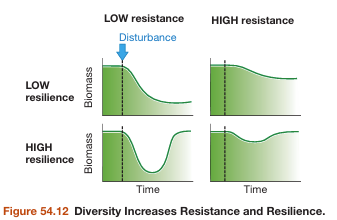
Biodiversity influences how ecosystems function, including their productivity, resistance to disturbance, and resilience after disturbance.
Productivity: More diverse communities often have higher primary productivity due to complementary resource use and facilitation among species.
Resistance: The ability of an ecosystem to remain unchanged when subjected to disturbance.
Resilience: The ability of an ecosystem to recover after a disturbance.
Ecosystem Services
Biodiversity supports ecosystem services, which are the benefits that humans derive from ecosystems. These include provisioning services (e.g., food, water), regulating services (e.g., climate regulation, disease control), cultural services (e.g., recreation, spiritual value), and supporting services (e.g., nutrient cycling, soil formation).
Conservation of biodiversity is essential for maintaining ecosystem services and human well-being.
Loss of biodiversity can reduce the stability and productivity of ecosystems, impacting both nature and society.
Summary
Biodiversity is a multifaceted concept that includes genetic, species, and ecosystem diversity. It can be measured in various ways, and its distribution is uneven across the globe. Biodiversity enhances ecosystem functioning, productivity, resistance, and resilience, and provides essential ecosystem services. Conservation efforts are critical to preserve biodiversity and maintain the benefits it provides to ecosystems and human societies.
