 Back
BackCommunity Ecology: Interactions, Succession, and Island Biogeography
Study Guide - Smart Notes
 Tailored notes based on your materials, expanded with key definitions, examples, and context.
Community Ecology: Building and Managing Communities
Introduction to Community Ecology
Community ecology examines the interactions among species living in the same area and the processes that structure biological communities. Understanding these interactions is essential for predicting biodiversity, ecosystem stability, and responses to environmental change.
Biological Community: An assemblage of populations of different species living close enough for potential interactions.
Species Interactions: The relationships among species, including competition, predation, mutualism, commensalism, and parasitism, shape community structure and function.
Species Interactions
Types of Species Interactions
Species interact in various ways, each with distinct ecological consequences:
Mutualism: Both species benefit (e.g., bees and flowering plants).
Parasitism: One species benefits at the expense of another (e.g., tapeworms in mammals).
Predation: One organism kills and eats another (e.g., wolves preying on elk).
Competition: Species compete for limited resources, negatively affecting both (e.g., plants competing for sunlight).
Commensalism: One species benefits, the other is unaffected (e.g., barnacles on whales).
Niche Concepts & Competition
Fundamental vs. Realized Niche
A species’ fundamental niche is the full range of environmental conditions under which it can survive and reproduce. The realized niche is the actual set of conditions used, limited by interactions such as competition.
Competitive Exclusion Principle: Two species competing for the same limiting resource cannot coexist indefinitely; one will outcompete the other (e.g., Paramecium species in lab cultures).
Character Displacement: Evolutionary divergence in traits due to competition, as seen in Darwin’s finches with different beak sizes on the Galápagos Islands.
Niche Partitioning: The process by which competing species use the environment differently to coexist (e.g., warblers feeding in different parts of a tree).
Top-Down vs. Bottom-Up Control
Population Regulation Mechanisms
Population sizes in communities are regulated by both top-down and bottom-up forces:
Top-Down Control: Predators control the abundance of prey and lower trophic levels (e.g., sea otters controlling sea urchin populations).
Bottom-Up Control: Resource availability (e.g., plant quality) limits herbivore and predator populations.
Example: Poor plant nutritional quality can reduce herbivore populations in a bottom-up system; predator removal can cause prey populations to increase in a top-down system.
Defenses and Mimicry
Constitutive Defenses and Types of Mimicry
Species have evolved various defenses against predation, including mimicry:
Constitutive Defenses: Always present (e.g., thorns, toxins).
Batesian Mimicry: A harmless species mimics a harmful one (e.g., viceroy butterfly mimicking monarch).
Müllerian Mimicry: Two harmful species resemble each other (e.g., bees and wasps).
Wasmannian Mimicry: Mimic resembles its host (e.g., some beetles mimic ants).
Peckhamian Mimicry: Aggressive mimicry; predator mimics harmless species to catch prey (e.g., anglerfish).
Sexual Mimicry: Individuals mimic the opposite sex to gain reproductive advantage (e.g., some cuttlefish).
Food Webs and Trophic Structure
Yellowstone Food Web Activity
Food webs illustrate the complex feeding relationships in ecosystems, showing energy flow and species roles:
Species are arranged from producers (plants) to apex predators (wolves).
Trophic Levels: Producers, primary consumers, secondary consumers, etc.
Keystone Species: Species with a disproportionately large effect on community structure (e.g., wolves in Yellowstone).
Trophic Cascades: Indirect effects that ripple through trophic levels when a top predator is added or removed.
Succession in Communities
Primary and Secondary Succession
Succession describes the sequence of community changes after disturbance:
Term | Description | Example |
|---|---|---|
Primary Succession | Begins with no soil | After volcanic eruption, bare rock colonized by lichens |
Secondary Succession | Soil remains, community disturbed | Forest regrowth after fire |
Facilitation | Early species improve conditions | Nitrogen-fixing plants enrich soil |
Inhibition | Species presence blocks others | Allelopathic plants release toxins |
Tolerance | No impact on newcomers | Late-arriving species unaffected by earlier ones |
Keystone Species and Trophic Cascades
Wolves in Yellowstone: A Case Study
Keystone species, such as wolves, regulate community structure through direct and indirect effects:
Direct Effects: Wolves reduce elk populations through predation.
Indirect Effects: Fewer elk allow plant communities to recover, benefiting birds and beavers.
Abiotic Changes: Vegetation recovery stabilizes soils and riverbanks, reducing erosion and altering river courses.
Trophic Cascade: The reintroduction of wolves triggered a cascade of ecological and physical changes throughout the ecosystem.
Island Biogeography Theory
Patterns of Species Richness on Islands
The theory of island biogeography explains how island size and distance from the mainland affect species diversity:
Species Richness: Larger islands and those closer to the mainland tend to have more species due to higher immigration and lower extinction rates.
Equilibrium Species Number: The balance point where immigration equals extinction rates for a given island.
Isolation: More isolated islands have lower immigration rates, leading to fewer species.
Island | Area (km2) | Distance to Mainland (km) | Observed Species | Predicted Species |
|---|---|---|---|---|
San Miguel | 38.0 | 42 | 65 | 60 |
Santa Rosa | 215.0 | 44 | 90 | 85 |
Santa Cruz | 249.0 | 35 | 115 | 110 |
Anacapa | 2.9 | 19 | 35 | 40 |
San Nicolas | 58.0 | 98 | 40 | 45 |
Santa Barbara | 2.6 | 61 | 30 | 28 |
San Clemente | 147.0 | 90 | 78 | 75 |
Santa Catalina | 194.0 | 35 | 105 | 100 |
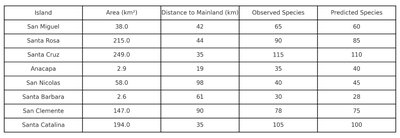
Analysis: Species richness generally increases with island area and decreases with distance from the mainland. Outliers may be explained by unique ecological or historical factors.
Applications and Management
Community Management and Restoration
Understanding community ecology principles allows for informed management and restoration strategies:
Identify keystone species and their roles before interventions.
Predict outcomes of species introductions or removals using food web and succession models.
Apply island biogeography to design nature reserves and corridors to maximize biodiversity.
