 Back
BackCommunity Ecology: Interspecific Interactions, Diversity, and Trophic Structure
Study Guide - Smart Notes
 Tailored notes based on your materials, expanded with key definitions, examples, and context.
Community Ecology
Introduction to Community Ecology
Community ecology examines the interactions between species living in the same area and how these interactions shape the structure and dynamics of biological communities. A community is defined as a group of populations of different species living close enough to interact.
Interspecific interactions are interactions between individuals of different species, including competition, predation, herbivory, symbiosis, and facilitation.
Types of Interspecific Interactions
Competition
Competition occurs when two or more species compete for a resource that limits their growth or survival. This is a -/- interaction because both species are negatively affected by the interaction.
Example: Lynx and foxes compete for snowshoe hares; garden plants and weeds compete for soil nutrients and water.
Competitive exclusion principle: Two species competing for the same limiting resource cannot coexist permanently; one will outcompete the other.
Ecological niche: The sum of a species' use of biotic and abiotic resources in its environment.
Resource partitioning: Differentiation of niches that enables similar species to coexist in a community.
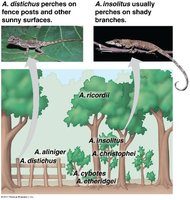
Specialization and Speciation
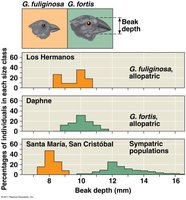
Specialization can lead to speciation, especially when populations overlap geographically (sympatric species). Character displacement is the tendency for characteristics to diverge more in sympatric than in allopatric populations, often due to competition.
Example: Darwin's finches on the Galápagos Islands show character displacement in beak depth when species coexist.
Predation and Herbivory
Predation is a +/- interaction where one species (predator) kills and eats another (prey). Herbivory is a similar interaction where an organism eats plant or algal material.
Predator adaptations: Heat sensors, fangs, claws, poison, teeth, stingers.
Prey adaptations: Behavioral (hiding, fleeing, alarm calls), cryptic coloration, aposematic coloration (warning colors), mimicry.
Herbivore adaptations: Chemical sensing, specialized teeth, detoxification systems.
Plant defenses: Spines, thorns, chemical toxins (e.g., nicotine, peppermint).
Mimicry
Batesian mimicry: A harmless species mimics a harmful one.
Müllerian mimicry: Two or more unpalatable species resemble each other.
Aggressive mimicry: Predators mimic harmless or beneficial species to lure prey.
Symbiosis
Symbiosis is a close and long-term biological interaction between two different biological organisms. Types include:
Parasitism (+/-): One organism (parasite) benefits at the expense of another (host). Includes endoparasites (inside host), ectoparasites (outside host), and parasitoids (eventually kill host).
Mutualism (+/+): Both species benefit. Can be obligate (required for survival) or facultative (optional).
Commensalism (+/0): One species benefits, the other is neither helped nor harmed.
Facilitation
Facilitation occurs when one species has positive effects on another species without direct and intimate contact. For example, some plants make the environment more hospitable for other species by modifying soil conditions.
Diversity and Trophic Structure
Species Diversity
Species diversity is a measure of the variety of organisms in a community. It includes:
Species richness: The number of different species in a community.
Relative abundance: The proportion each species represents of all individuals in the community.
Shannon Diversity Index
The Shannon Diversity Index (H) quantifies species diversity in a community: where is the proportion of individuals belonging to the th species.
Higher H values indicate greater diversity.
Importance of Diversity
Diverse communities are more productive, more stable, and more resistant to invasive species. They can better withstand environmental stresses and produce more biomass.
Trophic Structure
Trophic structure describes the feeding relationships between organisms in a community.
Food chain: A linear sequence of organisms through which nutrients and energy pass as one organism eats another.
Food web: A complex network of interconnected food chains in a community, showing the multiple feeding relationships among species.
Summary Table: Types of Interspecific Interactions
Interaction Type | Effect on Species 1 | Effect on Species 2 | Example |
|---|---|---|---|
Competition | - | - | Lynx and foxes for hares |
Predation | + | - | Lion and zebra |
Herbivory | + | - | Caterpillar and leaf |
Parasitism | + | - | Tapeworm in human |
Mutualism | + | + | Bees and flowers |
Commensalism | + | 0 | Barnacles on whales |
Facilitation | + | + | Juncus improving soil for other plants |
*Additional info: Academic context and examples have been added to clarify and expand on the original notes. Only images directly relevant to the explanation are included, such as those illustrating resource partitioning and character displacement.*
