 Back
BackCommunity Ecology: Species Interactions and Community Structure
Study Guide - Smart Notes
 Tailored notes based on your materials, expanded with key definitions, examples, and context.
Community Ecology
Introduction to Community Ecology
Community ecology is the study of interactions among species living within a defined area and how these interactions shape the structure and dynamics of biological communities. Community ecologists investigate how species interact, how these interactions affect species abundance and distribution, and how communities respond to environmental changes and disturbances.
Biological community: A group of interacting species in a shared environment.
Key questions: How do species interact? How do these interactions scale up to affect entire communities?
Applications: Managing communities to preserve biodiversity and ecosystem services.
Species Interactions
Types of Species Interactions
Species in a community interact in various ways, which can be classified based on the effects on the fitness of the individuals involved. The main types of interactions are:
Competition (–/–): Both species are harmed by the interaction.
Consumption (+/–): One species benefits, the other is harmed (includes predation, herbivory, and parasitism).
Mutualism (+/+): Both species benefit.
Commensalism (+/0): One species benefits, the other is unaffected.
These interactions affect the distribution and abundance of species, drive coevolution, and are dynamic and conditional depending on environmental context and species abundance.
Competition
Competition occurs when individuals use the same limiting resources, reducing the fitness of all involved. It can be:
Intraspecific competition: Between members of the same species; intensifies with population density.
Interspecific competition: Between members of different species; also intensifies with population density.
Competition is often strongest when species have overlapping ecological niches.
Outcomes of Interspecific Competition
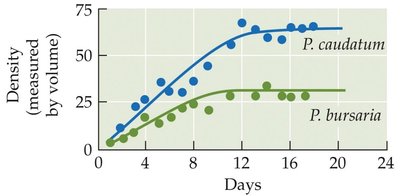
Competitive exclusion: One species is driven to extinction due to complete niche overlap.
Competitive coexistence: Species coexist if their niches do not completely overlap.
Asymmetric Competition and Niche Differentiation
Asymmetric competition occurs when one species suffers a greater fitness decline than the other. The weaker competitor may persist in areas of non-overlap (realized niche), while the stronger competitor occupies its fundamental niche.
Evolutionary Impacts: Niche Differentiation and Character Displacement
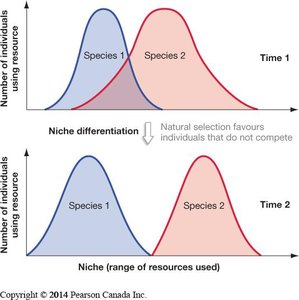
Natural selection favors traits that reduce niche overlap, leading to niche differentiation (resource partitioning) and character displacement (evolutionary change in traits due to competition).
Fitness Trade-Offs in Competition
Species may persist in less favorable habitats due to trade-offs in competitive ability and tolerance to environmental conditions. For example, some barnacles are excluded from lower intertidal zones by stronger competitors but survive in upper zones due to greater tolerance.
Consumption
Types of Consumption
Consumption is a +/– interaction where one organism eats another. Types include:
Herbivory: Consumption of plant tissues.
Parasitism: Consumption of small amounts of tissue from a host.
Predation: Killing and consumption of most or all of another individual (prey).
Predator-Prey Population Dynamics
Predators can regulate prey populations, often resulting in population cycles. These cycles are influenced by density-dependent factors such as food availability and predation intensity.
Bottom-up control: Prey populations are limited by food availability.
Top-down control: Predator populations limit prey abundance.
Evolutionary Arms Races
Predator-prey interactions drive coevolution, resulting in adaptations and counter-adaptations (arms races). Defenses against consumption can be:
Constitutive (standing) defenses: Always present (e.g., thorns, shells).
Inducible defenses: Produced in response to predators (e.g., thicker shells in mussels when crabs are present).
Mutualism
Mutualistic Interactions
Mutualism is a +/+ interaction where both species benefit. Examples include mycorrhizal fungi and plants, pollinators and flowers, and ants and treehoppers. Mutualisms can increase the abundance and range of the species involved.
Benefits: Nutrient exchange, protection, pollination, etc.
Context dependence: The benefits of mutualism can vary with environmental conditions and the presence of other species.
Natural Selection and Mutualism
Mutualisms evolve not from altruism but from each partner maximizing its own fitness. This can lead to conflict and coevolutionary arms races, similar to those seen in consumptive interactions.
Community Structure
Quantifying Communities
Community structure is described by four key attributes:
Species richness: The total number of species present.
Relative abundance: The proportion of each species in the community.
Sum of interactions: All the interactions among species.
Physical attributes: Abiotic (e.g., size, altitude) and biotic (e.g., vegetation structure) factors.
Evenness measures how similar the abundances of different species are. Diversity indices combine richness and evenness into a single metric.
Food Webs and Interaction Networks
Food webs summarize the consumption interactions in a community. They can reveal direct effects (one species directly affects another) and indirect effects (one species affects another through a third species).
Food chain: A linear sequence of consumption interactions.
Food web: A complex network of interconnected food chains.
Bottom-Up and Top-Down Effects
Bottom-up effects: Driven by abiotic factors and primary productivity (e.g., plants, algae).
Top-down effects: Driven by consumers, especially top predators (e.g., wolves in Yellowstone).
Ecosystem engineers (e.g., kelp, coral) provide physical habitat and have large impacts due to their dominance. Keystone species (e.g., otters, wolves) have a disproportionate effect on community structure relative to their abundance.
Trophic Cascades
A trophic cascade occurs when changes in top-down control cause effects that ripple through multiple trophic levels, as seen with the reintroduction of wolves in Yellowstone, which affected elk, plants, beavers, and other species.
Summary
Community ecology examines how species interactions shape biodiversity and ecosystem function.
Key processes include competition, consumption, mutualism, and the structuring of communities through direct and indirect effects.
Understanding these processes is essential for conservation, restoration, and management of ecosystems.
