 Back
BackCommunity Ecology: Structure, Diversity, and Dynamics
Study Guide - Smart Notes
 Tailored notes based on your materials, expanded with key definitions, examples, and context.
Community Ecology
Introduction to Community Ecology
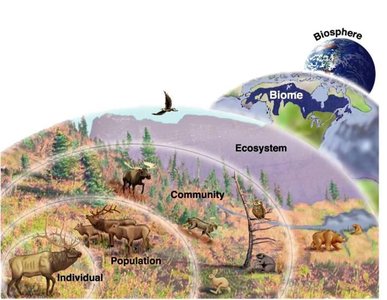
Community ecology examines how groups of species interact and form functional communities within a shared environment. A community is defined as an assemblage of many populations that live in the same place at the same time. Understanding community structure, roles, and dynamics is essential for studying ecosystem function and biodiversity.
Community Structure
Species Richness
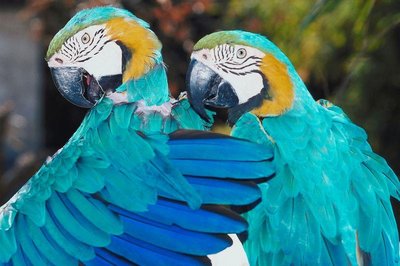
Species richness refers to the number of different species found in a community. It is a fundamental measure of biodiversity and varies according to geographic range, increasing from polar to temperate to tropical regions. Topographical variation also increases species richness.
Species richness is greatest in tropical rain forests and generally increases closer to the equator.
Factors such as latitude and habitat complexity influence species richness.
Species Diversity
Species diversity considers both the number of species (richness) and the relative abundance of each species in a community. Communities with a more even distribution of individuals among species are considered more diverse.
The Shannon diversity index () is a common metric for quantifying species diversity:
= proportion of individuals belonging to species i (individuals of a species/total organisms)
Higher absolute values of indicate higher diversity.
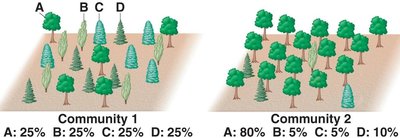
Calculating Species Diversity: Example Table
Species | n | pi | piln(pi) |
|---|---|---|---|
A | 25 | 0.25 | -0.3466 |
B | 25 | 0.25 | -0.3466 |
C | 25 | 0.25 | -0.3466 |
D | 25 | 0.25 | -0.3466 |
N | 100 | ||
HS | -1.386 | ||
Additional info: Table values are illustrative; actual calculations depend on observed data.
Roles in the Ecosystem
Keystone Species
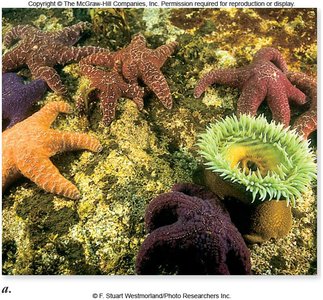
Keystone species have disproportionately large effects on community composition relative to their abundance. Their presence or absence can greatly alter species richness and ecosystem structure.
Example: Sea star predation on barnacles prevents barnacle overpopulation, allowing other species to thrive.
Beavers act as habitat engineers by constructing dams, transforming streams into ponds and creating new habitats for various organisms.
Ecological Niche
An ecological niche encompasses all the ways an organism uses the resources of its environment, including space, food, temperature range, mating conditions, and moisture requirements.
Fundamental niche: The full range of environmental conditions and resources an organism can potentially use.
Realized niche: The actual conditions and resources used, limited by interactions such as competition and predation.
Causes of niche restriction include predator presence, absence of pollinators, and presence of herbivores.
Community Dynamics
Species Interactions and Competition
Species interactions shape community structure through mechanisms such as competition, predation, and mutualism. The competitive exclusion principle states that two species competing for the same limiting resource cannot coexist indefinitely; one will outcompete the other.
Gause's experiments with Paramecium species demonstrated that complete competitors cannot coexist.
Resource Partitioning
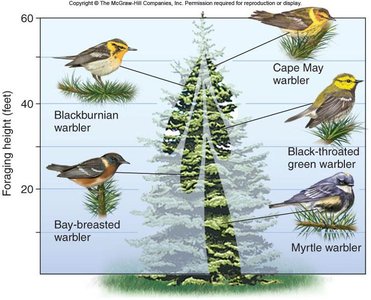
Resource partitioning is the differentiation of niches that enables similar species to coexist in a community by utilizing resources in different ways, times, or places.
Example: Five species of warblers feed at different heights and locations within spruce trees, reducing direct competition.
Character Displacement
Character displacement is the evolutionary tendency for two species to diverge in morphology and resource use due to competition, especially when they coexist (sympatry). This reduces competition and allows for stable coexistence.
Example: Differences in beak size among sympatric finch species allow them to specialize on different food sources.
Disturbance and Succession
Disturbance
A disturbance is an event such as a storm, fire, flood, drought, overgrazing, or human activity that changes a community by removing organisms or altering resource availability. Disturbances can reset successional stages and influence community structure.
Succession
Succession is the gradual, sequential regrowth of an area following a disturbance. There are two main types:
Primary succession: Occurs in areas that have not previously supported life (e.g., bare rock, new volcanic islands). The process is slow due to the lack of soil and nutrients.
Secondary succession: Occurs in areas where a community has been disturbed but soil remains intact (e.g., after fire or farming).
In primary succession, pioneer species such as lichens colonize bare substrates, contributing to soil formation. Over time, grasses, shrubs, and eventually trees establish, leading to a mature community.
In secondary succession, the presence of soil and seed banks allows for faster recovery and replacement of species.
Summary Table: Primary vs. Secondary Succession
Feature | Primary Succession | Secondary Succession |
|---|---|---|
Starting Condition | No soil, bare substrate | Soil present |
Pioneer Species | Lichens, mosses | Grasses, herbs |
Speed | Slow | Faster |
Examples | New volcanic island, retreating glacier | Post-fire, abandoned field |
