 Back
BackCommunity Ecology: Structure, Interactions, and Diversity
Study Guide - Smart Notes
 Tailored notes based on your materials, expanded with key definitions, examples, and context.
Community Ecology
Introduction to Community Ecology
Community ecology is the study of how groups of species interact and form functional communities. It examines the assemblage of many populations that occupy the same area and the interactions that shape their structure and dynamics.
Community: An assemblage of many populations that occupy the same area.
Community ecology: The study of interactions between organisms and how these interactions influence community structure and function.
Ecological Niches and Competition
Definition of Niche
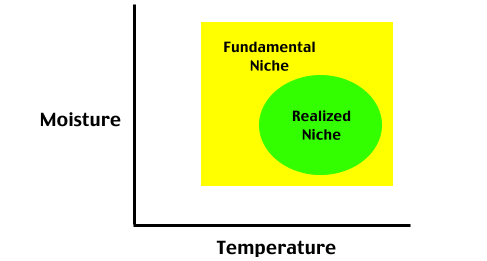
A niche encompasses all abiotic and biotic resources needed by a species to survive, grow, and reproduce. The concept of the niche is central to understanding species interactions and community structure.
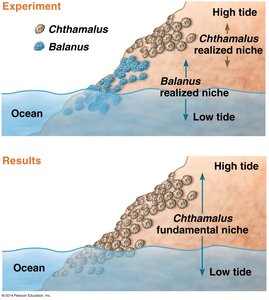
Fundamental niche: The full range of environmental conditions (resources, habitats) a species could theoretically use.
Realized niche: The actual conditions and resources a species uses, limited by interactions such as competition.
Competition and Competitive Exclusion
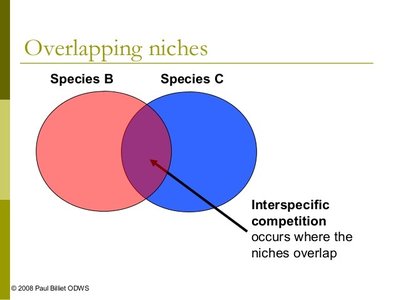
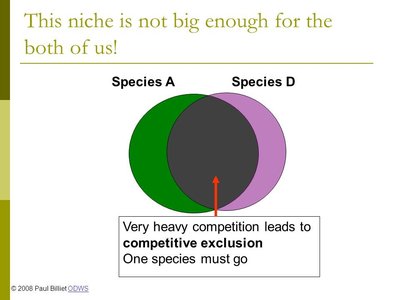
When two species compete for the same resources, their niches may overlap, leading to competition. If the overlap is strong, one species may outcompete the other, resulting in competitive exclusion.
Competitive exclusion principle: Two species competing for the same limiting resources cannot coexist in the same place.
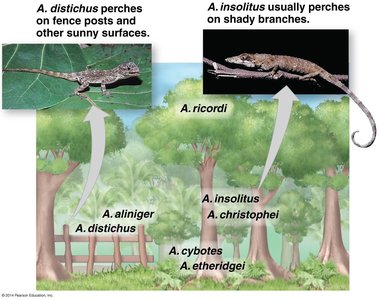
Resource partitioning: The differentiation of niches that enables similar species to coexist in a community by minimizing competition.
Realized vs. Fundamental Niche
The realized niche is typically smaller than the fundamental niche due to competition and other biotic interactions. Experiments with barnacles (e.g., Chthamalus and Balanus) illustrate this concept.
Species Interactions
Types of Species Interactions
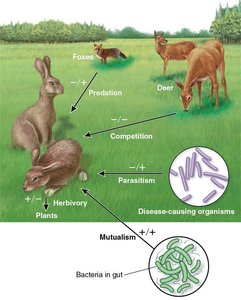
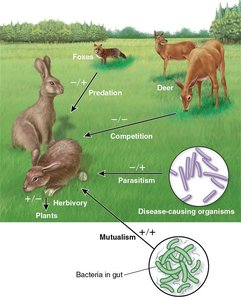
Species in a community interact in various ways, including mutualism, commensalism, and parasitism.
Mutualism (+/+): Both partners benefit from the interaction.
Commensalism (+/0): One species benefits, the other is unaffected.
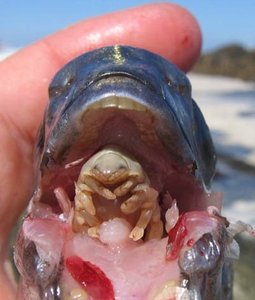
Parasitism (+/-): One species benefits at the expense of the other.

Predation and Prey Defenses
Prey Adaptations
Prey species have evolved a variety of defenses against predators, including cryptic coloration, mechanical defenses, aposematic coloration, and mimicry.
Cryptic coloration: Camouflage that makes prey difficult to spot.
Mechanical defenses: Physical structures such as shells or spines.
Aposematic coloration: Bright warning colors that signal toxicity.
Mimicry: One species evolves to resemble another.
Community Structure and Diversity
Measuring Diversity
Community diversity is described by two main components: species richness (the number of species in a community) and species evenness (the relative abundance of each species).
Species richness: The total number of different species present.
Species evenness: How evenly individuals are distributed among the species present.
Species diversity: A measure that combines both richness and evenness.
Keystone Species
Keystone species are species that have a disproportionately large effect on community structure relative to their abundance. For example, sea stars can maintain high species diversity by preying on dominant species.
Ecological Succession
Primary and Secondary Succession
Succession is the gradual change in species composition and community structure over time. There are two main types:
Primary succession: Occurs on newly exposed sites not previously occupied by soil and vegetation (e.g., after a volcanic eruption or glacier retreat).
Secondary succession: Occurs where a disturbance has destroyed a community but left the soil intact (e.g., after fire, hurricane, or flood).
Mechanisms of Succession
Facilitation: Early colonists modify the environment, making it more suitable for later species.
Inhibition: Early colonists inhibit the establishment of later species.
Tolerance: Early colonists have little or no effect on later species.
Disturbance and Diversity
Intermediate Disturbance Hypothesis
The intermediate disturbance hypothesis states that species diversity is highest at intermediate levels of disturbance. Low disturbance allows dominant species to exclude others, while high disturbance causes high mortality and extinction. Moderate disturbance prevents competitive exclusion and allows coexistence.
Biogeography and Community Diversity
Geographic Patterns of Diversity
Species richness varies geographically, generally increasing from polar to tropical regions. Older and larger communities tend to be more diverse due to longer periods for diversification and more available habitats.
Peninsular effect: Species richness decreases toward the end of a peninsula.
High primary production: Supports greater diversity in tropical regions.
Island Biogeography
The equilibrium model of island biogeography explains species richness on islands as a balance between immigration and extinction rates. Two main predictions are:
Species-area effect: Larger islands support more species due to lower extinction rates.
Distance effect: Islands farther from the mainland have lower immigration rates and thus fewer species.
Factor | Effect on Species Richness |
|---|---|
Island Size | Larger islands have higher richness |
Distance from Mainland | Farther islands have lower richness |
Key Terms
Community: Assemblage of populations in the same area
Facilitation: Early species make environment suitable for later species
Species richness: Number of species in a community
Species evenness: Relative abundance of species
Species diversity: Combination of richness and evenness
Biomass: Total mass of living organisms in a given area
Keystone species: Species with a large effect on community structure
