 Back
Community Ecology: Structure, Interactions, and Dynamics
Study Guide - Smart Notes
 Tailored notes based on your materials, expanded with key definitions, examples, and context.
Community Ecology
Introduction to Community Structure
Community ecology examines the organization and functioning of groups of interacting species living within a defined area. Communities are shaped by both abiotic and biotic factors, and similar environmental conditions often lead to the development of similar communities in different geographic regions.
Biological community: A set of interacting species living within a defined area.
Community structure: Determined by species composition, abundance, and the types of interactions among species.
Community dynamics: Refers to the changes in community structure and composition over time, influenced by species interactions, disturbances, and environmental changes.
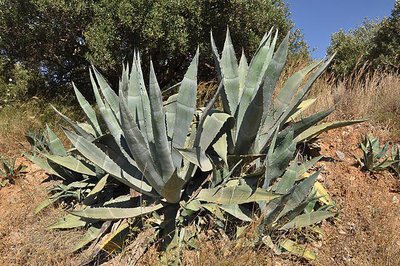
Examples of similar communities in different deserts:

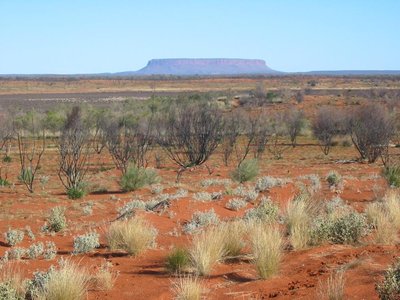
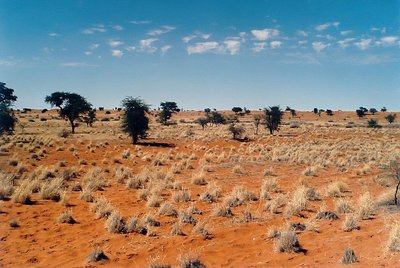
Major Types of Species Interactions
Species interactions are fundamental in shaping community structure and dynamics. The main types include:
Competition (-/-): Both species are harmed by the interaction as they compete for the same limited resources.
Consumption (+/-): One organism (consumer) benefits by eating or absorbing nutrients from another (prey/host), which is harmed. Includes predation, herbivory, and parasitism.
Mutualism (+/+): Both species benefit from the interaction.
Commensalism (+/0): One species benefits while the other is unaffected.
These interactions can be summarized as follows:
Interaction Type | Effect on Species 1 | Effect on Species 2 |
|---|---|---|
Competition | - | - |
Consumption | + | - |
Mutualism | + | + |
Commensalism | + | 0 |
Competition
Competition occurs when organisms use the same resources, resulting in reduced fitness for both. It can be:
Intraspecific: Between members of the same species.
Interspecific: Between members of different species.
Resources in short supply include prey, nutrients, water, light, and space. Negative outcomes of competition include less growth, shorter lifespan, and reduced reproduction.
Ecological Niche
An ecological niche encompasses all environmental conditions required by a species for its existence, including:
Abiotic factors: Temperature, humidity, rainfall, light levels, soil composition, shelter.
Biotic factors: Food availability, presence of predators/herbivores, parasites, and diseases.
Species with similar niches in different regions are called niche equivalents:
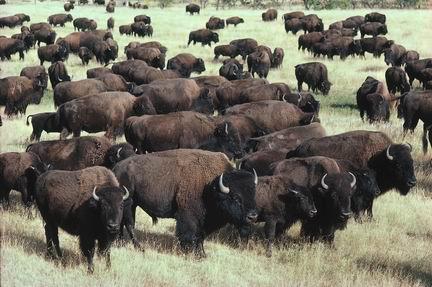
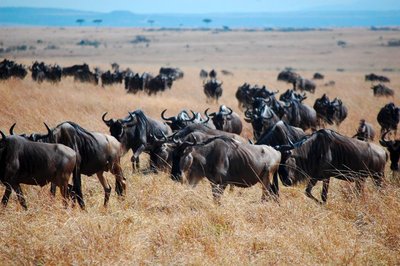

Competition for Resources and Niche Overlap
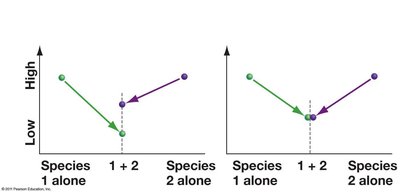
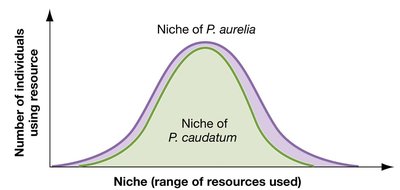
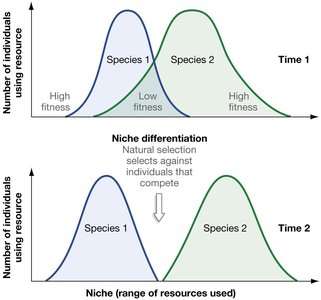
When two species have overlapping niches, they compete for shared resources, leading to reduced fitness for both. This can be visualized as partial niche overlap, where both species have less access to resources than if they were alone.
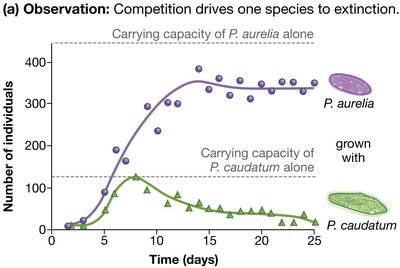
Asymmetric competition occurs when one species experiences a greater fitness decline than the other. The competitive exclusion principle states that two species with identical niches cannot coexist; the weaker competitor may be driven to extinction.
Experimental Evidence: Paramecium Competitive Exclusion
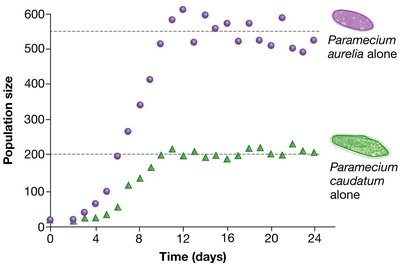
Experiments with Paramecium species demonstrate competitive exclusion and niche differentiation:
Density-dependent growth: Each species grows well alone but one outcompetes the other when together.
Realized niche: The portion of the fundamental niche actually used when competitors are present.
Character Displacement and Niche Differentiation
Competition often leads to character displacement, where natural selection favors traits that reduce niche overlap, allowing species to exploit different resources. This evolutionary process is called niche differentiation or resource partitioning.
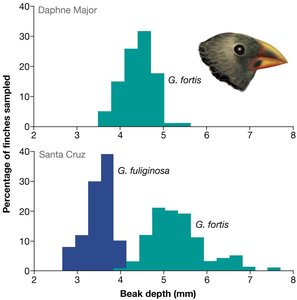
Example: On the Galápagos Islands, finch species have evolved different beak sizes to utilize different food resources, reducing competition.
Consumption Interactions and Defense Adaptations
Consumption interactions (herbivory, predation, parasitism) drive the evolution of defense mechanisms in prey species. Defenses can be:
Constitutive defenses: Always present (e.g., camouflage, armor, toxins).
Inducible defenses: Produced only in response to consumers.
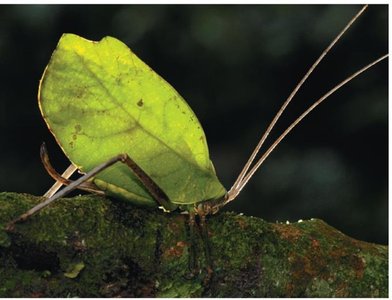
Example: Some insects resemble leaves to avoid predation (camouflage).
Coevolutionary Arms Race
Interactions between consumers and their prey/hosts can lead to a coevolutionary "arms race," where each evolves adaptations and counter-adaptations over time. For example, predators may evolve better hunting strategies, while prey evolve better defenses.
Summary Table: Types of Species Interactions
Interaction | Effect on Species 1 | Effect on Species 2 | Example |
|---|---|---|---|
Competition | - | - | Plants competing for sunlight |
Consumption | + | - | Lion eating zebra |
Mutualism | + | + | Bees pollinating flowers |
Commensalism | + | 0 | Barnacles on whales |
Additional info: Community ecology integrates concepts from population biology, evolution, and ecosystem science to understand how species interactions shape biodiversity and ecosystem function.
