 Back
BackComparative Genomics and Evolutionary Insights in Primates and Other Mammals
Study Guide - Smart Notes
 Tailored notes based on your materials, expanded with key definitions, examples, and context.
Comparative Genomics and Evolutionary Biology
Introduction to Comparative Genomics
Comparative genomics is the study of the similarities and differences in the genetic sequences of different species. This field has advanced rapidly in the last 40 years due to improvements in genome sequencing and data collection. By comparing genomes, scientists can assess gene activity, edit gene sequences, and develop refined approaches for understanding evolutionary relationships and biological functions.
Evolutionary Relationships Revealed by Genomic Comparisons
Genomic comparisons reveal how closely related different species are and help reconstruct evolutionary history. Closely related species have more similar gene sequences because less time has passed for mutations to accumulate. This allows researchers to infer common ancestry and evolutionary divergence.
Homologous genes: Genes inherited from a common ancestor, often retaining similar functions across species.
Phylogenetic trees: Diagrams that show evolutionary relationships based on genetic data.
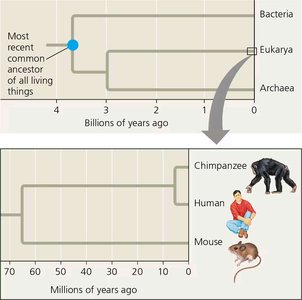
Example: The diagram above shows the ancient divergence of Bacteria, Archaea, and Eukarya, and a more recent divergence among primates such as chimpanzees, humans, and mice.
Genomic Similarity and Functional Conservation
Many genes are surprisingly similar in sequence and function across very different species. For example, a study tested whether human versions of certain genes could function in yeast (Saccharomyces cerevisiae), and found that nearly half of the tested genes worked equivalently in yeast cells. This demonstrates the conservation of essential biological functions across evolutionarily distant organisms.
Comparing Primate Genomes
Comparisons of the human genome with those of the chimpanzee, mouse, rat, and other mammals help identify genes shared by all mammals, as well as those unique to specific lineages. This provides clues about what makes each group unique and helps trace the evolutionary history of traits.
Shared genes: Indicate common ancestry and conserved functions.
Unique genes: Reveal lineage-specific adaptations.
Genomic Duplications and Disease
Some genomic regions have undergone duplications, and some of these duplications contain genes associated with human diseases. For example, certain elements such as Alu elements are more abundant in the human genome compared to other primates, and the chimpanzee genome contains many copies of a retroviral provirus not found in humans. These differences may have contributed to the divergence of the two species.
Chimpanzees and Bonobos: Closest Living Relatives of Humans
Chimpanzees and bonobos are the closest living relatives of Homo sapiens. Comparative studies of their genomes with humans provide valuable insights into human evolution, health, and behavior.

Example: The image above shows chimpanzees and bonobos, highlighting their close evolutionary relationship to humans.
Genomic Insights from Large-Scale Primate Studies
Large-scale studies comparing the genomes of hundreds of primate species have revealed important information about human evolution and disease. For example, analysis of millions of common genetic variants has identified genes that are evolving rapidly in humans, including those involved in brain size and disease resistance.
The FOXP2 Gene and Communication
The FOXP2 gene is of particular interest because it is involved in vocalization and language. Mutations in this gene can produce speech and language impairments in humans. Studies in mice have shown that disrupting FOXP2 affects the formation of neural circuits in the brain region corresponding to speech in humans, and alters the ultrasonic vocalizations (whistles) that mice use to communicate.
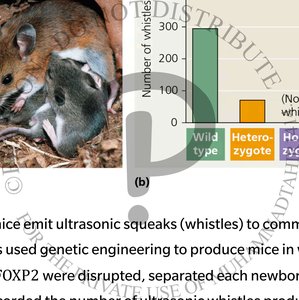
Example: The bar graph above shows that wild-type mice emit many whistles, while heterozygotes emit fewer, and homozygotes emit none, demonstrating the gene's role in communication.
Applications and Broader Implications
Comparative genomics not only advances our understanding of evolution but also informs medical research, such as identifying genes involved in disease and using model organisms like mice to study human biology. The conservation of genes and pathways across species allows for the use of animal models to investigate phenomena relevant to human health and development.
Exploring Genomes Within a Species
Sequencing genomes from diverse human populations has revealed widespread genetic variation, including copy-number variants and short tandem repeats (STRs). These studies have shown that genetic diversity is highest in African populations, consistent with the "Out of Africa" model of human evolution.
Widespread Conservation of Developmental Genes Among Animals
Developmental genes are often highly conserved across animal species, reflecting their fundamental roles in body plan formation and organ development. This conservation allows researchers to use model organisms to study developmental processes relevant to all animals, including humans.
