 Back
Comparative Study Guide: Alternation of Generations in Four Major Plant Life Cycles
Study Guide - Smart Notes
 Tailored notes based on your materials, expanded with key definitions, examples, and context.
Alternation of Generations: Overview
Introduction
Alternation of generations is a fundamental biological process in plants and some algae, involving the regular alternation between two multicellular stages: the haploid gametophyte and the diploid sporophyte. Each stage produces the other through meiosis and fertilization, resulting in a complex life cycle. The four major groups—algae, mosses, gymnosperms (pines), and angiosperms—exhibit distinct variations in this cycle.
Alga (Brown Alga: Laminaria)
Life Cycle and Alternation of Generations
Brown algae, such as Laminaria, display a clear alternation of generations, with both multicellular haploid and diploid stages. - Sporophyte (2n): The dominant, diploid stage, attached to rocks below the tide line. - Sporangia: Specialized cells on the blade surface undergo meiosis to produce haploid zoospores. - Zoospores (n): All structurally similar, but half develop into male gametophytes and half into female gametophytes. - Gametophytes (n): Short, branched filaments growing on rocks. - Fertilization: Sperm released by male gametophytes swim to eggs on female gametophytes, guided by chemical signals. - Zygote (2n): Forms on the female gametophyte and grows into a new sporophyte. Example: Laminaria's alternation of generations is typical of many algae, with both stages free-living and multicellular. 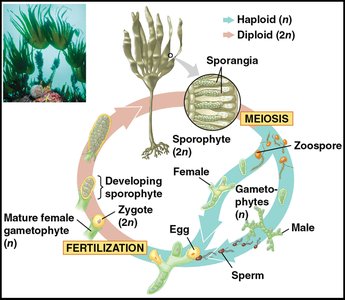
Moss (Bryophyte)
Life Cycle and Alternation of Generations
Mosses are nonvascular plants where the gametophyte is the dominant stage. - Gametophyte (n): The main, photosynthetic plant. - Spores (n): Produced by meiosis in the sporophyte's capsule, develop into protonemata. - Protonemata: Threadlike structures that give rise to gametophyte buds. - Antheridia: Male gametophyte organs producing sperm. - Archegonia: Female gametophyte organs producing eggs. - Fertilization: Sperm swim through moisture to fertilize eggs in archegonia. - Sporophyte (2n): Grows from the archegonium, remains attached and dependent on the gametophyte. - Meiosis: Occurs in the capsule, releasing spores to restart the cycle. Example: Mosses illustrate a life cycle where the sporophyte is short-lived and nutritionally dependent on the gametophyte. 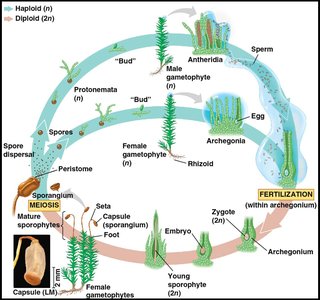
Fern (Representative Vascular Plant)
Life Cycle and Alternation of Generations
Ferns are seedless vascular plants with a prominent sporophyte stage. - Sporophyte (2n): The dominant, leafy plant. - Sporangia: Located in clusters (sori) on the underside of leaves, produce haploid spores by meiosis. - Spore (n): Develops into a bisexual gametophyte. - Gametophyte (n): Small, photosynthetic, produces both antheridia (sperm) and archegonia (eggs). - Fertilization: Sperm swim to eggs, often from different gametophytes, guided by attractants. - Zygote (2n): Develops into a new sporophyte, growing out from the gametophyte. Example: Ferns show independent, free-living gametophyte and sporophyte stages, with the sporophyte being dominant. 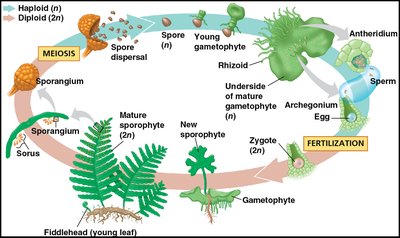
Pine (Gymnosperm)
Life Cycle and Alternation of Generations
Gymnosperms, such as pines, have a dominant sporophyte and reduced gametophyte. - Sporophyte (2n): The mature pine tree. - Microsporangia (male cones): Produce microspores (n) by meiosis, which develop into pollen grains (male gametophytes). - Megasporangia (female cones): Produce megaspores (n) by meiosis, one of which becomes the female gametophyte. - Pollen grain: Contains sperm nuclei, delivered to the ovule via a pollen tube. - Fertilization: Sperm fertilizes the egg in the archegonium, forming a zygote (2n). - Seed: Contains the embryo (new sporophyte), food reserves, and seed coat. Example: Pines demonstrate alternation of generations with highly reduced gametophytes and dominant sporophytes. 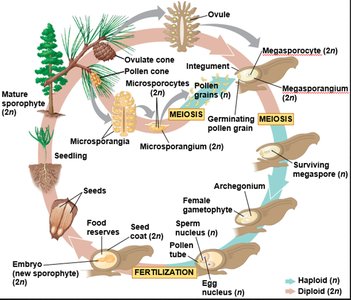
Angiosperm (Flowering Plant)
Life Cycle and Alternation of Generations
Angiosperms have the most complex life cycle, with double fertilization and highly reduced gametophytes. - Sporophyte (2n): The mature flowering plant. - Microsporangia (anthers): Produce microspores (n) by meiosis, which develop into pollen grains (male gametophytes). - Megasporangia (ovules): Produce four megaspores (n) by meiosis, one becomes the female gametophyte (embryo sac). - Pollen grain: Contains generative cell (forms two sperm) and tube cell (forms pollen tube). - Double fertilization: One sperm fertilizes the egg (zygote, 2n), the other fertilizes the central cell (endosperm, 3n). - Seed: Contains embryo, endosperm, and seed coat; fruit surrounds the seed. Example: Angiosperms are unique in having double fertilization, resulting in both a zygote and endosperm. 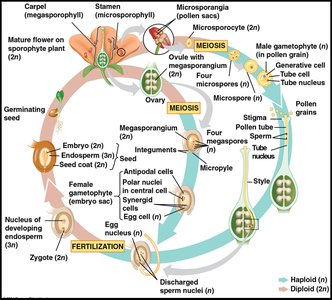
Comparative Table: Key Differences in Plant Life Cycles
Group | Dominant Stage | Gametophyte | Sporophyte | Fertilization | Unique Features |
|---|---|---|---|---|---|
Alga (Laminaria) | Sporophyte | Free-living, multicellular | Free-living, multicellular | Water, chemical attractants | Both stages multicellular |
Moss | Gametophyte | Dominant, photosynthetic | Dependent, short-lived | Water required | Sporophyte attached to gametophyte |
Fern | Sporophyte | Free-living, small | Dominant, leafy | Water required | Bisexual gametophyte |
Pine | Sporophyte | Reduced, within cones | Dominant, tree | Pollen tube | Seeds, separate male/female cones |
Angiosperm | Sporophyte | Highly reduced, within flower | Dominant, flowering plant | Pollen tube, double fertilization | Fruit, endosperm (3n) |
Summary of Alternation of Generations
Key Points
- All four groups exhibit alternation of generations, but the relative dominance and independence of gametophyte and sporophyte stages vary. - Water is required for fertilization in algae, mosses, and ferns, but not in gymnosperms and angiosperms due to pollen tubes. - Angiosperms are unique in their double fertilization, producing both a zygote and endosperm. Additional info: Ferns were included as a representative vascular plant to clarify the alternation of generations between mosses and seed plants. The comparative table was inferred for clarity and completeness.
