Back
Comparison of DNA and RNA: Structure, Function, and Stability
Study Guide - Smart Notes
 Tailored notes based on your materials, expanded with key definitions, examples, and context.
DNA and RNA: Structure and Function
Overview of Nucleic Acids
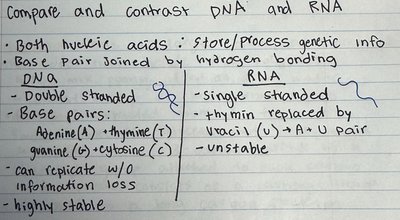
Nucleic acids are essential biomolecules responsible for the storage and processing of genetic information in all living organisms. The two primary types are DNA (deoxyribonucleic acid) and RNA (ribonucleic acid). Both molecules are polymers composed of nucleotide monomers, and their base pairs are joined by hydrogen bonding.
Comparison of DNA and RNA
The following table summarizes the similarities and differences between DNA and RNA:
Property | DNA | RNA |
|---|---|---|
Strandedness | Double stranded | Single stranded |
Base Pairs | Adenine (A) pairs with Thymine (T); Guanine (G) pairs with Cytosine (C) | Adenine (A) pairs with Uracil (U); Guanine (G) pairs with Cytosine (C) |
Stability | Highly stable | Unstable |
Replication | Can replicate without information loss | Does not replicate in the same way; more prone to degradation |
Function | Long-term storage of genetic information | Short-term processing and transfer of genetic information |
Key Terms and Definitions
Nucleotide: The monomer unit of nucleic acids, consisting of a sugar, phosphate group, and nitrogenous base.
Hydrogen Bond: A weak bond between two molecules, important in stabilizing the base pairs in DNA and RNA.
Base Pair: Two nitrogenous bases held together by hydrogen bonds; in DNA, A-T and G-C; in RNA, A-U and G-C.
Replication: The process by which DNA makes a copy of itself, ensuring genetic information is preserved.
Example: Base Pairing in DNA and RNA
In DNA, the sequence ATGC would pair with TACG on the complementary strand.
In RNA, the sequence AUGC would pair with UACG during transcription.
Additional info:
DNA is typically found in the nucleus of eukaryotic cells, while RNA can be found in the nucleus and cytoplasm.
RNA types include messenger RNA (mRNA), transfer RNA (tRNA), and ribosomal RNA (rRNA), each with specialized functions.