 Back
Complex Patterns of Inheritance: Beyond Mendelian Genetics
Study Guide - Smart Notes
 Tailored notes based on your materials, expanded with key definitions, examples, and context.
Inheritance Patterns Beyond Mendelian Genetics
Introduction
While Mendel's principles of inheritance laid the foundation for genetics, many traits do not follow simple Mendelian patterns. This section explores the complexities of inheritance, including incomplete dominance, codominance, multiple alleles, pleiotropy, epistasis, polygenic inheritance, and the influence of the environment on phenotype.
Extending Mendelian Genetics for a Single Gene
Degrees of Dominance
Not all alleles exhibit complete dominance. The relationship between genotype and phenotype can vary, leading to different inheritance patterns:
Complete Dominance: The phenotype of the heterozygote is identical to that of the dominant homozygote.
Incomplete Dominance: The phenotype of F1 hybrids is intermediate between the two parental phenotypes. For example, crossing red and white snapdragons produces pink offspring.
Codominance: Both alleles in a heterozygote are fully expressed, resulting in a phenotype that shows both traits distinctly, such as red and white patches in flowers.
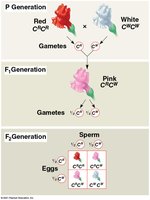
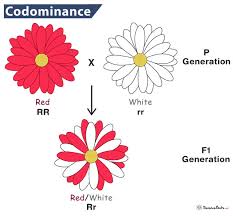
Frequency of Dominant Alleles
Dominant alleles are not always more common in populations than recessive alleles. For example, polydactyly (extra fingers or toes) is caused by a dominant allele but is much less frequent than the recessive allele in the population.
Multiple Alleles
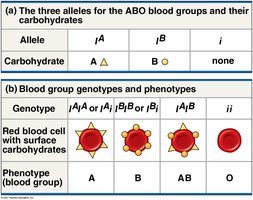
Most genes exist in populations in more than two allelic forms. A classic example is the ABO blood group system in humans, which is determined by three alleles: IA, IB, and i. These alleles combine to produce four possible blood types: A, B, AB, and O.
Allele | Carbohydrate |
|---|---|
IA | A |
IB | B |
i | none |
Genotype | Phenotype (Blood Group) |
|---|---|
IAIA or IAi | A |
IBIB or IBi | B |
IAIB | AB |
ii | O |
Pleiotropy
Pleiotropy occurs when a single gene influences multiple phenotypic traits. For example, the gene responsible for sickle-cell disease affects hemoglobin structure, red blood cell shape, and resistance to malaria. Similarly, cystic fibrosis is caused by a pleiotropic allele that leads to multiple symptoms affecting different organs.
Extending Mendelian Genetics for Two or More Genes
Epistasis
In epistasis, one gene affects the expression of another gene. For example, in Labrador retrievers, one gene determines pigment color (B for black, b for brown), while another gene (E) determines whether pigment is deposited in the hair. If the E gene is homozygous recessive (ee), no pigment is deposited, resulting in a yellow coat regardless of the B gene alleles. Epistatic interactions modify the expected Mendelian ratios, often producing variations of the 9:3:3:1 ratio.
Polygenic Inheritance
Polygenic inheritance occurs when multiple genes independently contribute to a single trait, resulting in continuous variation. Traits such as human height and skin pigmentation are controlled by many genes, each adding a small effect. These traits are called quantitative characters and typically show a range of phenotypes rather than discrete categories.
Example: Over 180 genes are known to affect human height.
Skin pigmentation is influenced by several genes, each with additive effects.
Nature and Nurture: The Environmental Impact on Phenotype
Multifactorial Traits
Many traits are influenced by both genetic and environmental factors. These are called multifactorial traits. The phenotypic range is broadest for polygenic characters, as environmental factors such as nutrition, climate, and lifestyle can significantly affect the expression of genetic potential.
Examples: Heart disease, cancer, alcoholism, and mental illnesses are influenced by both genes and environment.
Lifestyle choices can have a major impact on phenotype, regardless of genotype.
Summary Table: Key Extensions of Mendelian Genetics
Pattern | Description | Example |
|---|---|---|
Incomplete Dominance | Heterozygote phenotype is intermediate | Pink snapdragons |
Codominance | Both alleles fully expressed | AB blood type |
Multiple Alleles | More than two alleles in population | ABO blood groups |
Pleiotropy | One gene, multiple effects | Sickle-cell disease |
Epistasis | One gene affects another's expression | Labrador coat color |
Polygenic Inheritance | Multiple genes, one trait | Height, skin color |
Multifactorial | Genes and environment interact | Heart disease |
