 Back
Comprehensive Study Guidance for BIOL 190: Cell and Molecular Biology
Study Guide - Smart Notes
 Tailored notes based on your materials, expanded with key definitions, examples, and context.
Q1. Describe the structure of the plasma membrane. What are its three major functions?
Background
Topic: Membrane Structure and Function
This question tests your understanding of the plasma membrane's architecture and its essential roles in cellular life.
Key Terms:
Phospholipid bilayer
Hydrophilic heads and hydrophobic tails
Membrane proteins
Selective permeability
Step-by-Step Guidance
Start by describing the basic structure: the plasma membrane is primarily composed of a phospholipid bilayer.
Explain how the hydrophilic heads face outward toward the aqueous environment, while the hydrophobic tails face inward, away from water.
Identify the three major functions: protection, selective transport, and communication/signaling.
Consider how embedded proteins and cholesterol contribute to these functions.
Try solving on your own before revealing the answer!
Final Answer:
The plasma membrane consists of a phospholipid bilayer with hydrophilic heads facing outward and hydrophobic tails inward. Its three major functions are: (1) protecting the cell, (2) regulating transport of substances, and (3) facilitating cell communication and signaling. Embedded proteins and cholesterol help maintain fluidity and enable specific functions.
Q2. Define osmosis and explain the relationship between water movement and solute concentration.
Background
Topic: Osmosis and Membrane Transport
This question focuses on the process of osmosis and how solute concentration affects water movement across membranes.
Key Terms:
Osmosis
Solute concentration
Semipermeable membrane
Step-by-Step Guidance
Define osmosis as the movement of water across a semipermeable membrane.
Explain that water moves from areas of low solute concentration to areas of high solute concentration.
Discuss how this movement is driven by the concentration gradient.
Consider the effect of osmosis on cell volume in different environments.
Try solving on your own before revealing the answer!
Final Answer:
Osmosis is the passive movement of water across a semipermeable membrane toward a region of higher solute concentration. Water moves to balance solute concentrations, affecting cell volume depending on the environment (isotonic, hypertonic, or hypotonic).
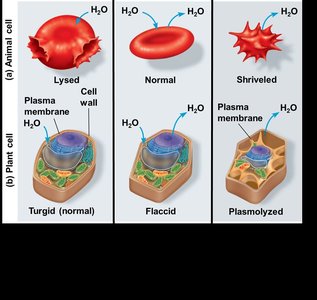
Q3. Compare isotonic, hypertonic, and hypotonic environments. Predict the direction of net water movement and the effect on animal-cell volume in each solution.
Background
Topic: Tonicity and Cell Volume Regulation
This question tests your ability to distinguish between different osmotic environments and predict their effects on cells.
Key Terms:
Isotonic
Hypertonic
Hypotonic
Net water movement
Cell lysis and shrinkage
Step-by-Step Guidance
Define each environment: isotonic (equal solute concentration), hypertonic (higher solute outside), hypotonic (lower solute outside).
Predict water movement: in isotonic, no net movement; in hypertonic, water leaves the cell; in hypotonic, water enters the cell.
Describe the effect on animal-cell volume: isotonic (normal), hypertonic (shrivels), hypotonic (lyses).
Use diagrams to visualize these effects if available.
Try solving on your own before revealing the answer!
Final Answer:
In isotonic environments, animal cells remain normal as there is no net water movement. In hypertonic solutions, cells lose water and shrink (shrivel). In hypotonic solutions, cells gain water and may burst (lyse). The direction of water movement is always toward the higher solute concentration.
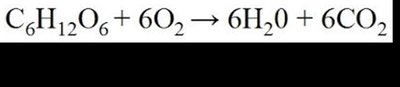
Q4. What is the overall purpose of aerobic cellular respiration? Write the overall chemical equation.
Background
Topic: Cellular Respiration
This question tests your understanding of why cells perform aerobic respiration and the chemical equation that summarizes the process.
Key Terms and Formula:
Aerobic respiration
ATP production
Glucose, oxygen, carbon dioxide, water
Step-by-Step Guidance
State the purpose: aerobic respiration allows cells to extract energy from glucose to produce ATP.
Identify the reactants: glucose and oxygen.
Identify the products: carbon dioxide, water, and ATP (not shown in the equation but implied).
Write the balanced chemical equation for aerobic respiration.
Try solving on your own before revealing the answer!
Final Answer:
The purpose of aerobic cellular respiration is to generate ATP by breaking down glucose in the presence of oxygen. The overall equation is: .
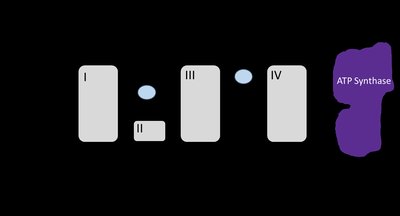
Q5. Explain the roles of the electron transport chain, chemiosmosis, and ATP synthase in oxidative phosphorylation.
Background
Topic: Oxidative Phosphorylation
This question tests your understanding of how cells produce ATP using the electron transport chain and related processes.
Key Terms:
Electron transport chain (ETC)
Chemiosmosis
ATP synthase
Proton gradient
Step-by-Step Guidance
Describe the ETC: electrons from NADH and FADH2 are transferred through protein complexes, releasing energy.
Explain how this energy pumps protons (H+) across the inner mitochondrial membrane, creating a gradient.
Define chemiosmosis: protons flow back through ATP synthase due to the gradient.
ATP synthase uses this flow to synthesize ATP from ADP and inorganic phosphate.
Try solving on your own before revealing the answer!
Final Answer:
The electron transport chain transfers electrons and pumps protons to create a gradient. Chemiosmosis is the movement of protons back across the membrane, and ATP synthase uses this energy to produce ATP. This process is essential for efficient ATP production in cells.
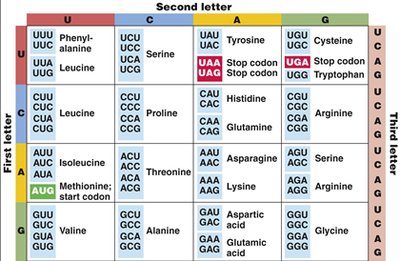
Q6. Given an mRNA sequence and a genetic-code chart, be able to identify the start codon, translate the coding region, and identify the stop codon.
Background
Topic: Gene Expression and Translation
This question tests your ability to use the genetic code to translate mRNA into a polypeptide.
Key Terms:
mRNA
Codon
Start codon (AUG)
Stop codon (UAA, UAG, UGA)
Genetic code chart
Step-by-Step Guidance
Locate the start codon (AUG) in the mRNA sequence.
Use the genetic code chart to translate each codon into its corresponding amino acid.
Continue translation until you reach a stop codon (UAA, UAG, or UGA).
Write out the sequence of amino acids (polypeptide) produced.
Try solving on your own before revealing the answer!
Final Answer:
Identify the start codon (AUG) and begin translation. Use the chart to match each codon to its amino acid, stopping at the first stop codon. The resulting polypeptide is the sequence of amino acids coded by the mRNA.
