 Back
Comprehensive Study Guidance for General Biology Exam 1 Review
Study Guide - Smart Notes
 Tailored notes based on your materials, expanded with key definitions, examples, and context.
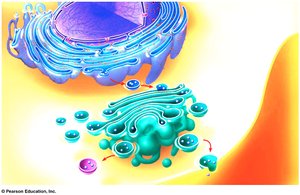
Q17. Label the following organelles: Golgi Body, Rough ER, Nucleus, Vesicle.
Background
Topic: Cell Structure and Function
This question tests your knowledge of eukaryotic cell organelles and their identification based on structure and function.
Key Terms:
Golgi Body: Organelle involved in modifying, sorting, and packaging proteins.
Rough ER (Endoplasmic Reticulum): Organelle with ribosomes attached, involved in protein synthesis.
Nucleus: Organelle that houses the cell's DNA.
Vesicle: Small membrane-bound sac used for transport within the cell.
Step-by-Step Guidance
Review the typical appearance of each organelle: The Golgi body often looks like a stack of flattened sacs; the Rough ER has a network-like structure with dots (ribosomes); the nucleus is usually a large, round structure; vesicles are small, spherical structures.
Examine the provided cell diagram and identify the structures based on their shape and location.
Match each label (a, b, c, d) to the correct organelle by comparing the features described above.
Remember that the Golgi body is often near the Rough ER, and vesicles are usually found near the Golgi body.
Try solving on your own before revealing the answer!
Final Answer:
a. Rough ER b. Nucleus c. Golgi Body d. Vesicle
The image shows the Golgi body (stacked, turquoise structure), Rough ER (network with dots), Nucleus (large purple structure), and Vesicles (small spheres).
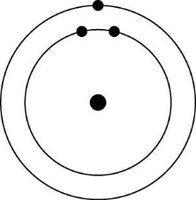
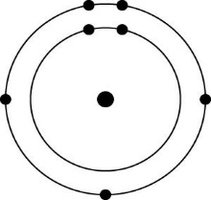
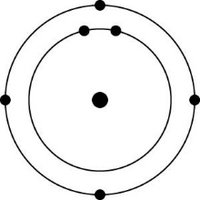
Q25. Which one of the atoms shown would be most likely to form a cation with a charge of +1?
Background
Topic: Atomic Structure and Ion Formation
This question tests your understanding of how atoms form ions based on their electron configuration.
Key Terms:
Cation: A positively charged ion formed when an atom loses electrons.
Electron Shell: The arrangement of electrons around the nucleus.
Step-by-Step Guidance
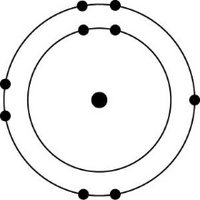
Examine each atom's electron configuration in the provided images.
Recall that atoms with one electron in their outermost shell are most likely to lose that electron and form a +1 cation.
Compare the outer shell electron count for each atom to determine which is most likely to lose one electron.
Identify the atom with a single electron in its outermost shell.
Try solving on your own before revealing the answer!
Final Answer:
The atom shown in image_3 (with one electron in its outer shell) is most likely to form a cation with a charge of +1.
This is because it can easily lose that single electron to achieve a stable electron configuration.
Q36. A nitrogen atom has an atomic number of 7, with an atomic mass of 15.
Background
Topic: Atomic Structure and Chemical Bonding
This question tests your ability to determine the number of protons, neutrons, and possible bonds based on atomic number and mass.
Key Terms and Formulas:
Atomic Number: Number of protons in the nucleus.
Atomic Mass: Sum of protons and neutrons.
Electron Distribution: Determines bonding capacity.
Step-by-Step Guidance
Recall that the atomic number (7) tells you the number of protons.
Calculate the number of neutrons:
Determine the number of electrons (same as protons for a neutral atom).
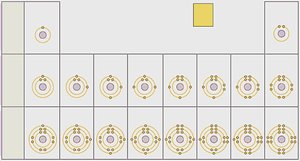
Use the electron distribution diagram to see how many electrons are in the outer shell (valence electrons).
Bonding capacity is determined by the number of unpaired electrons in the outer shell.
Try solving on your own before revealing the answer!
Final Answer:
a) Nitrogen has 7 protons. b) Nitrogen has 8 neutrons (15 - 7 = 8). c) Nitrogen can form 3 bonds, as it has 3 unpaired electrons in its outer shell.
The electron distribution diagram shows 5 electrons in the outer shell, with 3 unpaired, allowing for 3 covalent bonds.
