 Back
Comprehensive Study Guide for Cell Structure, Function, and Transport (General Biology)
Study Guide - Smart Notes
 Tailored notes based on your materials, expanded with key definitions, examples, and context.
Q1. Match the cell structures (nucleus, mitochondria, ribosome, endoplasmic reticulum, chloroplast) with their functions and examples.
Background
Topic: Cell Structure and Function
This question tests your understanding of the major organelles found in eukaryotic cells and their specific roles in cellular processes.
Key Terms:
Nucleus: Contains genetic material (DNA) and controls cell activities.
Mitochondria: Site of cellular respiration and energy (ATP) production.
Ribosome: Site of protein synthesis.
Endoplasmic Reticulum (ER): Involved in protein and lipid synthesis; rough ER has ribosomes, smooth ER does not.
Chloroplast: Site of photosynthesis in plant cells.
Step-by-Step Guidance
Review the function of each organelle listed above.
Match each organelle to its primary function (e.g., energy production, protein synthesis).
Think of an example of a cell type or organism where each organelle is especially important (e.g., chloroplasts in plant cells).
Fill in the table with the correct organelle, function, and example, stopping before the final entries.
Try solving on your own before revealing the answer!
Final Answer:
Nucleus: Controls cell activities; found in all eukaryotic cells.
Mitochondria: Produces ATP; abundant in muscle cells.
Ribosome: Synthesizes proteins; found in all cells.
Endoplasmic Reticulum: Synthesizes proteins/lipids; rough ER in cells producing lots of protein.
Chloroplast: Photosynthesis; found in plant cells.
Each organelle has a distinct function that is essential for cell survival and specialization.
Q2. List the three original parts of the Cell Theory.
Background
Topic: Cell Theory
This question tests your knowledge of the foundational principles of cell biology.
Key Terms:
Cell Theory: Fundamental concept describing the properties of cells.
Step-by-Step Guidance
Recall the three main statements of the cell theory.
Write each statement in your own words, focusing on the concepts of structure, function, and origin.
Check your statements for accuracy and completeness.
Try solving on your own before revealing the answer!
Final Answer:
All living things are made of cells.
Cells are the basic unit of structure and function in living things.
All cells come from pre-existing cells.
These principles are the foundation of modern biology.
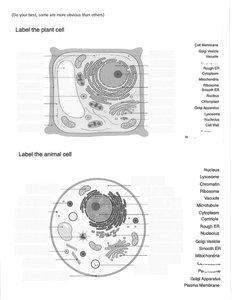
Q3. Compare prokaryotic and eukaryotic cells: nucleus presence, organelles, ribosomes, and provide a sketch.
Background
Topic: Cell Types
This question tests your ability to distinguish between prokaryotic and eukaryotic cells based on structural features.
Key Terms:
Prokaryote: Cell without a nucleus or membrane-bound organelles.
Eukaryote: Cell with a nucleus and membrane-bound organelles.
Ribosome: Present in both cell types, but structure differs.
Step-by-Step Guidance
Identify whether each cell type has a nucleus.
List the organelles present in each cell type.
Describe the ribosomes in prokaryotes vs. eukaryotes.
Draw a simple sketch of each cell type, labeling key features.
Try solving on your own before revealing the answer!
Final Answer:
Prokaryotes: No nucleus, no membrane-bound organelles, have ribosomes, simple structure.
Eukaryotes: Have nucleus, membrane-bound organelles, complex structure.
Sketches: Prokaryote is simple, eukaryote is more complex with labeled organelles.
Understanding these differences is key to cell biology.
Q4. Match cell organelles to their functions and indicate if they are found in plant, animal, or both types of cells.
Background
Topic: Cell Organelles
This question tests your ability to identify organelles based on their functions and recognize their presence in different cell types.
Key Terms:
Cell organelle: Specialized structure within a cell.
Plant cell: Contains chloroplasts, cell wall, large vacuole.
Animal cell: Lacks chloroplasts and cell wall, smaller vacuole.
Step-by-Step Guidance
Read each function and recall which organelle performs it.
Determine if the organelle is found in plant cells, animal cells, or both.
Fill in the table with the organelle name and cell type, stopping before the final entries.
Try solving on your own before revealing the answer!
Final Answer:
Cell membrane: Both
Chloroplast: Plant
Mitochondria: Both
Ribosome: Both
Cell wall: Plant
Lysosome: Animal
Vacuole: Both (large in plant, small in animal)
Each organelle has a specific function and distribution in cell types.
Q5. Label the plant and animal cell diagrams with the correct organelle names.
Background
Topic: Cell Structure Identification
This question tests your ability to visually identify and label organelles in plant and animal cell diagrams.
Key Terms:
Cell membrane, nucleus, mitochondria, chloroplast, vacuole, etc.
Step-by-Step Guidance
Review the list of organelles provided.
Identify each organelle in the plant and animal cell diagrams based on shape and location.
Label each organelle, stopping before the final entries.
Try solving on your own before revealing the answer!
Final Answer:
Plant cell: Cell wall, chloroplast, large vacuole, nucleus, mitochondria, etc.
Animal cell: Cell membrane, nucleus, mitochondria, small vacuole, lysosome, etc.
Correct labeling helps reinforce organelle identification skills.
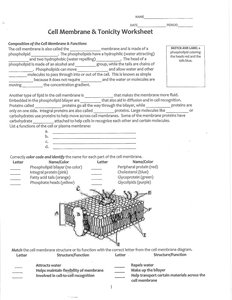
Q6. Describe the composition and function of the cell membrane, and identify its parts.
Background
Topic: Cell Membrane Structure and Function
This question tests your understanding of the cell membrane's structure, its components, and their roles in cellular function.
Key Terms and Formulas:
Phospholipid bilayer: Double layer of phospholipids forming the membrane.
Hydrophilic head: Water-attracting part of phospholipid.
Hydrophobic tail: Water-repelling part of phospholipid.
Proteins: Embedded in membrane, serve as channels or receptors.
Step-by-Step Guidance
Describe the basic structure of the cell membrane (phospholipid bilayer).
Identify the hydrophilic and hydrophobic regions.
List the functions of membrane proteins.
Label the parts of the membrane diagram, stopping before the final entries.
Try solving on your own before revealing the answer!
Final Answer:
Phospholipid bilayer: Main structure
Hydrophilic heads face outward, hydrophobic tails face inward
Proteins: Channels, carriers, receptors
The cell membrane controls what enters and leaves the cell.
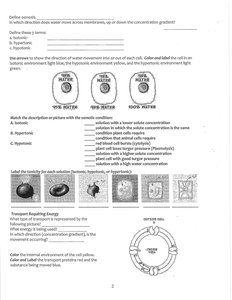
Q7. Define osmosis and describe the direction of water movement across membranes.
Background
Topic: Osmosis and Cell Transport
This question tests your understanding of osmosis and how water moves in response to concentration gradients.
Key Terms:
Osmosis: Diffusion of water across a semipermeable membrane.
Concentration gradient: Difference in solute concentration across a membrane.
Step-by-Step Guidance
Define osmosis in your own words.
Describe how water moves from areas of low solute concentration to high solute concentration.
Explain the effect of osmosis on cell volume.
Try solving on your own before revealing the answer!
Final Answer:
Osmosis: Water moves across membranes from low solute to high solute concentration.
Water movement can cause cells to swell or shrink.
Osmosis is essential for maintaining cell homeostasis.
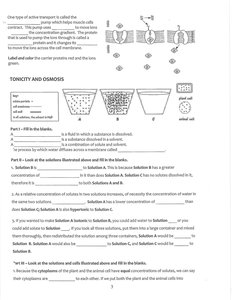
Q8. Match the descriptions of solutions (isotonic, hypertonic, hypotonic) with their effects on cells.
Background
Topic: Tonicity and Cell Response
This question tests your ability to identify solution types and predict their effects on cells.
Key Terms:
Isotonic: Equal solute concentration inside and outside the cell.
Hypertonic: Higher solute concentration outside the cell.
Hypotonic: Lower solute concentration outside the cell.
Step-by-Step Guidance
Define each solution type.
Predict the direction of water movement for each type.
Describe the effect on cell size and shape.
Try solving on your own before revealing the answer!
Final Answer:
Isotonic: No net water movement; cell stays the same.
Hypertonic: Water leaves cell; cell shrinks.
Hypotonic: Water enters cell; cell swells.
Understanding tonicity helps explain cell behavior in different environments.
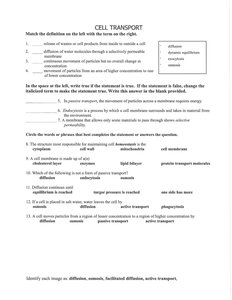
Q9. Explain the different types of cell transport: diffusion, osmosis, facilitated diffusion, and active transport.
Background
Topic: Cell Transport Mechanisms
This question tests your understanding of how substances move across cell membranes.
Key Terms:
Diffusion: Movement of molecules from high to low concentration.
Osmosis: Movement of water across a membrane.
Facilitated diffusion: Movement of molecules via protein channels.
Active transport: Movement against concentration gradient, requires energy.
Step-by-Step Guidance
Define each type of transport.
Identify whether energy is required.
Describe the direction of movement relative to concentration gradients.
Give examples of molecules transported by each method.
Try solving on your own before revealing the answer!
Final Answer:
Diffusion: Passive, high to low concentration.
Osmosis: Passive, water movement.
Facilitated diffusion: Passive, uses protein channels.
Active transport: Requires energy, low to high concentration.
Each transport type is essential for cell function and homeostasis.
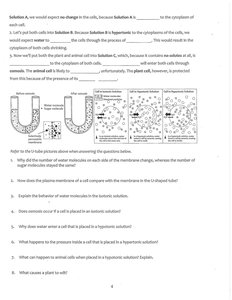
Q10. Describe the effects of different solutions on plant and animal cells.
Background
Topic: Cell Response to Environment
This question tests your ability to predict how cells respond to isotonic, hypertonic, and hypotonic solutions.
Key Terms:
Plasmolysis: Shrinking of plant cell membrane away from cell wall.
Crenation: Shrinking of animal cells.
Turgor pressure: Swelling of plant cells in hypotonic solution.
Step-by-Step Guidance
Describe what happens to plant and animal cells in isotonic solutions.
Explain the effects of hypertonic solutions on both cell types.
Describe the effects of hypotonic solutions on both cell types.
Try solving on your own before revealing the answer!
Final Answer:
Isotonic: Cells remain unchanged.
Hypertonic: Animal cells shrink (crenation), plant cells undergo plasmolysis.
Hypotonic: Animal cells may burst, plant cells become turgid.
Cell responses depend on their environment and structure.
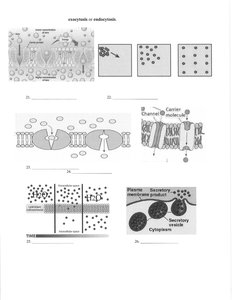
Q11. Match cell transport definitions and identify each image as diffusion, osmosis, facilitated diffusion, or active transport.
Background
Topic: Cell Transport Identification
This question tests your ability to match definitions and visually identify types of cell transport.
Key Terms:
Diffusion, osmosis, facilitated diffusion, active transport
Step-by-Step Guidance
Read each definition and match it to the correct transport type.
Examine each image and identify the transport mechanism depicted.
Label each image, stopping before the final entries.
Try solving on your own before revealing the answer!
Final Answer:
Diffusion: Simple movement across membrane.
Osmosis: Water movement.
Facilitated diffusion: Uses protein channels.
Active transport: Requires energy, uses carrier proteins.
Visual identification reinforces understanding of transport mechanisms.
Q12. Describe diffusion, osmosis, passive transport, facilitated diffusion, active transport, and osmosis in detail.
Background
Topic: Cell Transport Mechanisms
This question tests your ability to describe and differentiate between various cell transport processes.
Key Terms:
Diffusion, osmosis, passive transport, facilitated diffusion, active transport
Step-by-Step Guidance
Define each transport process.
Describe the direction of movement and whether energy is required.
Provide examples for each process.
Try solving on your own before revealing the answer!
Final Answer:
Diffusion: Passive, high to low concentration.
Osmosis: Passive, water movement.
Passive transport: No energy required.
Facilitated diffusion: Passive, uses channels.
Active transport: Requires energy, low to high concentration.
Each process is vital for cell function and maintaining homeostasis.
