 Back
Comprehensive Study Guide for Cell Transport in General Biology
Study Guide - Smart Notes
 Tailored notes based on your materials, expanded with key definitions, examples, and context.
Q22. How do cells move substances that are too large to pass through the cell membrane?
Background
Topic: Cell Transport Mechanisms (Endocytosis and Exocytosis)
This question tests your understanding of how cells handle the transport of large molecules that cannot pass directly through the cell membrane.
Key Terms and Concepts:
Endocytosis: The process by which cells take in large substances by engulfing them in a vesicle formed from the cell membrane.
Exocytosis: The process by which cells expel large substances by enclosing them in a vesicle that fuses with the cell membrane, releasing the contents outside.
Vesicle: A small, membrane-bound sac used for transport within cells.
Step-by-Step Guidance
Consider why some substances cannot pass through the cell membrane directly (size, polarity, or charge).
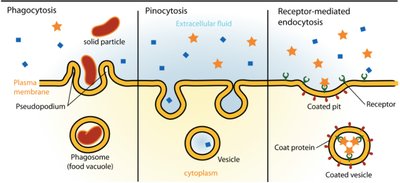
Recall that endocytosis is used to bring large molecules into the cell. The cell membrane wraps around the substance, forming a vesicle.
Think about the steps involved in endocytosis: membrane invagination, vesicle formation, and internalization.
For removing large substances, remember that exocytosis is the process where vesicles containing the substance fuse with the cell membrane and release their contents outside.
Review the energy requirements: both endocytosis and exocytosis are active transport processes, requiring ATP.
Set up your explanation by describing the sequence of events for both processes, but stop before giving the full description.
Try solving on your own before revealing the answer!
Final Answer:
Cells move substances that are too large to pass through the membrane by endocytosis, where the cell membrane forms a vesicle around the substance and brings it inside. To remove large substances, cells use exocytosis, where a vesicle containing the substance fuses with the membrane and releases its contents outside. Both processes require energy (ATP) and are forms of active transport.
Q23. Three cells each containing 98% water are soaked in different solutions. Cell #1 is in 100% water, Cell #2 in 98% water, Cell #3 in 80% water. Where does water move due to osmosis in each cell? Use vocabulary words to describe each solution.
Background
Topic: Osmosis and Cell Environments
This question tests your understanding of osmosis and the effects of different solution concentrations (isotonic, hypotonic, hypertonic) on cells.
Key Terms:
Osmosis: The diffusion of water across a semipermeable membrane.
Isotonic: Equal concentration of solutes inside and outside the cell; no net water movement.
Hypotonic: Lower solute concentration outside the cell; water moves into the cell.
Hypertonic: Higher solute concentration outside the cell; water moves out of the cell.
Step-by-Step Guidance
Identify the water concentration inside each cell (98%) and compare it to the surrounding solution for each cell.
For Cell #1 (100% water outside), determine if the environment is hypotonic, isotonic, or hypertonic relative to the cell.
For Cell #2 (98% water outside), assess the environment type and predict water movement.
For Cell #3 (80% water outside), analyze the environment and direction of water movement.
Use the vocabulary words to describe each environment and predict whether the cell will expand, shrink, or stay the same.
Set up your explanation for each cell, but stop before stating the final outcome for all three.
Try solving on your own before revealing the answer!

Final Answer:
Cell #1 is in a hypotonic environment (100% water outside), so water moves into the cell and it expands. Cell #2 is in an isotonic environment (98% water outside), so there is no net movement of water and the cell stays the same. Cell #3 is in a hypertonic environment (80% water outside), so water moves out of the cell and it shrinks.
Q24. When does the paramecium pump out more water: high salt concentration or low salt concentration surrounding the paramecium?
Background
Topic: Osmoregulation in Single-Celled Organisms
This question tests your understanding of how paramecia regulate water balance in response to their environment.
Key Terms:
Contractile vacuole: An organelle in paramecia that expels excess water.
Osmosis: Water movement from areas of high concentration to low concentration.
Salt concentration: Affects the direction and rate of water movement into or out of the cell.
Step-by-Step Guidance
Recall that water moves from areas of high concentration to low concentration by osmosis.
Consider how the salt concentration outside the paramecium affects water movement: low salt means high water concentration outside.
Think about the role of the contractile vacuole in pumping out excess water to prevent the cell from bursting.
Analyze the data: as salt concentration decreases, the rate of contractile vacuole contractions increases.
Set up your explanation for which environment causes more water to be pumped out, but stop before stating the final result.
Try solving on your own before revealing the answer!
Final Answer:
The paramecium pumps out more water when the salt concentration surrounding it is low, because more water enters the cell by osmosis and must be expelled to prevent bursting.
Q36. Name and describe the process depicted in the illustration labeled 'A'.
Background
Topic: Osmosis
This question tests your ability to identify and describe the process of osmosis in cell transport.
Key Terms:
Osmosis: The diffusion of water across a semipermeable membrane from high to low concentration.
Semipermeable membrane: Allows certain molecules (like water) to pass through while blocking others.
Step-by-Step Guidance
Examine the illustration for evidence of water movement across a membrane.
Identify the direction of water movement (from high to low concentration).
Recall the definition of osmosis and how it applies to the depicted process.
Set up your description of the process, but stop before giving the full explanation.
Try solving on your own before revealing the answer!
Final Answer:
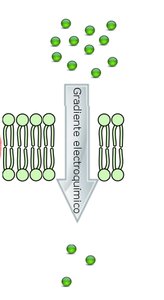
The process depicted is osmosis: the diffusion of water from areas of high concentration to low concentration across a semipermeable membrane.
Q37. Name and describe the process depicted in the illustration labeled 'B'.
Background
Topic: Facilitated Diffusion
This question tests your understanding of how polar or charged molecules move across the cell membrane using transport proteins.
Key Terms:
Facilitated diffusion: Passive transport of molecules across the membrane via transport proteins.
Transport protein: Protein that helps move substances across the membrane.
Step-by-Step Guidance
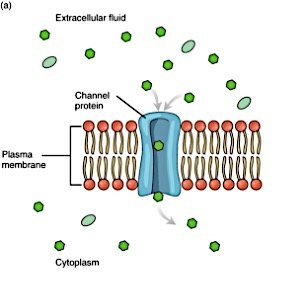
Examine the illustration for evidence of molecules moving through a protein channel in the membrane.
Identify the direction of movement (with the concentration gradient).
Recall the definition of facilitated diffusion and how it applies to the depicted process.
Set up your description of the process, but stop before giving the full explanation.
Try solving on your own before revealing the answer!
Final Answer:
The process depicted is facilitated diffusion: the movement of polar or charged molecules across a semipermeable membrane using transport proteins, from high to low concentration.
Q38. Name and describe the process depicted in the illustration labeled 'C'.
Background
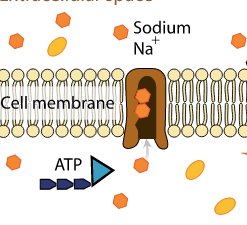
Topic: Sodium-Potassium Pump (Active Transport)
This question tests your understanding of how cells use energy to move ions against their concentration gradient.
Key Terms:
Sodium-potassium pump: A membrane protein that uses ATP to move sodium and potassium ions against their concentration gradients.
Active transport: Movement of substances against the concentration gradient, requiring energy.
ATP: The energy molecule used in active transport.
Step-by-Step Guidance
Examine the illustration for evidence of ions being moved across the membrane against their gradient.
Identify the involvement of ATP in the process.
Recall the definition of the sodium-potassium pump and its role in maintaining cell function.
Set up your description of the process, but stop before giving the full explanation.
Try solving on your own before revealing the answer!
Final Answer:
The process depicted is the sodium-potassium pump: active transport of 3 sodium ions out of the cell and 2 potassium ions into the cell, using ATP to move ions against their concentration gradients.
Q39. Name and describe the process depicted in the illustration labeled 'D'.
Background
Topic: Exocytosis
This question tests your understanding of how cells remove large molecules using vesicles.
Key Terms:
Exocytosis: The process of expelling large molecules from the cell via vesicles.
Vesicle: A membrane-bound sac used for transport.
Active transport: Requires energy (ATP).
Step-by-Step Guidance
Examine the illustration for evidence of vesicles fusing with the cell membrane and releasing contents outside.
Recall the definition of exocytosis and its role in cell transport.
Set up your description of the process, but stop before giving the full explanation.
Try solving on your own before revealing the answer!
Final Answer:
The process depicted is exocytosis: the active transport of very large molecules out of the cell via vesicles that fuse with the cell membrane and release their contents.
