 Back
Comprehensive Study Guide for College Biology: Plant Physiology, Evolution, and Genetics
Study Guide - Smart Notes
 Tailored notes based on your materials, expanded with key definitions, examples, and context.
Q1. What do plants need and what are those things used for?
Background
Topic: Plant Physiology & Ecology
This question tests your understanding of the essential requirements for plant survival and how these requirements are utilized in various physiological processes.
Key Terms:
Photosynthesis
Respiration
Mineral uptake
Transport systems (xylem, phloem)
Step-by-Step Guidance
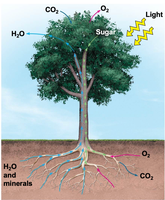
List the basic requirements for plants: light, water, carbon dioxide (CO2), oxygen (O2), and minerals.
Describe how each requirement is obtained: light from the sun, water and minerals from the soil, CO2 from the air.
Explain the role of each requirement: light and CO2 are used in photosynthesis to produce sugars; water is used in photosynthesis and for transport; minerals are used for growth and metabolic processes.
Discuss how these requirements are transported within the plant: water and minerals via xylem, sugars via phloem.
Try solving on your own before revealing the answer!
Final Answer:
Plants need light, water, CO2, O2, and minerals. Light and CO2 are used in photosynthesis to make sugars, water and minerals are absorbed from the soil, and O2 is used in respiration. These substances are transported throughout the plant by specialized tissues.
Q2. Where do plants get carbon, how is it regulated, what is it used to make, and how is it transported once it is sugar?
Background
Topic: Photosynthesis & Carbon Transport
This question focuses on the carbon cycle in plants, including uptake, regulation, utilization, and transport.
Key Terms and Formulas:
Stomata: pores for gas exchange
Photosynthesis:
Phloem: tissue for sugar transport
Step-by-Step Guidance
Identify the source of carbon: atmospheric CO2.
Explain how CO2 enters the plant: through stomata in the leaves.
Discuss regulation: guard cells control stomatal opening and closing, affecting CO2 uptake.
Describe the use of carbon: CO2 is fixed during photosynthesis to produce glucose.
Explain transport: glucose is moved through the phloem to other parts of the plant.
Try solving on your own before revealing the answer!
Final Answer:
Plants get carbon from atmospheric CO2 via stomata, regulated by guard cells. Carbon is used to make sugars through photosynthesis, and these sugars are transported by the phloem.
Q3. What is the principle of alternation of generations in plants?
Background
Topic: Plant Life Cycle
This question tests your understanding of the alternation of generations, a fundamental concept in plant biology.
Key Terms:
Sporophyte (2n): diploid generation
Gametophyte (n): haploid generation
Meiosis and mitosis
Step-by-Step Guidance
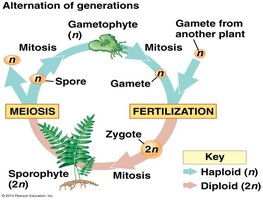
Define alternation of generations: plants alternate between haploid (gametophyte) and diploid (sporophyte) stages.
Describe the process: sporophyte produces spores by meiosis; spores grow into gametophytes.
Explain gametophyte function: produces gametes by mitosis.
Discuss fertilization: gametes fuse to form a diploid zygote, which grows into a sporophyte.
Try solving on your own before revealing the answer!
Final Answer:
Alternation of generations is the cycle in which plants alternate between a haploid gametophyte and a diploid sporophyte, with meiosis and fertilization connecting the stages.
Q4. What are the characteristics of the four major plant groups and what derived traits appeared at each point in plant evolution?
Background
Topic: Plant Evolution
This question tests your knowledge of plant diversity and evolutionary innovations.
Key Terms:
Bryophytes, seedless vascular plants, gymnosperms, angiosperms
Derived traits: vascular tissue, seeds, flowers
Step-by-Step Guidance
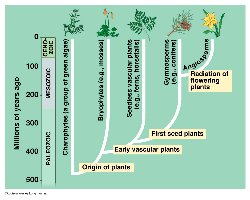
Identify the four major plant groups: bryophytes, seedless vascular plants, gymnosperms, angiosperms.
List key characteristics of each group: bryophytes lack vascular tissue; seedless vascular plants have vascular tissue but no seeds; gymnosperms have seeds but no flowers; angiosperms have seeds and flowers.
Describe derived traits: vascular tissue, seeds, flowers, fruits.
Explain evolutionary timeline: when each trait appeared.
Try solving on your own before revealing the answer!
Final Answer:
Bryophytes lack vascular tissue; seedless vascular plants have vascular tissue; gymnosperms have seeds; angiosperms have seeds and flowers. Derived traits appeared sequentially: vascular tissue, seeds, flowers.
Q5. What is the difference between artificial selection and GMOs? How is artificial selection similar and different to natural selection?
Background
Topic: Plant Breeding & Genetics
This question explores the concepts of artificial selection, genetic modification, and their relationship to natural selection.
Key Terms:
Artificial selection: human-driven breeding
Genetically Modified Organisms (GMOs): organisms with altered genomes
Natural selection: environment-driven evolution
Step-by-Step Guidance
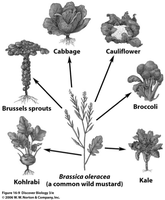
Define artificial selection: humans select traits and breed plants/animals accordingly.
Define GMOs: organisms whose DNA has been altered using biotechnology.
Compare artificial selection and natural selection: both involve selection of traits, but artificial is human-driven, natural is environment-driven.
List similarities: both change allele frequencies in populations.
List differences: artificial selection is intentional and rapid; natural selection is gradual and based on survival/reproduction.
Try solving on your own before revealing the answer!
Final Answer:
Artificial selection is human-driven breeding for desired traits; GMOs are organisms with directly modified genomes. Artificial selection is similar to natural selection in changing traits, but differs in being intentional and rapid.
Q6. What is the principle of transport in biology, especially in plants?
Background
Topic: Transport Mechanisms
This question tests your understanding of diffusion, osmosis, water potential, and transport in plant tissues.
Key Terms and Formulas:
Diffusion: movement of molecules from high to low concentration
Osmosis: movement of water across a membrane
Water potential ():
Xylem and phloem: transport tissues
Step-by-Step Guidance
Define diffusion and osmosis: passive transport mechanisms.
Explain water potential: determines direction of water movement.
Describe transport in roots: water moves from soil into roots by osmosis.
Discuss guard cell regulation: controls stomatal opening and water loss.
Try solving on your own before revealing the answer!
Final Answer:
Transport in plants relies on diffusion, osmosis, and water potential. Water moves into roots by osmosis, and guard cells regulate stomatal opening for gas exchange and water loss.
Q7. What is the biological species concept and what are the categories of pre- and post-zygotic barriers to speciation?
Background
Topic: Speciation & Evolution
This question tests your understanding of how species are defined and the mechanisms that prevent interbreeding.
Key Terms:
Biological species concept: species are groups of interbreeding populations
Pre-zygotic barriers: prevent mating or fertilization
Post-zygotic barriers: affect hybrid offspring
Step-by-Step Guidance
Define the biological species concept: ability to produce viable, fertile offspring.
List pre-zygotic barriers: mechanical, behavioral, habitat, temporal isolation.
List post-zygotic barriers: hybrid inviability, hybrid sterility, hybrid breakdown.
Explain how these barriers contribute to speciation.
Try solving on your own before revealing the answer!
Final Answer:
The biological species concept defines species by their ability to produce viable, fertile offspring. Pre-zygotic barriers prevent mating, while post-zygotic barriers affect hybrid offspring.
Q8. How do you interpret cladograms and what are ancestral state, shared derived trait, homology, and analogy?
Background
Topic: Phylogeny & Classification
This question tests your ability to read evolutionary trees and understand key terms in phylogenetics.
Key Terms:
Cladogram: diagram showing evolutionary relationships
Ancestral state: trait present in ancestor
Shared derived trait: trait present in descendants but not ancestor
Homology: similarity due to shared ancestry
Analogy: similarity due to convergent evolution
Step-by-Step Guidance
Identify nodes and branches in a cladogram.
Distinguish ancestral state from shared derived trait.
Define homology and analogy.
Explain how to use these concepts to interpret evolutionary relationships.
Try solving on your own before revealing the answer!
Final Answer:
Cladograms show evolutionary relationships. Ancestral state is a trait in the ancestor; shared derived trait is a new trait in descendants. Homology is similarity from shared ancestry; analogy is similarity from convergent evolution.
