 Back
Comprehensive Study Guide for General Biology I: Key Concepts, Learning Objectives, and Study Strategies
Study Guide - Smart Notes
 Tailored notes based on your materials, expanded with key definitions, examples, and context.
Final Exam Overview and Study Strategies
Exam Structure and Preparation
The cumulative final exam for Principles of Biology I is designed to assess your understanding of foundational biological concepts, with a focus on both recent and cumulative learning objectives. The exam consists of two parts: a primary section on new material and a cumulative assessment covering the entire course. Success depends on consistent engagement with the Study Cycle and active use of learning objectives.
Part 1: Focuses on new objectives since the midterm (~40 multiple choice questions, paper-based, 55 minutes).
Part 2: Cumulative assessment (~20 multiple choice questions, online, 30 minutes).
Bring required materials: clicker, scantron, pencils, photo ID. Electronic devices and headwear are not permitted during the exam.
Study Cycle and Focused Study Sessions
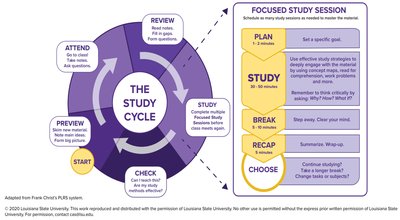
Effective preparation involves following the Study Cycle, which emphasizes previewing material, attending lectures, reviewing content, and self-assessment. Focused study sessions help maximize retention and understanding.
Preview: Skim readings, videos, and assignments before class.
Attend: Participate actively in lectures and discussions.
Review: Summarize and revisit notes after class.
Study: Complete assignments and practice problems.
Check: Test your understanding through self-quizzing and application.
The DEAL Method for Mastery
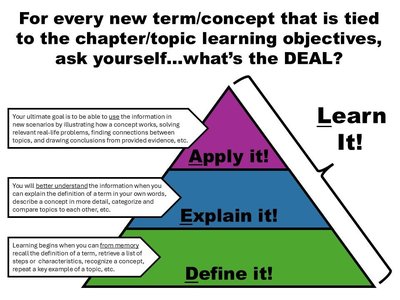
For each new term or concept, use the DEAL method to ensure deep understanding and application:
Define it: Recall and state the definition from memory.
Explain it: Describe the concept in your own words, including details and comparisons.
Apply it: Use the concept in examples, solve problems, and draw connections between topics.
Core Biological Concepts and Learning Objectives
Scientific Process
Understanding the scientific process is fundamental to biology. It involves systematic observation, hypothesis formation, experimentation, and analysis.
Biology: The scientific study of life and living organisms.
Scientific Method: Steps include observation, hypothesis, experimentation, data collection, and conclusion. Science is adaptable and iterative.
Scientific Questions/Hypotheses: Must be testable, falsifiable, and based on observations.
Data Interpretation: Analyze tables and figures to identify variables, controls, sample size, and summarize findings.
Properties of Life
Living organisms share key characteristics that distinguish them from non-living matter.
Characteristics of Life: Organization, metabolism, homeostasis, growth, reproduction, response to stimuli, and adaptation through evolution.
Cells: The basic unit of life; all living things are composed of cells.
Application: Use observations to determine if an object (e.g., vesicle) meets criteria for life.
Cell Structure
Cells are classified as prokaryotic or eukaryotic based on structural and functional characteristics.
Prokaryotic Cells: Lack membrane-bound organelles; DNA is in the nucleoid region (e.g., bacteria, archaea).
Eukaryotic Cells: Contain membrane-bound organelles (e.g., nucleus, mitochondria, endoplasmic reticulum).
Organelle: Specialized subunit within a cell with a specific function.
Structure-Function Relationship: Cell structure and organization adapt to cellular function.
Membrane Structure
The plasma membrane is a dynamic barrier that regulates the movement of substances into and out of the cell.
Fluid Mosaic Model: Describes the membrane as a flexible layer with embedded proteins and lipids.
Components: Phospholipids, proteins, cholesterol, and carbohydrates.
Formation: Phospholipids arrange into a bilayer due to hydrophilic heads and hydrophobic tails.
Lipids and Biochemistry
Lipids are diverse biomolecules essential for membrane structure, energy storage, and signaling.
Types of Lipids: Phospholipids, steroids, triglycerides/fats.
Primary Elements: Hydrogen (H), Carbon (C), Nitrogen (N), Oxygen (O).
Structural Formulas: Recognize hydrocarbon skeletons and functional groups.
Intramolecular Bonds: Nonpolar covalent, polar covalent, and ionic bonds based on electronegativity differences.
Molecular Interactions and Membrane Formation
Non-covalent interactions are critical for molecular recognition, membrane formation, and biological function.
Types of Intermolecular Interactions: Ionic bonds, hydrogen bonds/dipoles, Van der Waals forces.
Hydrophilic vs. Hydrophobic: Hydrophilic regions interact with water; hydrophobic regions avoid water.
Water Properties: Unique characteristics arise from hydrogen bonding.
Membrane Formation: Driven by hydrophobic interactions among phospholipids.
Membrane Transport
Cells regulate the movement of substances across membranes through various transport mechanisms.
Structures: Channels, carriers, pumps, vesicles.
Concentration Gradients: Molecules move from high to low concentration (diffusion).
Transport Mechanisms: Passive (simple/facilitated diffusion), active (requires energy), bulk transport (endocytosis/exocytosis).
Environmental Influence: Direction and rate of movement depend on conditions.
Proteins
Proteins are polymers of amino acids with diverse structures and functions.
Types: Transport, receptor, enzymes, cell identification proteins.
Structure: Primary (sequence), secondary (alpha-helix, beta-sheet), tertiary (3D folding), quaternary (multiple subunits).
Monomers/Polymers: Amino acids (monomers) form polypeptides (polymers).
Protein Function: Determined by shape and structure; affected by mutations or environmental changes.
Gene Expression
Gene expression is the process by which genetic information is used to synthesize proteins.
Flow of Information: DNA → RNA → Protein (Central Dogma).
Processes: Transcription (DNA to RNA), translation (RNA to protein), protein folding/modification.
Genotype to Phenotype: Variations in DNA sequence (alleles) can affect protein structure and function.
Dominance Relationships: Complete dominance, codominance, incomplete dominance, multifactorial traits.
Genetic Material
Nucleic acids store and transmit genetic information.
Types: DNA (deoxyribonucleic acid), RNA (ribonucleic acid).
Structure: Sugar-phosphate backbone, nitrogenous bases; monomers are nucleotides.
Mutations: Base substitutions, frameshifts; can alter protein structure/function.
Genetics
Genetics explores the inheritance and variation of traits.
Symbols: Represent genes, alleles, genotypes (e.g., AA, Aa, aa).
Punnett Squares: Predict offspring genotypes and phenotypes using Mendelian and non-Mendelian principles.
Chromosome Structure: Genome, chromosome, gene locus, gene, allele.
Replication and Cell Division
Cell division ensures genetic continuity and diversity.
DNA Replication: Produces identical copies of DNA before cell division.
Mitosis vs. Meiosis: Mitosis produces identical cells; meiosis produces gametes with genetic diversity.
Ploidy: Haploid (n), diploid (2n); predicts chromosome number at cell cycle stages.
Enzymes and Metabolism
Enzymes catalyze biochemical reactions, regulating metabolism and energy flow.
Structure/Function: Enzymes lower activation energy; specificity determined by active site.
Regulation: Substrate/enzyme concentration, inhibitors (competitive/noncompetitive), cofactors, environmental factors.
Energy and Cellular Processes
Cells manage energy through metabolic pathways, coupling reactions to drive biological work.
Energy Types: Kinetic, potential; free energy change () relates to enthalpy (), entropy (), and stability.
Thermodynamics: First and second laws govern energy transformations.
ATP: Structure and role in phosphorylation/dephosphorylation for energy coupling.
Cellular Respiration and Photosynthesis
These processes are central to energy flow in ecosystems.
Photosynthesis: Converts light energy to chemical energy (food) in autotrophs.
Cellular Respiration: Extracts energy from food; includes glycolysis, Krebs cycle, electron transport chain, and chemiosmosis.
Aerobic vs. Anaerobic: Oxygen-dependent vs. fermentation pathways.
Carbohydrates
Carbohydrates serve as energy sources and structural components.
Types: Monosaccharides, disaccharides, polysaccharides.
Structure: Recognize hydrocarbon skeletons and functional groups.
Course Outcomes and Core Curriculum Impact
Apply the scientific process to biological problems at the cellular and molecular level.
Use biological vocabulary to describe cellular and molecular biology concepts.
Distinguish the structure and function of organic biomolecules.
Summarize cellular metabolism and the flow of biological information.
Analyze data, solve problems, and explain natural phenomena using scientific and quantitative methods.
