 Back
Comprehensive Study Guide for General Biology Unit 1
Study Guide - Smart Notes
 Tailored notes based on your materials, expanded with key definitions, examples, and context.
Q1. Define and give an example of the following terms: matter, element, molecule. What four elements make up 96% of all living matter? What are three subatomic particles?
Background
Topic: Basic Chemistry and Atomic Structure
This question tests your understanding of fundamental chemical concepts that underpin biology, including the definitions of matter, elements, molecules, and the basic composition of atoms.
Key Terms:
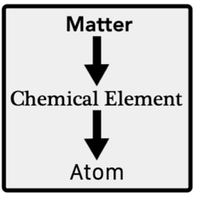
Matter: Anything that has mass and takes up space.
Element: A substance that cannot be broken down into other substances by chemical means.
Molecule: Two or more atoms bonded together.
Subatomic particles: Protons, neutrons, electrons.
Step-by-Step Guidance
Start by recalling the definition of matter and think of a simple example (e.g., water, air).
Define an element and consider an example from the periodic table (e.g., oxygen, carbon).
Define a molecule and give an example (e.g., H2O, CO2).
Think about the four elements most abundant in living organisms. Try to remember their chemical symbols.
List the three subatomic particles and briefly describe their charge and location in the atom.
Try solving on your own before revealing the answer!
Final Answer:
Matter: Anything that has mass and occupies space. Example: Water.
Element: A pure substance made of only one kind of atom. Example: Carbon.
Molecule: A group of atoms bonded together. Example: H2O (water).
The four elements that make up 96% of living matter are: Carbon (C), Hydrogen (H), Oxygen (O), and Nitrogen (N).
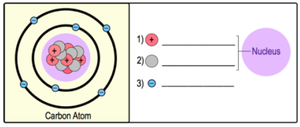
The three subatomic particles are: Protons (positive charge, in nucleus), Neutrons (neutral, in nucleus), Electrons (negative charge, orbiting nucleus).
Q2. Define neutron, proton, electron, atomic nucleus, atomic number, and mass number.
Background
Topic: Atomic Structure
This question tests your knowledge of the basic components of atoms and how scientists use these to identify elements.
Key Terms:
Neutron: Neutral subatomic particle found in the nucleus.
Proton: Positively charged subatomic particle found in the nucleus.
Electron: Negatively charged subatomic particle found outside the nucleus.
Atomic nucleus: The central part of the atom containing protons and neutrons.
Atomic number: Number of protons in an atom.
Mass number: Sum of protons and neutrons in an atom.
Step-by-Step Guidance
Recall the location and charge of each subatomic particle.
Define the atomic nucleus and its composition.
Remember how atomic number is used to identify elements.
Think about how mass number is calculated.
Try solving on your own before revealing the answer!
Final Answer:
Neutron: A neutral particle in the nucleus.
Proton: A positively charged particle in the nucleus.
Electron: A negatively charged particle outside the nucleus.
Atomic nucleus: The center of the atom containing protons and neutrons.
Atomic number: The number of protons in an atom.
Mass number: The sum of protons and neutrons in an atom.
Q3. What are isotopes? Use carbon as an example. What are radioactive isotopes? Give one medical application.
Background
Topic: Isotopes and Radioactivity
This question tests your understanding of isotopes, their properties, and their applications in medicine.
Key Terms:
Isotope: Atoms of the same element with different numbers of neutrons.
Radioactive isotope: An isotope whose nucleus decays, emitting radiation.
Step-by-Step Guidance
Recall the definition of isotopes and how they differ from regular atoms.
Use carbon as an example: Think about C-12, C-13, and C-14.
Explain what makes an isotope radioactive.
Think of a medical application, such as imaging or cancer treatment.
Try solving on your own before revealing the answer!
Final Answer:
Isotopes are atoms of the same element with different numbers of neutrons. For example, carbon has isotopes C-12, C-13, and C-14.
Radioactive isotopes have unstable nuclei that decay and emit radiation. One medical application is using radioactive isotopes in PET scans for imaging.
Q4. What is the only subatomic particle directly involved in chemical reactions between atoms? Why do atoms make bonds? What are the major types of bonds?
Background
Topic: Chemical Bonding
This question tests your understanding of how atoms interact to form molecules and the types of bonds involved.
Key Terms:
Electron: The subatomic particle involved in chemical reactions.
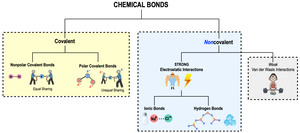
Chemical bond: Attractive force between atoms.
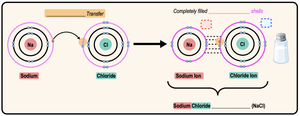
Ionic bond: Transfer of electrons.
Covalent bond: Sharing of electrons.
Step-by-Step Guidance
Recall which subatomic particle is involved in chemical reactions.
Think about why atoms form bonds (stability, filling valence shells).
List the major types of bonds and briefly describe each.
Try solving on your own before revealing the answer!
Final Answer:
Electrons are directly involved in chemical reactions. Atoms make bonds to achieve stability by filling their valence shells. The major types of bonds are ionic (transfer of electrons) and covalent (sharing of electrons).
Q5. What is a covalent bond? What is meant by electronegativity? Explain the difference between a nonpolar covalent bond and a polar covalent bond.
Background
Topic: Covalent Bonding and Electronegativity
This question tests your understanding of how atoms share electrons and how differences in electronegativity affect bond polarity.
Key Terms:
Covalent bond: Sharing of electrons between atoms.
Electronegativity: Atom's ability to attract electrons.
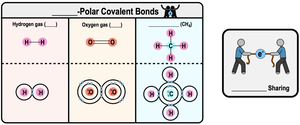
Nonpolar covalent bond: Equal sharing of electrons.
Polar covalent bond: Unequal sharing of electrons.
Step-by-Step Guidance
Define covalent bond and describe how it forms.
Explain electronegativity and its role in bond formation.
Distinguish between nonpolar and polar covalent bonds based on electron sharing.
Think of examples for each type of bond.
Try solving on your own before revealing the answer!
Final Answer:
A covalent bond is formed when atoms share electrons. Electronegativity is the tendency of an atom to attract electrons. Nonpolar covalent bonds involve equal sharing, while polar covalent bonds involve unequal sharing of electrons.
Q6. Make an electron distribution diagram of water. Which element is most electronegative? Why is water considered a polar molecule? Label the regions that are more positive or more negative.
Background
Topic: Water Structure and Polarity
This question tests your understanding of water's molecular structure, polarity, and the concept of electronegativity.
Key Terms:
Electron distribution diagram: Shows how electrons are shared in a molecule.
Electronegativity: Oxygen is more electronegative than hydrogen.
Polar molecule: Has regions of partial positive and negative charge.
Step-by-Step Guidance
Draw or visualize the water molecule (H2O) with oxygen at the center and hydrogens attached.
Label oxygen as the most electronegative element in the molecule.
Indicate which regions are more negative (near oxygen) and which are more positive (near hydrogen).
Explain why water is polar based on electron distribution.
Try solving on your own before revealing the answer!
Final Answer:
Oxygen is the most electronegative element in water. Water is polar because oxygen pulls electrons closer, making its region more negative, while hydrogen regions are more positive.
Q7. Define anion and cation. In the NaCl example, which is the anion?
Background
Topic: Ions and Ionic Bonding
This question tests your understanding of ions and their roles in ionic compounds.
Key Terms:
Anion: Negatively charged ion.
Cation: Positively charged ion.
Step-by-Step Guidance
Recall the definitions of anion and cation.
Think about the NaCl example: Which ion is positive, which is negative?
Identify which is the anion in NaCl.
Try solving on your own before revealing the answer!
Final Answer:
An anion is a negatively charged ion; a cation is a positively charged ion. In NaCl, chloride (Cl-) is the anion.
Q8. What is a hydrogen bond?
Background
Topic: Hydrogen Bonding
This question tests your understanding of weak interactions between molecules, especially in water and biological molecules.
Key Terms:
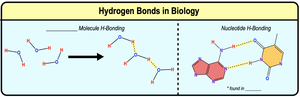
Hydrogen bond: Weak attraction between a hydrogen atom and an electronegative atom.
Step-by-Step Guidance
Recall the definition of a hydrogen bond.
Think about where hydrogen bonds occur (e.g., between water molecules, in DNA).
Describe the importance of hydrogen bonds in biology.
Try solving on your own before revealing the answer!
Final Answer:
A hydrogen bond is a weak attraction between a hydrogen atom and an electronegative atom (like oxygen or nitrogen). Hydrogen bonds are important for the structure of water, proteins, and DNA.
Q9. Distinguish between cohesion and adhesion.
Background
Topic: Properties of Water
This question tests your understanding of how water molecules interact with each other and with other surfaces.
Key Terms:
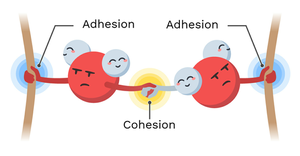
Cohesion: Attraction between water molecules.
Adhesion: Attraction between water molecules and other substances.
Step-by-Step Guidance
Define cohesion and give an example (e.g., surface tension).
Define adhesion and give an example (e.g., water climbing up a straw).
Compare the two properties and their biological significance.
Try solving on your own before revealing the answer!
Final Answer:
Cohesion is the attraction between water molecules, while adhesion is the attraction between water molecules and other surfaces. Both are important for processes like water transport in plants.
Q10. Which property explains the ability of a water spider to walk on water?
Background
Topic: Surface Tension
This question tests your understanding of how water's surface tension allows certain organisms to move across its surface.
Key Terms:
Surface tension: Result of cohesion among water molecules.
Step-by-Step Guidance
Recall what surface tension is and how it relates to cohesion.
Think about how surface tension allows objects or organisms to stay on the surface of water.
Try solving on your own before revealing the answer!
Final Answer:
Surface tension, caused by cohesion among water molecules, allows a water spider to walk on water.
Q11. Water has high specific heat. What does this mean? Explain how hydrogen bonding contributes to water’s high specific heat.
Background
Topic: Water's Thermal Properties
This question tests your understanding of how water resists temperature changes and the role of hydrogen bonds.
Key Terms:
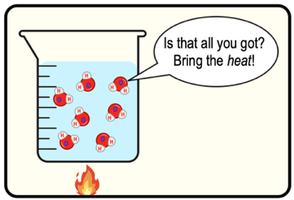
Specific heat: Amount of heat needed to raise the temperature of 1 gram of a substance by 1°C.
Hydrogen bonding: Makes it harder for water molecules to move apart.
Step-by-Step Guidance
Define specific heat and relate it to water.
Explain how hydrogen bonds resist temperature change.
Think about the biological importance of water’s high specific heat.
Try solving on your own before revealing the answer!
Final Answer:
Water has high specific heat, meaning it takes a lot of energy to change its temperature. Hydrogen bonds absorb heat, making water resistant to temperature changes.
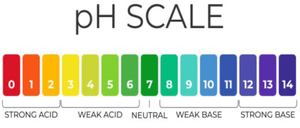
Q12. What is an acid? What is a base? How many times more basic is a pH of 12 compared to a pH of 8? How do buffers moderate pH change?
Background
Topic: Acids, Bases, and Buffers
This question tests your understanding of pH, acids, bases, and the role of buffers in biological systems.
Key Terms:
Acid: Substance that releases H+ ions.
Base: Substance that accepts H+ ions.
Buffer: Chemical that stabilizes pH.
Step-by-Step Guidance
Define acid and base.
Recall the pH scale and how it relates to acidity and basicity.
Calculate how many times more basic a pH of 12 is compared to pH 8.
Explain how buffers work to moderate pH changes.
Try solving on your own before revealing the answer!
Final Answer:
An acid releases H+ ions; a base accepts H+ ions. A pH of 12 is 10,000 times more basic than pH 8 (each pH unit is a tenfold difference). Buffers moderate pH change by absorbing or releasing H+ ions.
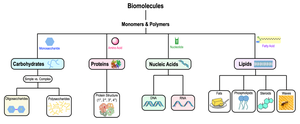
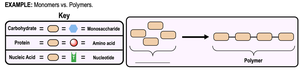
Q13. What are macromolecules? What are monomers and polymers? Name the four main classes of macromolecules.
Background
Topic: Biomolecules
This question tests your understanding of the structure and function of biological macromolecules.
Key Terms:
Macromolecule: Large molecule essential for life.
Monomer: Single subunit.
Polymer: Chain of monomers.
Four classes: Carbohydrates, proteins, nucleic acids, lipids.
Step-by-Step Guidance
Define macromolecule, monomer, and polymer.
List the four main classes of macromolecules.
Think about examples for each class.
Try solving on your own before revealing the answer!
Final Answer:
Macromolecules are large molecules essential for life. Monomers are single subunits; polymers are chains of monomers. The four main classes are carbohydrates, proteins, nucleic acids, and lipids.
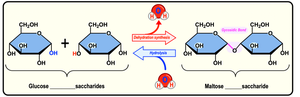
Q14. What is dehydration synthesis? What is hydrolysis?
Background
Topic: Polymer Formation and Breakdown
This question tests your understanding of how biological polymers are built and broken down.
Key Terms:
Dehydration synthesis: Joining monomers by removing water.
Hydrolysis: Breaking polymers by adding water.
Step-by-Step Guidance
Recall the process of dehydration synthesis and its role in forming polymers.
Explain hydrolysis and its role in breaking down polymers.
Think about examples in biological systems (e.g., digestion).
Try solving on your own before revealing the answer!
Final Answer:
Dehydration synthesis joins monomers by removing water; hydrolysis breaks polymers by adding water.
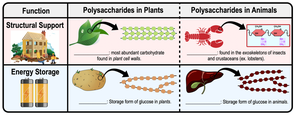
Q15. Name three common monosaccharides. Name two categories of polysaccharides and give examples.
Background
Topic: Carbohydrates
This question tests your knowledge of carbohydrate structure and function.
Key Terms:
Monosaccharide: Simple sugar (e.g., glucose, fructose, galactose).
Polysaccharide: Complex carbohydrate (e.g., starch, cellulose, glycogen).
Step-by-Step Guidance
Recall the names of three common monosaccharides.
List two categories of polysaccharides (structural and storage).
Give examples for each category.
Try solving on your own before revealing the answer!
Final Answer:
Three common monosaccharides: glucose, fructose, galactose. Two categories of polysaccharides: structural (cellulose, chitin) and storage (starch, glycogen).
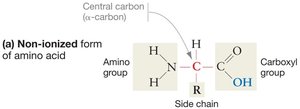
Q16. Sketch an amino acid and label the α or central carbon, amino group, carboxyl group, and R group.
Background
Topic: Protein Structure
This question tests your understanding of amino acid structure, which is fundamental to protein function.
Key Terms:
Amino acid: Building block of proteins.
Central (α) carbon: The main carbon atom in an amino acid.
Amino group: NH2.
Carboxyl group: COOH.
R group: Side chain that varies among amino acids.
Step-by-Step Guidance
Draw the basic structure of an amino acid.
Label the central carbon, amino group, carboxyl group, and R group.
Think about how the R group determines the properties of the amino acid.
Try solving on your own before revealing the answer!
Final Answer:
The central carbon (α-carbon) is bonded to an amino group (NH2), a carboxyl group (COOH), a hydrogen atom, and an R group (side chain).
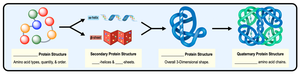
Q17. What are the four levels of protein structure?
Background
Topic: Protein Structure
This question tests your understanding of how proteins fold and function.
Key Terms:
Primary structure: Sequence of amino acids.
Secondary structure: Alpha helices and beta sheets.
Tertiary structure: 3D folding of a single polypeptide.
Quaternary structure: Association of multiple polypeptides.
Step-by-Step Guidance
Recall the sequence of protein structure levels.
Describe each level and its significance.
Think about examples for each level.
Try solving on your own before revealing the answer!
Final Answer:
The four levels of protein structure are: primary (amino acid sequence), secondary (alpha helices and beta sheets), tertiary (3D folding), and quaternary (multiple polypeptides).
