 Back
Comprehensive Study Guide: Plant and Animal Biology (Chapters 35-42, 44-46)
Study Guide - Smart Notes
 Tailored notes based on your materials, expanded with key definitions, examples, and context.
Unifying Principles in Plant and Animal Biology
Energy Flow and Nutrient Cycling
Plants and animals interact with their abiotic environment to sustain life through energy capture, nutrient cycling, and metabolic processes. Understanding these interactions is fundamental to biology and helps explain broader ecological and societal issues.
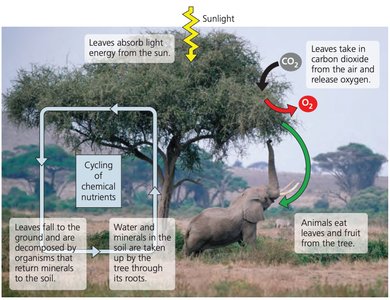
Plants are autotrophs: They absorb sunlight, take in carbon dioxide, and release oxygen via photosynthesis.
Animals are heterotrophs: They consume plants or other organisms, take in oxygen, and release carbon dioxide via cellular respiration.
Both plants and animals require ATP for cellular work, but differ in how they obtain and utilize energy.
Nutrient cycling involves the decomposition of organic matter, uptake of minerals by roots, and transfer of energy through food webs.
These processes are essential for understanding issues like global climate change and biodiversity loss.
Example: The diagram below illustrates the cycling of energy and nutrients between plants, animals, and the environment.
ATP Generation in Plants and Animals
Both plants and animals generate ATP, but the tissues, mechanisms, and energy allocation differ.
Plants: ATP is generated in chloroplasts during photosynthesis and in mitochondria during cellular respiration.
Animals: ATP is generated in mitochondria via cellular respiration.
Energy transport: Plants use vascular tissues (xylem and phloem); animals use circulatory systems.
Metabolism: Animals allocate energy for movement, thermoregulation, and reproduction; plants allocate energy for growth, storage, and reproduction.
Seasonal energy storage: Temperate plants store energy in roots or stems during winter; animals may store fat or migrate.
Equation for cellular respiration:
Additional info: Plants perform both photosynthesis and cellular respiration, while animals only perform cellular respiration.
Shared Characteristics and Mechanisms of Living Things
Basic Characteristics of Life
All living organisms, including plants and animals, share fundamental characteristics:
Cellular organization
Metabolism
Homeostasis
Growth
Reproduction
Response to stimuli
Adaptation
Genetic information (DNA/RNA)
Evolution
Shared Properties and Mechanisms
Plants and animals share several properties and mechanisms, though they may differ in details:
Bulk flow: Movement of fluids through vessels (xylem/phloem in plants; blood vessels in animals).
Reproduction: Both sexual and asexual modes; plants may use spores or seeds, animals use gametes.
Vascular systems: Specialized tissues for transport (xylem/phloem vs. circulatory system).
Hormones and chemical signaling: Regulate growth, development, and responses.
Metabolic pathways: Shared pathways like glycolysis, Krebs cycle.
Levels of organization: Cells, tissues, organs, organ systems.
Movement of water: Osmosis and transpiration in plants; osmoregulation in animals.
Homeostasis: Maintenance of stable internal conditions.
Osmosis and Water Transport
Principles of Osmosis
Osmosis is a form of passive transport where water moves across a semipermeable membrane from areas of low solute concentration to high solute concentration.
Animal cells: Osmosis can cause cells to swell (hypotonic) or shrink (hypertonic); regulated by kidneys and other mechanisms.
Plant cells: Cell walls prevent bursting; turgor pressure is essential for structure and growth.
Equation:
Feedback Systems in Plants and Animals
Feedback Mechanisms
Feedback systems regulate physiological processes to maintain homeostasis.
Negative feedback: Counteracts changes (e.g., temperature regulation in animals).
Positive feedback: Amplifies changes (e.g., fruit ripening in plants).
Example: In leaf abscission, the ratio of ethylene to auxin determines whether leaves are shed.
Antagonistic hormones: Hormones with opposing effects (e.g., ethylene vs. auxin).
Signal Transduction Pathways
Plant and Animal Hormone Signaling
Signal transduction pathways allow organisms to respond to environmental cues.
Auxin and ethylene: Plant hormones with distinct signaling mechanisms; auxin promotes growth, ethylene promotes abscission.
Phytochrome system: Light-sensitive proteins regulate plant development.
Hypothalamus-pituitary axis: In animals, regulates hormone release; anterior pituitary uses hormonal signals, posterior pituitary uses neural signals.
Example: Human growth hormone feedback system regulates growth; excess or deficiency leads to disorders.
Counter-Current Exchange
Mechanism and Importance
Counter-current exchange is a highly efficient method for maintaining homeostasis, especially in heat and gas exchange.
Definition: Fluids flow in opposite directions, maximizing gradient and exchange efficiency.
Example: Fish gills use counter-current exchange for oxygen uptake; animals use it for heat retention.
Alternation of Generations in Plants
Life Cycle and Double Fertilization
Plants exhibit alternation of generations, alternating between haploid gametophyte and diploid sporophyte stages.
Gametophyte: Produces gametes (haploid).
Sporophyte: Produces spores (diploid).
Double fertilization: Unique to angiosperms; one sperm fertilizes egg, another fertilizes central cell to form endosperm.
Animals: Do not exhibit double fertilization.
Adaptations for Life on Land
Principal Characteristics
Plants evolved several adaptations to thrive on land:
Cuticle: Prevents water loss.
Stomata: Regulate gas exchange.
Vascular tissue: Supports transport and structure.
Seeds: Protect embryos.
Additional info: Each adaptation addresses specific environmental challenges.
Water Transport in Plants
Mechanism of Water Movement
Water moves from soil to leaves via a combination of root uptake, capillary action, cohesion, adhesion, and transpiration.
Leaves: Transpiration creates negative pressure, pulling water upward.
Trunk/stem: Xylem vessels transport water; cohesion and adhesion facilitate movement.
Structure and Function: Xylem and Phloem
Xylem Tissue
Xylem transports water and minerals from roots to leaves. It consists of specialized cell types:
Tracheids: Long, tapered cells; thick walls; dead at maturity.
Vessel elements: Short, wide cells; form continuous tubes; dead at maturity.
Structure-function link: Thick cell walls prevent collapse; dead cells allow efficient water flow.
Genetic Inheritance and Gamete Production
Differences Between Plants and Animals
Gamete production varies between plants and animals:
Plants: Double fertilization; gametes produced in gametophyte stage.
Animals: Internal or external fertilization; gametes produced in gonads.
Homeostasis of Body Temperature
Endothermy vs. Ectothermy
Animals regulate body temperature through different strategies:
Endothermy: Internal heat generation (e.g., mammals, birds).
Ectothermy: External heat sources (e.g., reptiles, amphibians).
Meristems and Equivalent Animal Cells
Apical and Lateral Meristems
Meristems are regions of active cell division in plants:
Apical meristems: Growth at tips of roots and shoots.
Lateral meristems: Growth in girth (secondary growth).
Animals: Stem cells are functionally equivalent, enabling growth and repair.
Plant vs. Animal Cells
Similarities and Differences
Plant and animal cells share many features but also have distinct differences:
Similarities: Both have nucleus, mitochondria, plasma membrane, and cytoplasm.
Differences: Plant cells have cell walls, chloroplasts, and large vacuoles; animal cells do not.
Exchange with the Environment
Adaptations in Amphibians
Organisms must exchange gases and nutrients with their environment. Adaptations vary by habitat and size:
Desert amphibians: May have reduced surface area to minimize water loss; rely on lungs for oxygen.
Freshwater amphibians: Larger surface area for gas exchange; may use skin and lungs.
Circulatory adaptations: Vary to optimize oxygen uptake and distribution.
