 Back
BackComprehensive Study Notes for Introductory Biology: Structure and Function of Flower Parts
Study Guide - Smart Notes
 Tailored notes based on your materials, expanded with key definitions, examples, and context.
Flower Structure and Function
Overview of Flower Anatomy
Flowers are the reproductive organs of angiosperms (flowering plants). Each part of the flower has a specific role in the process of sexual reproduction, facilitating the production of seeds and fruit. Understanding the structure and function of each part is essential for grasping plant reproductive biology.
Stamen: The male reproductive organ, consisting of the anther and filament.
Carpel (Pistil): The female reproductive organ, consisting of the stigma, style, and ovary.
Petals: Often colorful structures that attract pollinators.
Sepals: Leaf-like structures that protect the flower bud before it opens.
Key Flower Parts and Their Functions
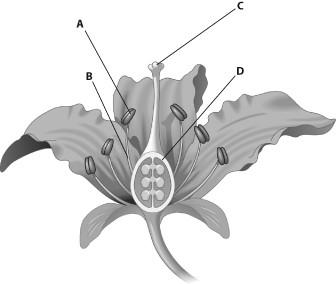
Stigma (A): The sticky surface at the top of the carpel that captures and holds pollen grains.
Style (B): The slender stalk that connects the stigma to the ovary; pollen tubes grow through the style to reach the ovule.
Ovary (C): The enlarged basal portion of the carpel that contains ovules; after fertilization, the ovary develops into fruit.
Anther (D): The part of the stamen that produces and releases pollen grains.
Additional Flower Structures
Filament: The stalk that supports the anther.
Ovule: The structure within the ovary where fertilization occurs and seeds develop.
Petals: Attract pollinators with color and scent.
Sepals: Protect the developing flower bud.
Summary Table: Flower Part Functions
Part | Function |
|---|---|
Stigma | Receives pollen during pollination |
Style | Supports stigma; pathway for pollen tubes |
Ovary | Contains ovules; develops into fruit after fertilization |
Anther | Produces and releases pollen |
Filament | Holds anther in position |
Petal | Attracts pollinators |
Sepal | Protects flower bud |
Reproductive Process in Flowers
Pollination occurs when pollen from the anther is transferred to the stigma.
Pollen germinates and grows a tube down the style to the ovary, where fertilization of the ovule occurs.
The fertilized ovule develops into a seed, and the ovary matures into a fruit.
Key Terms
Pollination: The transfer of pollen from anther to stigma.
Fertilization: The fusion of male and female gametes to form a zygote.
Fruit: The mature ovary of a flower, containing seeds.
Additional info: The ovule develops into the seed, and the ovary develops into the fruit after fertilization. The coordinated function of all flower parts ensures successful sexual reproduction in angiosperms.
