 Back
BackComprehensive Study Notes for Introductory College Biology
Study Guide - Smart Notes
 Tailored notes based on your materials, expanded with key definitions, examples, and context.
Characteristics and Organization of Life
Characteristics of Living Things
Living organisms share several defining characteristics that distinguish them from non-living matter.
Cellular Organization: All living things are composed of one or more cells, which are the basic units of life.
Metabolism: Living organisms carry out chemical reactions to obtain and use energy.
Homeostasis: The ability to maintain a stable internal environment.
Growth and Development: Organisms increase in size and complexity over time.
Reproduction: The ability to produce new individuals, either sexually or asexually.
Response to Stimuli: Organisms can sense and respond to changes in their environment.
Evolutionary Adaptation: Populations of organisms change over generations through evolution.
Hierarchical Organization of Life
Biological systems are organized in a hierarchy from smallest to largest:
Molecule → Organelle → Cell → Tissue → Organ → Organ System → Organism
Plant Structure and Reproduction
Flower Structure and Function
Flowers are the reproductive organs of angiosperms (flowering plants). Each part of the flower has a specific function in reproduction.
Stamen: The male reproductive organ, consisting of the anther and filament. The anther produces pollen grains (male gametes).
Carpel (Pistil): The female reproductive organ, consisting of the stigma, style, and ovary. The ovary contains ovules (female gametes).
Stigma: The sticky surface at the top of the carpel that captures pollen.
Style: The stalk that connects the stigma to the ovary.
Ovary: The base of the carpel that contains ovules; after fertilization, the ovary develops into fruit.
Petals: Often colorful structures that attract pollinators.
Sepals: Leaf-like structures that protect the flower bud before it opens.
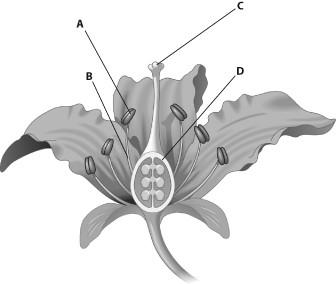
Label Key:
A: Stigma
B: Style
C: Ovary
D: Anther
Alternation of Generations
Plants exhibit alternation of generations, a life cycle that alternates between a multicellular haploid gametophyte and a multicellular diploid sporophyte.
Gametophyte: Produces gametes by mitosis.
Sporophyte: Produces spores by meiosis.
Example: In flowering plants, the dominant generation is the sporophyte.
Adaptations for Terrestrial Life
Plants have evolved several structures to survive on land:
Cuticle: Waxy layer that prevents water loss.
Stomata: Pores for gas exchange, regulated by guard cells.
Vascular Tissue: Xylem and phloem for transport of water, minerals, and sugars.
Lignin: Strengthens cell walls for structural support.
Cellular Respiration and Photosynthesis
Chemical Equations
Cellular Respiration:
Photosynthesis:
Steps of Cellular Respiration
Glycolysis: Occurs in the cytoplasm; breaks glucose into pyruvate; produces ATP and NADH; anaerobic.
Citric Acid Cycle (Krebs Cycle): Occurs in the mitochondrial matrix; completes the breakdown of glucose; produces ATP, NADH, FADH2, and CO2; aerobic.
Oxidative Phosphorylation (Electron Transport Chain & Chemiosmosis): Occurs in the inner mitochondrial membrane; uses NADH and FADH2 to produce ATP; aerobic.
Steps of Photosynthesis
Light Reactions: Occur in the thylakoid membranes; convert light energy to chemical energy (ATP and NADPH); produce O2 as a by-product.
Calvin Cycle: Occurs in the stroma; uses ATP and NADPH to convert CO2 into glucose; does not require light directly.
Genetics and Inheritance
DNA Structure and Function
DNA is a double helix composed of nucleotides. It stores genetic information and directs the synthesis of proteins.
Nucleotide: Consists of a phosphate group, deoxyribose sugar, and a nitrogenous base (A, T, C, G).
Base Pairing: A pairs with T, C pairs with G.
Central Dogma of Genetics
The flow of genetic information is described as:
Transcription: DNA is transcribed into mRNA.
Translation: mRNA is translated into a polypeptide (protein).
Mitosis and Meiosis
Mitosis: Cell division producing two genetically identical diploid cells; used for growth and repair.
Meiosis: Cell division producing four genetically unique haploid gametes; used for sexual reproduction.
Evolution and Ecology
Natural Selection and Evolution
Natural selection is the process by which organisms with advantageous traits survive and reproduce more successfully.
Mutation: The ultimate source of genetic variation.
Gene Pool: The total collection of genes in a population.
Speciation: The formation of new species through reproductive isolation and genetic divergence.
Ecological Organization
Population: Group of individuals of the same species in an area.
Community: All populations of different species in an area.
Ecosystem: Community plus the abiotic environment.
Biomes and Biodiversity
Biomes are large ecological areas with distinct climate, flora, and fauna. Biodiversity refers to the variety of life in an area.
Animal Structure and Function
Levels of Organization
Tissue: Group of similar cells performing a specific function.
Organ: Structure composed of multiple tissue types.
Organ System: Group of organs working together.
Homeostasis and Feedback
Homeostasis: Maintenance of a stable internal environment.
Negative Feedback: Mechanism that counteracts changes (e.g., body temperature regulation).
Positive Feedback: Mechanism that amplifies changes (e.g., blood clotting).
Additional info: This guide covers foundational concepts in biology, including cell structure, genetics, evolution, plant and animal physiology, and ecology, as outlined in a typical introductory college biology course.
