 Back
BackControl of Gene Expression in Eukaryotes
Study Guide - Smart Notes
 Tailored notes based on your materials, expanded with key definitions, examples, and context.
Control of Gene Expression in Eukaryotes
Overview of Gene Regulation in Eukaryotes
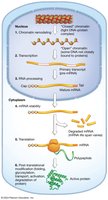
Gene expression in eukaryotes is regulated at multiple levels, allowing cells to respond to internal and external signals with precision. Unique mechanisms in eukaryotes include chromatin remodeling, extensive RNA processing, and complex post-translational modifications.
Chromatin remodeling alters DNA accessibility for transcription.
Transcriptional control involves regulatory elements and transcription factors.
RNA processing includes capping, splicing, and polyadenylation.
mRNA stability and translation control further refine gene expression.
Protein modification and degradation determine protein activity and lifespan.
Chromatin Structure and Remodeling
Chromatin and Nucleosomes
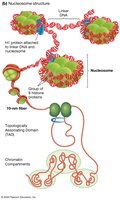
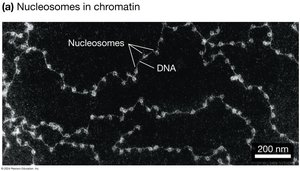
Chromatin is the complex of DNA and proteins (mainly histones) that packages eukaryotic DNA into the nucleus. The basic unit of chromatin is the nucleosome, which consists of DNA wrapped around a histone octamer.
Histones are positively charged proteins that interact with negatively charged DNA.
Nucleosomes help compact DNA and regulate access to genetic information.
Chromatin States: Heterochromatin vs. Euchromatin
Chromatin exists in two main states that influence gene expression:
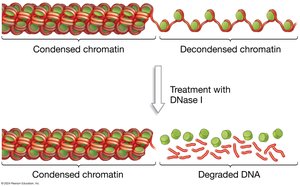
Heterochromatin: Highly condensed, transcriptionally inactive.
Euchromatin: Less condensed, transcriptionally active.
Chromatin must be remodeled from a condensed to a decondensed state for transcription to occur.
Mechanisms of Chromatin Remodeling
Two major chemical modifications regulate chromatin structure and gene accessibility:
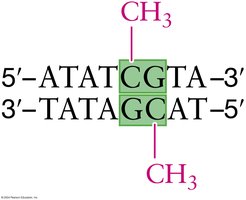
DNA methylation: Addition of methyl groups (–CH3) to cytosine bases, typically silencing gene expression.
Histone acetylation: Addition of acetyl groups to histone tails, usually associated with active transcription.
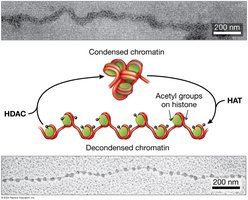
Enzymes: Histone acetyltransferases (HATs) add acetyl groups; histone deacetylases (HDACs) remove them.
Effect: Acetylation loosens chromatin, increasing transcription; deacetylation condenses chromatin, reducing transcription.
Epigenetics
Epigenetics refers to heritable changes in gene expression that do not involve changes to the DNA sequence. DNA methylation and histone modification are key epigenetic mechanisms.
Epigenetic marks can be influenced by environmental factors such as diet, stress, and toxins.
These changes can persist across generations.
Example: Identical twins can have different epigenetic patterns due to different life experiences.
Transcriptional Control in Eukaryotes
Regulatory Elements and Transcription Factors
Transcription in eukaryotes is regulated by DNA sequences called control elements and the proteins that bind them:
Promoter: Core sequence where RNA polymerase binds to initiate transcription.
Enhancers: Distant regulatory sequences that increase transcription when bound by activators.
Silencers: Sequences that repress transcription when bound by repressors.
General transcription factors: Required for the assembly of the transcription initiation complex.

Transcription Initiation in Eukaryotes
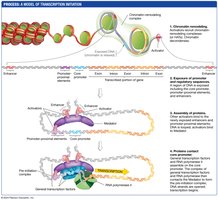
Transcription initiation involves the coordinated assembly of multiple proteins at the promoter:
Chromatin remodeling exposes the promoter region.
Regulatory transcription factors bind enhancers and promoter-proximal elements.
General transcription factors and RNA polymerase II assemble at the core promoter.
Transcription begins when the complex is fully assembled.
RNA Processing Control: Alternative Splicing
Alternative Splicing
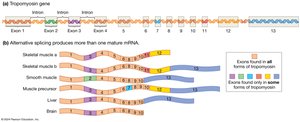
Alternative splicing allows a single gene to produce multiple protein isoforms by varying the combination of exons included in the mature mRNA.
Spliceosomes remove introns and join exons in different arrangements.
This increases protein diversity without increasing gene number.
Example: The tropomyosin gene produces different proteins in muscle and non-muscle cells via alternative splicing.
mRNA Stability: RNA Interference (RNAi)
Mechanism of RNA Interference
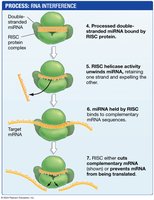
RNA interference (RNAi) is a post-transcriptional regulatory mechanism that uses small RNAs to silence gene expression:
miRNAs (microRNAs) are short, non-coding RNAs that bind to complementary sequences in target mRNAs.
RISC (RNA-induced silencing complex) incorporates miRNAs and mediates gene silencing.
If miRNA is a perfect match: mRNA is cleaved and degraded.
If miRNA is an imperfect match: translation is inhibited without mRNA degradation.
Protein Degradation: Ubiquitin and the Proteasome
Ubiquitin-Proteasome System
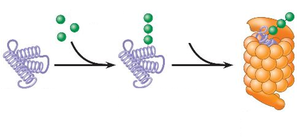
Protein levels are regulated by targeted degradation. Proteins destined for destruction are tagged with ubiquitin, a small protein. The proteasome recognizes ubiquitin-tagged proteins and degrades them into peptides.
This process removes damaged, misfolded, or unneeded proteins.
Regulates the abundance of key regulatory proteins (e.g., cyclins in the cell cycle).
Comparison of Gene Regulation in Bacteria and Eukaryotes
Key Differences and Similarities
Control Mechanism | Bacteria | Eukaryotes |
|---|---|---|
Chromatin Remodeling | No | Yes |
Transcriptional Control | Yes | Yes |
RNA Processing | No | Yes |
mRNA Stability/Interference | Some | Yes |
Protein Degradation (Ubiquitin-Proteasome) | No | Yes |
Summary: Eukaryotes have more complex and multi-layered gene regulation, including chromatin remodeling, alternative splicing, and sophisticated protein degradation systems.
