 Back
Control of Gene Expression in Eukaryotes: Chapter 19 Study Guide
Study Guide - Smart Notes
 Tailored notes based on your materials, expanded with key definitions, examples, and context.
Control of Gene Expression in Eukaryotes
Introduction to Gene Regulation
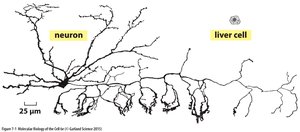
Gene expression in eukaryotes is a highly regulated and complex process, essential for the formation of specialized cell types, tissue organization, and coordinated cellular activity. Differential gene expression allows multicellular organisms to develop diverse cell types from the same genetic material.
Differential gene expression: The process by which cells express different sets of genes, leading to cell specialization.
Multicellular society: Specialized cells work together to form tissues and organs.
Regulation complexity: Eukaryotes have more regulatory mechanisms than prokaryotes.
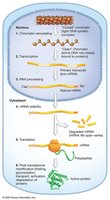
Overview of Gene Regulation in Eukaryotes
Eukaryotic gene expression can be controlled at multiple levels, from DNA to protein. These include transcription, translation, and post-translational modifications, as well as chromatin remodeling, RNA processing, and mRNA stability.
Transcription: Synthesis of RNA from DNA template.
Translation: Synthesis of proteins from mRNA.
Post-translation: Modifications after protein synthesis.
Chromatin remodeling: Changes in DNA packaging to allow or restrict access to genes.
RNA processing: Splicing and modification of RNA transcripts.
mRNA stability: Determines how long mRNA is available for translation.
Chromatin Remodeling
Chromatin Structure
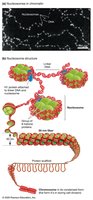
Chromatin is composed of DNA wrapped around histone proteins, forming nucleosomes. This structure allows DNA to fit in the nucleus and plays a key role in gene regulation.
Histones: Most abundant DNA-associated proteins.
Nucleosome: About 200 bases of DNA wrapped around a core of 8 histone proteins.
Histone H1: Causes nucleosomes to interact, forming 30-nm fibers.
Chromatin condensation: Chromosomes become tightly packed before cell division.
Chromatin Territories
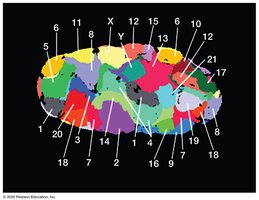
Chromosomes reside in distinct territories within the nucleus, which may influence gene expression by spatially organizing chromatin.
Chromatin Structure and Gene Activity
Active genes require chromatin to be decondensed so that RNA polymerase can access the promoter. DNase treatment experiments show that only decondensed chromatin is accessible to enzymatic cleavage.
DNase: Enzyme that cuts DNA at random locations, but only in decondensed chromatin.
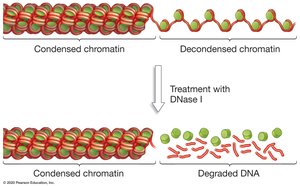
Mechanisms of Chromatin Remodeling
Chromatin remodeling involves DNA methylation, histone modification, and chromatin-remodeling complexes.
DNA methylation: Addition of methyl groups to cytosines, often at CpG sites, leading to chromatin condensation and gene silencing.
Histone modification: Addition of acetyl, methyl, phosphate groups to histones, affecting chromatin state.
Chromatin-remodeling complexes: Molecular machines that use ATP to reposition or remove nucleosomes.
Histone Acetylation and Deacetylation
Acetylation of histones by HATs (histone acetyltransferases) leads to chromatin decondensation and gene activation, while removal by HDACs (histone deacetylases) leads to condensation and gene repression.
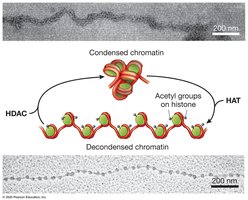
Epigenetic Inheritance
Patterns of chromatin modification can be inherited by daughter cells, influencing gene expression without altering DNA sequence. This is known as epigenetic inheritance.
Epigenetic mechanisms: Include DNA methylation and histone modification.
Phenotype influence: Life events can affect chromatin state and offspring phenotype.
Initiating Transcription
Promoters and Regulatory Sequences
Eukaryotic promoters are more complex than bacterial promoters, containing multiple regulatory sequences. The core promoter often includes a TATA box, where the TATA-binding protein (TBP) initiates transcription.
Promoter-proximal elements: Regulatory sequences close to the promoter, unique to specific gene sets.
Enhancers: Regulatory sequences far from the promoter, can be thousands of bases away, and increase transcription.
Silencers: Similar to enhancers but repress gene expression.

Transcription Factors and Differential Expression
Transcription factors are proteins that bind to regulatory DNA sequences, controlling gene expression. Activators promote transcription, while repressors inhibit it. Different cell types express different transcription factors, leading to differential gene expression.
Transcription factor recognition: DNA bases are exposed in grooves, allowing specific binding.
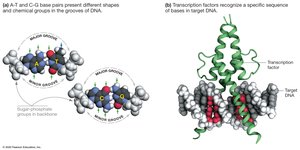
Model for Transcription Initiation
Transcription initiation in eukaryotes involves multiple steps, including chromatin remodeling, activator binding, DNA looping, and assembly of general transcription factors and RNA polymerase.
Step 1: Activators recruit chromatin-remodeling complexes and HATs.
Step 2: Chromatin opens, exposing promoter and regulatory sequences.
Step 3: Activators bind enhancers and promoter-proximal elements; DNA loops for mediator interaction.
Step 4: General transcription factors and RNA polymerase assemble for transcription initiation.
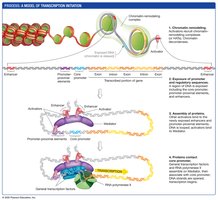
Post-Transcriptional Control
Alternative Splicing
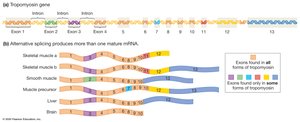
Alternative splicing allows a single gene to produce multiple mRNA variants, leading to different proteins in different cell types. Over 90% of human genes undergo alternative splicing.
Spliceosomes: Protein complexes that mediate splicing.
Example: Tropomyosin gene produces different proteins in muscle and liver cells.
mRNA Stability and RNA Interference
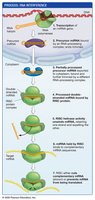
mRNA stability affects how long transcripts are available for translation. RNA interference (RNAi) uses small RNAs, such as microRNAs (miRNAs), to regulate mRNA lifespan and translation.
miRNA: Binds to complementary mRNA, leading to degradation or translation inhibition.
siRNA and piRNA: Protect against viruses and transposable elements.
Post-Translational Control
Post-translational regulation allows rapid cellular responses by modifying proteins after translation. Mechanisms include phosphorylation, ubiquitination, and proteasome-mediated degradation.
Protein kinases: Add phosphate groups to proteins.
Ubiquitin: Tags proteins for destruction by proteasomes.
Gene Regulation and Cancer
Genetic Basis of Uncontrolled Cell Growth
Cancer results from mutations in genes that regulate the cell cycle. Tumor suppressors inhibit cell division, while proto-oncogenes promote it. Mutations can convert proto-oncogenes to oncogenes, leading to uncontrolled growth.
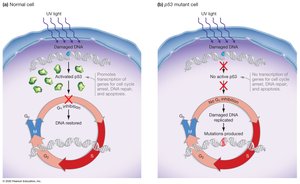
p53: A tumor suppressor transcription factor; mutations in p53 are found in over half of human cancers.
DNA damage response: p53 arrests cell cycle, repairs DNA, or triggers apoptosis.
Comparison of Gene Expression in Bacteria and Eukaryotes
Gene expression in eukaryotes is more complex than in bacteria due to chromatin structure, transcriptional complexity, lack of operons, and greater reliance on post-transcriptional control.
DNA packaging: Chromatin provides negative control in eukaryotes.
Transcription complexity: Eukaryotic transcription initiation is more elaborate.
Coordinated transcription: Bacteria use operons; eukaryotes do not.
Post-transcriptional control: More prominent in eukaryotes.
