 Back
Control of Microbial Growth and Antimicrobial Drugs: Principles and Applications
Study Guide - Smart Notes
 Tailored notes based on your materials, expanded with key definitions, examples, and context.
Control of Microbial Growth
Microbial Death Rates
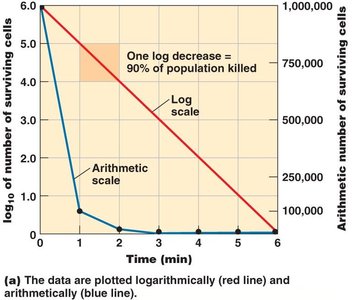
Microbial death occurs at a constant rate when exposed to antimicrobial treatments. Understanding the kinetics of microbial death is essential for designing effective sterilization and disinfection protocols.
Death Rate: The rate at which microbes are killed is often logarithmic, meaning a constant percentage of the population dies per unit time.
Log Reduction: A one-log decrease corresponds to a 90% reduction in the microbial population.
Arithmetic vs. Logarithmic Scale: Death rates are best visualized on a logarithmic scale, which shows a straight line for constant percentage killing.
Time (min) | Deaths per Minute | Number of Survivors |
|---|---|---|
0 | 0 | 1,000,000 |
1 | 900,000 | 100,000 |
2 | 90,000 | 10,000 |
3 | 9,000 | 1,000 |
4 | 900 | 100 |
5 | 90 | 10 |
6 | 9 | 1 |
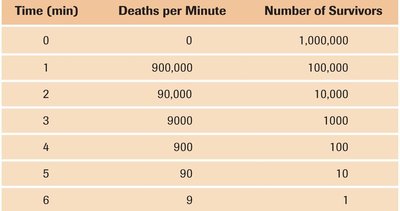
Example: If you start with 1,000,000 bacteria and apply a treatment that kills 90% per minute, after 6 minutes only 1 bacterium remains.
Factors Influencing Effectiveness of Antimicrobial Treatments
Several factors determine how effective an antimicrobial treatment will be:
Number of Microbes: Larger populations take longer to eliminate.
Environmental Influences: Organic matter (e.g., blood, vomitus, feces) can protect microbes from chemical agents.
Time of Exposure: Some agents require prolonged contact to be effective.
Microbial Characteristics: Endospores, mycobacteria, and other resistant forms require more rigorous treatment.
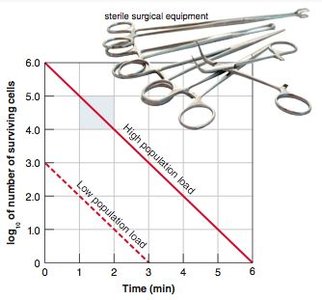
Example: Surgical instruments with a high microbial load require longer sterilization times than those with a low load.
Methods of Microbial Control
Physical Methods
Physical methods control microbial growth by targeting essential cellular components or processes.
Oxidization: Dry heat (e.g., flaming) kills by oxidizing cellular components.
Size: Filtration removes microbes from liquids and air by size exclusion.
Mutation: Radiation (ionizing and UV) damages DNA, leading to cell death.
Protein Denaturation: Moist heat (autoclaving, pasteurization), high pressure, and some chemicals denature proteins, inactivating microbes.
Metabolism Inhibition: Desiccation, osmotic pressure, refrigeration, and freezing inhibit microbial metabolism and growth.
Example: Autoclaving sterilizes by denaturing proteins with moist heat and pressure.
Chemical Methods
Chemical agents control microbes by disrupting membranes, denaturing proteins, or inhibiting metabolism.
Damage to Membranes: Phenolics, bisphenols, biguanides, and surfactants disrupt cell membranes.
Protein Denaturation: Alcohols, aldehydes, halogens, heavy metals, and gaseous sterilants denature proteins.
Metabolism Inhibition: Organic acids and nitrates inhibit microbial metabolism, often used as preservatives.
Example: Ethanol denatures proteins and dissolves lipids but is ineffective against endospores.
Antimicrobial Drugs (Chemotherapies)
History and Sources
The development of antimicrobial drugs revolutionized medicine. Early examples include Salvarsan for syphilis and penicillin for bacterial infections. Most antibiotics are derived from bacteria and fungi.
Microorganism | Antibiotic |
|---|---|
Bacillus subtilis | Bacitracin |
Streptomyces griseus | Streptomycin |
Penicillium chrysogenum | Penicillin |
Cephalosporium spp. | Cephalothin |
Streptomyces fradiae | Neomycin |
Streptomyces venezuelae | Chloramphenicol |
Example: Penicillin was discovered by Alexander Fleming from the mold Penicillium.
Classification and Mechanisms of Action
Antimicrobial drugs are classified by their spectrum (broad or narrow) and mechanism of action:
Inhibition of Cell Wall Synthesis: Penicillins, cephalosporins, bacitracin, vancomycin, isoniazid, ethambutol.
Inhibition of Protein Synthesis: Aminoglycosides, tetracyclines, chloramphenicol, macrolides, streptogramins.
Inhibition of Nucleic Acid Synthesis: Rifamycins, quinolones.
Injury to Plasma Membrane: Polymyxins, daptomycin.
Inhibition of Essential Metabolite Synthesis: Sulfonamides (folic acid synthesis inhibitors).
Example: Sulfonamides inhibit folic acid synthesis, which is essential for bacterial growth but not for humans.
Antimicrobial Resistance
Resistance arises through genetic mutations and horizontal gene transfer (plasmids, transposons). Misuse of antibiotics accelerates resistance development.
Mechanisms of Resistance:
Enzymatic destruction of the drug (e.g., β-lactamase).
Prevention of drug penetration.
Alteration of drug target site.
Rapid ejection (efflux) of the drug.
Prevention: Proper use of antibiotics, completing prescribed regimens, and limiting use in agriculture.
Example: MRSA (methicillin-resistant Staphylococcus aureus) is resistant to many β-lactam antibiotics.
Testing Effectiveness of Chemotherapies
Laboratory tests determine the minimal inhibitory concentration (MIC) and minimal bactericidal concentration (MBC) of drugs.
Disk Diffusion Method: Measures zone of inhibition around antibiotic disks.
E-Test: Determines MIC using a gradient strip.
Broth Dilution Test: Determines MIC and MBC by serial dilution in broth.
Classes of Antimicrobial Drugs
Antibacterial Drugs
Cell Wall Synthesis Inhibitors: Penicillins, cephalosporins, carbapenems, monobactams, bacitracin, vancomycin, isoniazid, ethambutol.
Protein Synthesis Inhibitors: Aminoglycosides, tetracyclines, chloramphenicol, macrolides, streptogramins.
Nucleic Acid Synthesis Inhibitors: Rifamycins, quinolones.
Plasma Membrane Disruptors: Polymyxins.
Metabolite Synthesis Inhibitors: Sulfonamides.
Antifungal Drugs
Plasma Membrane Targeting: Amphotericin B, azoles, allylamines (target ergosterol synthesis).
Cell Wall Synthesis Inhibitors: Echinocandins (inhibit β-glucan synthesis).
Nucleic Acid Synthesis Inhibitors: Flucytosine.
Cytoskeleton Inhibitors: Griseofulvin (inhibits microtubule formation).
Antiviral Drugs
Nucleoside/Nucleotide Analogs: Acyclovir (inhibits viral DNA polymerase).
Enzyme Inhibitors: Protease inhibitors, integrase inhibitors, entry/fusion inhibitors, uncoating inhibitors.
Interferons: Proteins that inhibit viral replication and spread.
Antiprotozoal and Antihelminthic Agents
Antiprotozoal: Quinine and derivatives (inhibit DNA synthesis in malaria), metronidazole (damages DNA).
Antihelminthic: Niclosamide (prevents ATP generation), praziquantel (alters membrane permeability), mebendazole (inhibits nutrient absorption), ivermectin (paralyzes worms).
Summary Table: Mechanisms of Antimicrobial Action
Mechanism | Example Drugs | Target |
|---|---|---|
Cell Wall Synthesis Inhibition | Penicillins, Vancomycin | Peptidoglycan |
Protein Synthesis Inhibition | Tetracyclines, Macrolides | Ribosomes |
Nucleic Acid Synthesis Inhibition | Quinolones, Rifamycins | DNA/RNA Polymerases |
Plasma Membrane Disruption | Polymyxins, Amphotericin B | Membrane Integrity |
Metabolite Synthesis Inhibition | Sulfonamides | Folic Acid Pathway |
Antimicrobial Resistance: Evolution and Prevention
Antibiotic resistance is a major public health concern. Resistance genes can spread rapidly among bacteria, especially under selective pressure from antibiotic misuse.
Evolutionary Mechanisms: Mutation and horizontal gene transfer increase diversity; natural selection and genetic drift reduce diversity.
Prevention Strategies: Judicious use of antibiotics, infection control, and development of new drugs.
Example: The use of antibiotics in animal feed has contributed to the rise of resistant bacteria.
Key Equations
Logarithmic Death Rate: where is the number of survivors at time , is the initial number, and is the death rate constant.
Additional info: This guide covers core concepts from General Biology related to microbial control, antimicrobial drugs, and resistance, integrating academic context for clarity and exam preparation.
