 Back
BackDarwinian Evolution, Populations, and Mechanisms of Evolution
Study Guide - Smart Notes
 Tailored notes based on your materials, expanded with key definitions, examples, and context.
Darwinian Evolution
Darwin’s Observations and Conclusions
Charles Darwin’s theory of evolution by natural selection is based on several key observations and logical conclusions about the natural world. These ideas are interconnected and form the foundation of modern evolutionary biology.
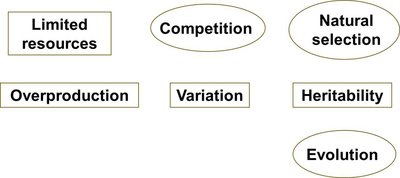
Observation: Overproduction – More individuals are produced than can survive in the environment, leading to competition for limited resources.
Observation: Limited Resources – Resources such as food, water, and shelter are finite, creating competition among individuals.
Observation: Variation – Individuals within a population vary in their traits; no two are exactly alike.
Observation: Heritability – Traits can be inherited from parents to offspring.
Conclusion: Competition – Because of overproduction and limited resources, individuals must compete for survival.
Conclusion: Natural Selection – Individuals with traits best suited to their environment are more likely to survive and reproduce.
Conclusion: Evolution – Over generations, populations change as advantageous traits become more common.
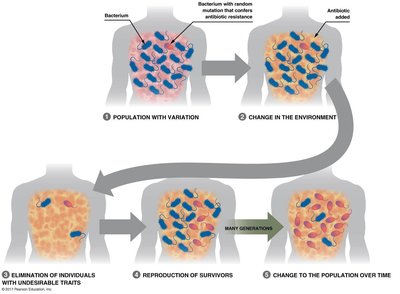
Example: Antibiotic resistance in bacteria demonstrates natural selection, where only resistant individuals survive and reproduce in the presence of antibiotics.
Key Points about Evolution
Individuals do not evolve; populations evolve over time.
Natural selection acts on heritable traits – Only traits encoded in genes are subject to selection.
Evolution is not goal-directed – It occurs in response to current environmental conditions, not future needs.
Populations: The Unit of Evolution
Definition and Characteristics of Populations
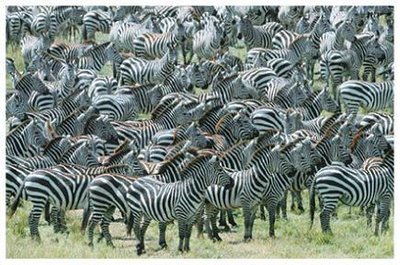
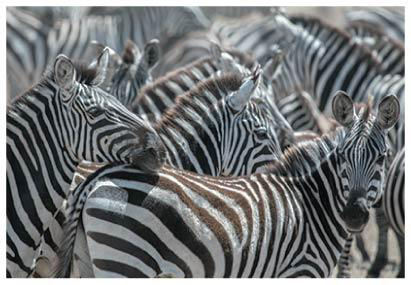
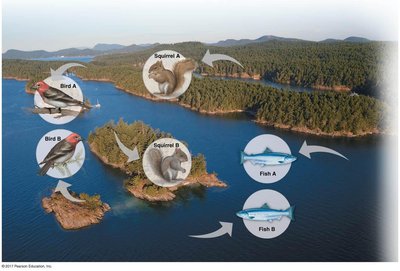
A population is a group of individuals of the same species living in the same place at the same time. Members of a population are capable of meeting and mating, sharing a common gene pool.
Gene Pool – The collection of all gene versions (alleles) in a population.
Genetic Variation – Arises through mutation and sexual reproduction, ensuring diversity within the population.
Microevolution: Changes in the Gene Pool
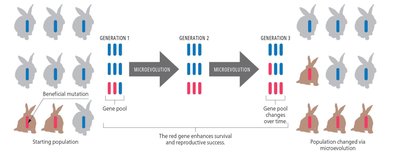
Microevolution refers to generation-to-generation changes in the gene pool of a population, representing evolution on its smallest scale.
Traits that enhance survival and reproduction increase in frequency in the gene pool.
Microevolution can lead to adaptation of species to their local environment over many generations.
Mechanisms of Evolution
Natural Selection
Natural selection is the primary mechanism driving changes in the gene pool. Individuals with higher evolutionary fitness contribute more to the next generation.
Evolutionary Fitness – The relative contribution an individual makes to the gene pool compared to others.
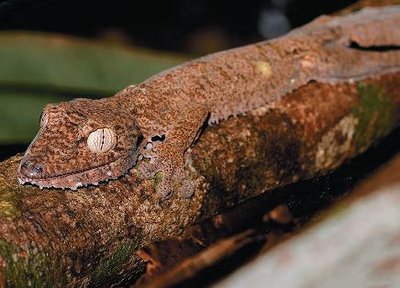
Adaptations – Traits that improve fitness, such as camouflage.
Sources of Genetic Variation
Mutation – Random changes to DNA can create new genes.
Sexual Reproduction – Chromosomes can exchange pieces of DNA during gamete formation, shuffling alleles.
Other Mechanisms of Evolution
Genetic Drift – Changes in the gene pool due to chance alone, especially important in small or isolated populations.
Bottleneck Effect – Drastic reduction in population size leads to loss of genetic diversity.
Founder Effect – A few individuals colonize a new habitat, leading to a new gene pool.
Gene Flow – Genetic exchange among populations due to migration, reducing differences among gene pools.
Sexual Selection – Individuals compete for mates, and traits that enhance mating success become more common.
Speciation and the Origin of Species
What is a Species?
The most common definition of a species is a population capable of interbreeding to produce healthy, fertile offspring. However, this definition does not fit all organisms, such as those that reproduce asexually or extinct species.
Reproductive Barriers
Reproductive barriers prevent members of different species from breeding, maintaining species integrity.
Behavioral Isolation – Specific rituals identify members of a species.
Temporal Isolation – Mating occurs at specific times.
Habitat Isolation – Species live in different habitats.
Anatomical Incompatibility – Physical differences prevent mating.
Gametic Incompatibility – Sperm and egg cannot fertilize each other.
Hybrid Weakness – Offspring may be unfit or sterile.
How Do New Species Arise?
Speciation occurs when one ancestral species evolves into one or more new species, often due to separation by time, space, or genetics.
Gradual Model – Species acquire small adaptations over millions of years.
Punctuated Equilibrium Model – Periods of stasis are interrupted by bursts of speciation.
Allopatric Speciation – Physical barriers isolate populations, leading to new species.
Sympatric Speciation – New species arise without geographic isolation, often due to genetic changes.
Evolution of Eukaryotes and Plants
Evolution of Eukaryotes
Prokaryotes were the only cell type for the first 1.4 billion years of life. Eukaryotes evolved about 2 billion years ago, distinguished by internal membrane systems and organelles.
Endomembrane System – Consists of interconnected internal membranes and membrane-enclosed organelles.
Endosymbiosis – Mitochondria and chloroplasts likely originated from one species living inside another.
Evolution of Plants
Modern plants evolved adaptations for living on land, including a waxy outer layer, vascular tissue, seeds, and flowers.
Major Groups – Bryophytes, seedless vascular plants, gymnosperms, angiosperms.
Adaptations – Waxy cuticle, vascular tissue, seeds, flowers.
Human Evolution
Humans in the Tree of Life
Humans belong to the phylum Chordata and the order Primates. Primate characteristics include large brains, binocular vision, limber joints, complex behaviors, and extended parental care.
Timeline of Human Evolution
Australopithecus afarensis – Earliest known hominin to display upright posture.
Homo habilis – Intermediate brain size, evidence for tool use.
Homo erectus – First hominin species to migrate out of Africa.
Homo neanderthalensis – Not direct relatives of Homo sapiens, but interbred.
Homo sapiens – Our species, spread globally.
Important Points: Humans did not evolve from chimps; we share a common ancestor. Human evolution is not a linear procession, and key features evolved separately.
History of Life on Earth
If the history of life on Earth were compressed into a 24-hour day, Homo sapiens would appear less than a second before midnight, highlighting the recency of our species.
Summary Table: Mechanisms of Evolution
Mechanism | Description | Effect on Gene Pool |
|---|---|---|
Natural Selection | Traits that enhance survival and reproduction increase in frequency | Adaptive change |
Genetic Drift | Random changes due to chance | Loss of genetic diversity |
Gene Flow | Exchange of genes between populations | Reduces differences |
Mutation | Random changes in DNA | Creates new alleles |
Sexual Selection | Traits that enhance mating success increase | Non-random change |
Additional info: Academic context was added to clarify mechanisms, definitions, and examples for completeness.
