 Back
BackDefenses Against Disease: The Immune System
Study Guide - Smart Notes
 Tailored notes based on your materials, expanded with key definitions, examples, and context.
Defenses Against Disease
Overview of Body Defenses
The human body is constantly exposed to a variety of pathogens, including bacteria, viruses, fungi, and protozoa. To protect itself, the body employs multiple layers of defense mechanisms, which can be broadly categorized into nonspecific (innate) and specific (adaptive) immunity.
Nonspecific defenses provide immediate, general protection against pathogens.
Specific defenses (the immune system) target particular pathogens with high specificity and memory.
Nonspecific (Innate) Defenses
Physical and Chemical Barriers
The first line of defense includes physical and chemical barriers that prevent pathogen entry.
Skin: Acts as a physical barrier to block pathogen entry.
Mucus membranes: Trap pathogens in the respiratory and digestive tracts.
Secretions: Such as saliva and tears, contain lysozyme, an enzyme that destroys bacterial cell walls.
Cellular and Chemical Defenses
Once pathogens breach barriers, the body relies on cellular and chemical responses.
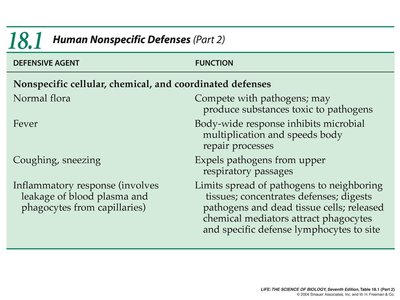
Normal flora: Compete with pathogens and may produce toxic substances.
Fever: Inhibits microbial growth and accelerates repair processes.
Coughing and sneezing: Expel pathogens from respiratory passages.
Inflammatory response: Localizes infection, recruits immune cells, and promotes healing.
Complement Proteins
Complement proteins are a group of about 30 antimicrobial proteins in vertebrates that:
Attach to microbes, enhancing phagocytosis.
Activate inflammation and attract phagocytes.
Lyse invading cells.
Phagocytes
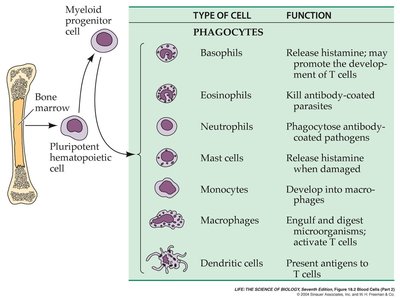
Phagocytes are white blood cells that engulf and digest pathogens. Major types include:
Neutrophils: Attack pathogens in infected tissues.
Monocytes: Mature into macrophages, which are long-lived and consume large numbers of pathogens.
Mast cells: Release histamine, important in inflammation and allergies.
Inflammatory Response
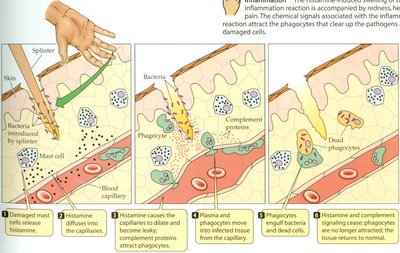
The inflammatory response is a localized reaction to infection or injury.
Damaged cells release histamine, causing blood vessels to dilate and become permeable.
Phagocytes migrate to the site, engulfing pathogens and debris.
Pus may accumulate, composed of dead cells and fluid.
Specific (Adaptive) Immunity: The Immune System
Recognition of Self vs. Non-Self
The immune system distinguishes between the body's own cells (self) and foreign invaders (non-self) primarily through cell-surface proteins, especially major histocompatibility complex (MHC) proteins.
Antibodies: Secreted by B cells, bind specifically to antigens.
T cell receptors: Bind non-self substances on other cells.
MHC proteins: Present on cell surfaces, help distinguish self from non-self.
Cytokines: Signal proteins that modulate immune responses.
Cells of the Immune System
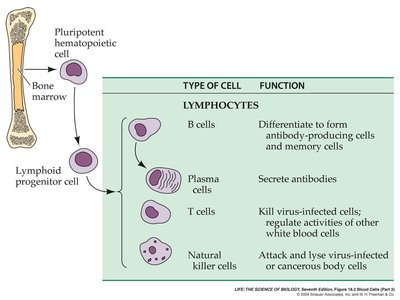
The immune system consists of two main groups of white blood cells:
Phagocytes: Engulf pathogens (see above).
Lymphocytes: Include B cells and T cells, both derived from stem cells in the bone marrow.
Key Characteristics of the Immune System
Specificity: Each immune cell recognizes a specific antigenic determinant (epitope).
Diversity: The immune system can recognize millions of different epitopes.
Self vs. Non-Self Recognition: Prevents attack on the body's own cells.
Immunological Memory: Enables faster, stronger responses upon re-exposure to the same pathogen.
Humoral and Cellular Immune Responses
Humoral immune response: Involves B cells producing antibodies that neutralize pathogens in body fluids.
Cellular immune response: Involves T cells that destroy infected or abnormal cells.

Clonal Selection Theory
Each B cell and T cell is specific to a single antigen. When an antigen binds to its specific lymphocyte, that cell proliferates and differentiates into effector and memory cells. This process explains the specificity and memory of adaptive immunity. 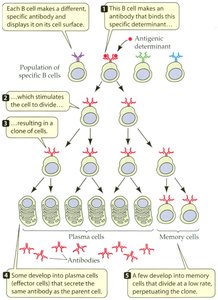
Antibody Structure and Diversity
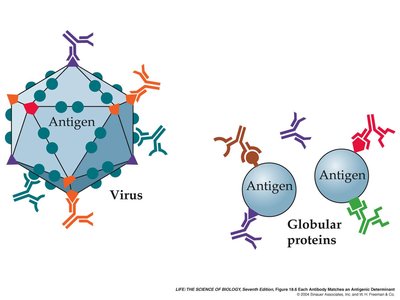
Antibodies (immunoglobulins) are Y-shaped proteins with two heavy and two light chains, each with variable and constant regions. The variable regions determine antigen specificity.
There are five main classes of antibodies; IgG is the most common.
Antibody diversity arises from gene rearrangement during B cell development, allowing the immune system to recognize billions of antigens.
T Cell Receptors and MHC Proteins
T cell receptors (TCRs) are similar to antibodies but recognize antigens only when presented by MHC proteins on cell surfaces.
Class I MHC: Present on all nucleated cells; present antigens to cytotoxic T cells (CD8+).
Class II MHC: Present on antigen-presenting cells (e.g., macrophages, dendritic cells, B cells); present antigens to helper T cells (CD4+).
Immune System Disorders
Autoimmunity: Immune system attacks self (e.g., Type I diabetes, multiple sclerosis, rheumatoid arthritis).
Immunodeficiency: Immune system is weakened (e.g., AIDS caused by HIV infection of CD4+ T cells).
Allergies: Immune response to harmless antigens (allergens), mediated by IgE and histamine release from mast cells.
Vaccination and Immunity
Active immunity: Acquired by exposure to antigen (natural infection or vaccination).
Passive immunity: Acquired by transfer of antibodies (e.g., maternal antibodies, antitoxins).
Vaccines stimulate the production of memory cells, providing long-term protection.
The Microbiome
Not all bacteria are harmful; the human body hosts trillions of beneficial microbes that aid in digestion, protect against pathogens, and influence health. The study of these communities is known as the microbiome.
Summary Table: Key Immune System Components
Component | Function |
|---|---|
Skin & Mucus | Physical barrier, traps pathogens |
Lysozyme | Enzyme that destroys bacterial cell walls |
Phagocytes | Engulf and digest pathogens |
Complement Proteins | Enhance phagocytosis, lyse cells, trigger inflammation |
B cells | Produce antibodies |
T cells | Kill infected cells, regulate immune responses |
MHC Proteins | Present antigens, distinguish self from non-self |
Cytokines | Signal and regulate immune responses |
Key Terms
Antigen: A molecule that elicits an immune response.
Antibody: A protein produced by B cells that binds specifically to an antigen.
Epitope: The specific part of an antigen recognized by the immune system.
Phagocytosis: The process by which cells engulf and digest particles.
Immunological memory: The ability of the immune system to respond more rapidly and effectively to pathogens it has encountered before.
