 Back
Descent with Modification: A Darwinian View of Life
Study Guide - Smart Notes
 Tailored notes based on your materials, expanded with key definitions, examples, and context.
Descent with Modification: A Darwinian View of Life
Introduction to Evolutionary Theory
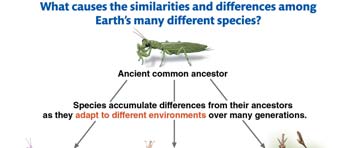
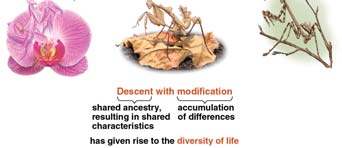
Evolutionary biology explores how life on Earth has changed over time, focusing on the mechanisms that drive the diversity and unity of living organisms. The concept of descent with modification is central to understanding how species evolve and adapt to their environments.
Key Observations About Life
Adaptation: Organisms are adapted to their biotic (living) and abiotic (non-living) environments.
Unity: Many shared characteristics among species illustrate the unity of life.
Diversity: Differences among species highlight the diversity of life.
Historical Foundations of Evolutionary Theory
The development of evolutionary theory was influenced by several key figures and discoveries:
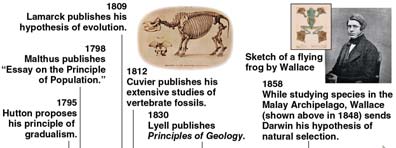
Aristotle: Proposed the scala naturae, a scale of increasing complexity, viewing species as fixed.
Carolus Linnaeus: Developed a classification system and binomial nomenclature for naming species.
Georges Cuvier: Founded paleontology and proposed catastrophism to explain fossil strata.
James Hutton: Introduced the principle of gradualism, suggesting slow geological processes shape Earth.
Charles Lyell: Advocated uniformitarianism, stating that geological processes are constant over time.
Jean-Baptiste Lamarck: Proposed use and disuse and inheritance of acquired characteristics (later rejected).
Thomas Malthus: Published on population growth and its limits.
Alfred Russel Wallace: Independently conceived the theory of natural selection.
Lamarck’s Hypothesis and Its Rejection
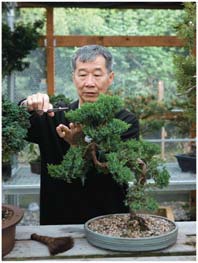
Lamarck suggested that traits acquired during an organism's lifetime could be inherited by offspring. However, experimental evidence has shown that acquired traits, such as the shape of a bonsai tree, are not passed to the next generation.
Darwin’s Voyage and Observations
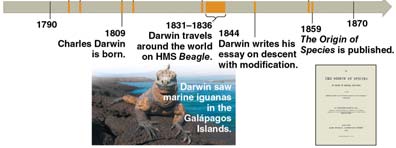
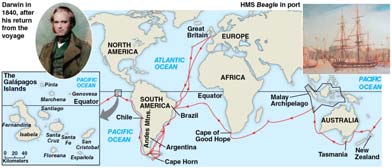
Charles Darwin’s journey on HMS Beagle provided critical insights into the adaptation and distribution of species. His observations in the Galápagos Islands led him to hypothesize that species from South America colonized the islands and diversified.
Adaptation and Speciation
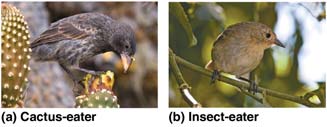
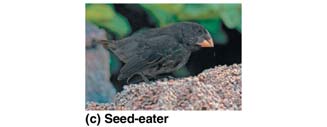
Darwin observed that adaptations are inherited traits that enhance survival and reproduction. The Galápagos finches are a classic example, where different species evolved distinct beak shapes suited to their diets.
Adaptation: Traits that promote survival or reproduction in a specific environment.
Speciation: The formation of new species from ancestral forms through gradual accumulation of adaptations.
Descent with Modification and Natural Selection
Darwin’s theory explains the unity and diversity of life through descent with modification and natural selection:
Descent with Modification: New species originate from ancestral forms, explaining unity and diversity.
Natural Selection: Individuals with favorable traits are more likely to survive and reproduce, leading to adaptive evolution.
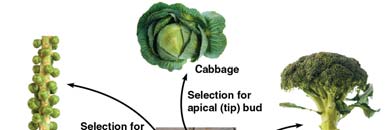
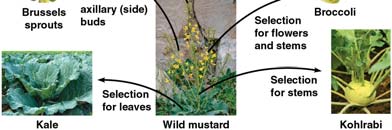
Artificial Selection
Humans have modified species through artificial selection, breeding individuals with desired traits. This process has produced crops and animals that differ significantly from their wild ancestors.
Darwin’s Observations and Inferences
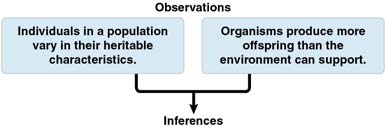
Darwin made two key observations and drew two inferences:
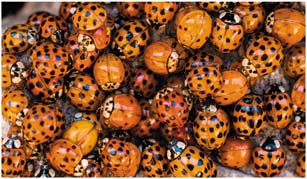
Observation 1: Individuals in a population vary in their heritable traits.
Observation 2: Organisms produce more offspring than the environment can support.
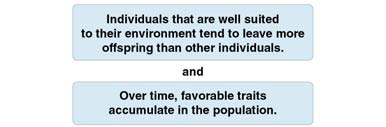
Inference 1: Individuals with traits that increase survival and reproduction tend to produce more offspring.
Inference 2: Favorable traits accumulate in the population over generations.
Key Features of Natural Selection
Individuals with certain heritable traits survive and reproduce at higher rates.
Natural selection increases the frequency of favorable adaptations.
If the environment changes, new adaptations may arise, leading to speciation.
Populations, not individuals, evolve over time.
Natural selection acts only on heritable traits that vary within a population.
Scientific Evidence for Evolution
Multiple lines of evidence support the theory of evolution:
Direct Observations: Evolutionary change observed in response to environmental pressures, such as drug-resistant bacteria.
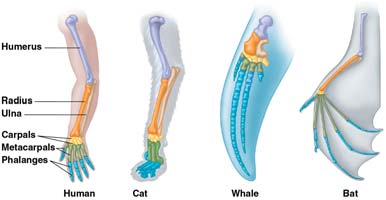
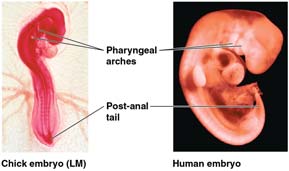
Homology: Similarity resulting from common ancestry, including anatomical and molecular homologies.
Fossil Record: Fossils document the pattern of evolution and reveal extinct species.
Biogeography: Geographic distribution of species provides evidence for evolution.
Homology and Vestigial Structures
Homologous structures are anatomical features shared by related species due to common ancestry, but may serve different functions. Vestigial structures are remnants of features that served a function in ancestors.
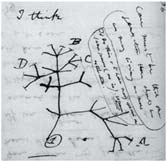
Evolutionary Trees
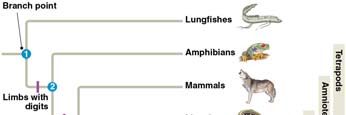
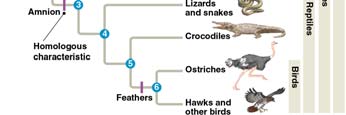
Evolutionary trees illustrate relationships among species based on anatomical and genetic data.
Convergent Evolution
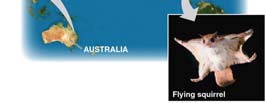
Convergent evolution occurs when distantly related organisms independently evolve similar traits due to adaptation to similar environments. These traits are called analogous, not homologous.

Summary Table: Key Contributors to Evolutionary Theory
Name | Contribution |
|---|---|
Aristotle | Species are fixed; scala naturae |
Linnaeus | Classification system; binomial nomenclature |
Cuvier | Paleontology; catastrophism |
Hutton | Gradualism |
Lyell | Uniformitarianism |
Lamarck | Use and disuse; inheritance of acquired traits (rejected) |
Malthus | Population growth and limits |
Wallace | Natural selection theory |
Darwin | Descent with modification; natural selection |
Key Terms and Definitions
Evolution: Change in the genetic composition of a population over time.
Natural Selection: Process by which individuals with favorable traits are more likely to survive and reproduce.
Adaptation: Inherited trait that enhances survival and reproduction.
Homology: Similarity due to shared ancestry.
Analogous Traits: Similar traits arising independently in different lineages.
Vestigial Structure: Remnant of a feature that served a function in ancestors.
Convergent Evolution: Independent evolution of similar traits in distantly related organisms.
Important Equations
While this chapter does not focus on mathematical equations, the concept of population genetics is central to understanding evolution. The Hardy-Weinberg equation is often used in later chapters:
where p and q represent the frequencies of two alleles in a population.
Summary Checklist
Describe contributions to evolutionary theory by key scientists.
Explain Lamarck’s theories and why they were rejected.
Define "descent with modification" and its significance.
List and explain Darwin’s observations and inferences.
Clarify why individuals do not evolve, but populations do.
Describe homologous and vestigial structures.
Explain convergent evolution and its implications.
