 Back
Descent with Modification: A Darwinian View of Life (Chapter 22 Study Notes)
Study Guide - Smart Notes
 Tailored notes based on your materials, expanded with key definitions, examples, and context.
Descent with Modification: A Darwinian View of Life
Introduction to Evolutionary Biology
Evolutionary biology explores the origins, adaptations, and diversity of life on Earth. The publication of Charles Darwin's The Origin of Species in 1859 marked a scientific revolution, introducing the concept of evolution by natural selection and challenging traditional views of a static, young Earth.
Concept 22.1: The Darwinian Revolution
Historical Context and Influences
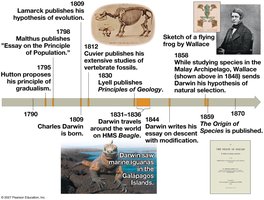
Darwin's ideas developed through the influence of earlier philosophers and scientists, as well as his own observations during his travels. The intellectual context included contributions from Aristotle, Linnaeus, Cuvier, Hutton, Lyell, and Lamarck.
Aristotle: Proposed the scala naturae, a scale of increasing complexity, viewing species as fixed and unchanging.
Carolus Linnaeus: Developed a nested classification system and binomial nomenclature, still used today.
Georges Cuvier: Founded paleontology, observed fossil differences in strata, and proposed catastrophism.
James Hutton & Charles Lyell: Suggested gradual geological processes shape Earth, implying an older planet.
Jean-Baptiste de Lamarck: Proposed evolution via use/disuse and inheritance of acquired traits, though unsupported by evidence.
Fossils and Strata
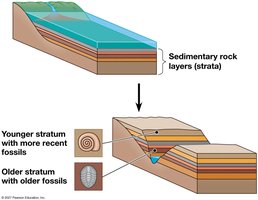
Fossils found in sedimentary rock layers (strata) provide evidence for change over time. Older strata contain fossils less similar to current organisms, supporting the idea of gradual change.
Concept 22.2: Descent with Modification by Natural Selection
Darwin's Voyage and Observations
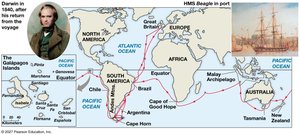
Darwin's five-year voyage on the HMS Beagle allowed him to collect specimens and observe adaptations in plants and animals. He noted similarities between fossils and living species, and unique species on the Galápagos Islands that resembled mainland species.
Adaptation and Natural Selection
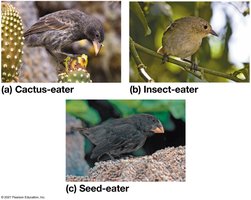
Adaptations are inherited traits that enhance survival and reproduction. Darwin observed beak variations in Galápagos finches, illustrating how new species arise from ancestral forms through gradual accumulation of adaptations.
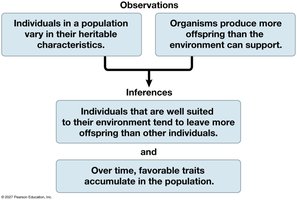
Natural Selection: Individuals with advantageous traits survive and reproduce more, leading to accumulation of favorable traits in populations.
Artificial Selection: Humans breed organisms for desired traits, demonstrating the power of selection.
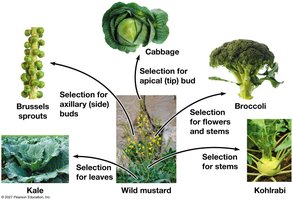
Key Features of Natural Selection
Individuals do not evolve; populations evolve over generations.
Natural selection acts on heritable variation within populations.
Environmental changes can drive adaptation and speciation.
Concept 22.3: Evidence for Evolution
Direct Observations
Evolutionary change has been documented in thousands of studies. Examples include natural selection in response to introduced species and the evolution of drug-resistant bacteria.
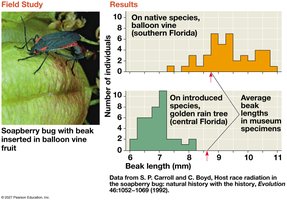
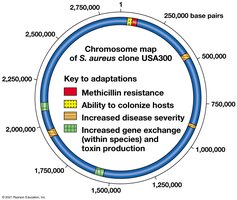
Homology
Homology refers to similarity due to common ancestry. Anatomical homologies, such as mammalian forelimbs, and molecular homologies, like shared genes, provide strong evidence for evolution.
Homologous Structures: Variations on a structural theme present in a common ancestor.
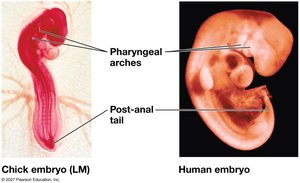
Comparative Embryology: Reveals homologies not visible in adults, such as pharyngeal arches and post-anal tails in vertebrate embryos.
Vestigial Structures: Remnants of features that served functions in ancestors.
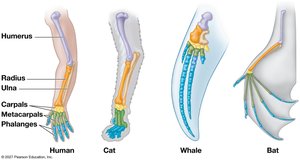
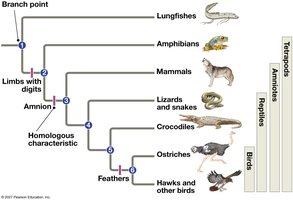
Evolutionary Trees and Tree Thinking
Evolutionary trees illustrate relationships among groups based on homologies. Branch points represent common ancestors, and nested patterns reflect evolutionary history.
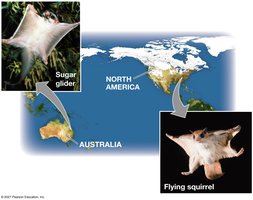
Convergent Evolution
Convergent evolution occurs when distantly related groups independently evolve similar traits due to adaptation to similar environments. These traits are analogous, not homologous.
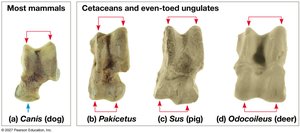
The Fossil Record
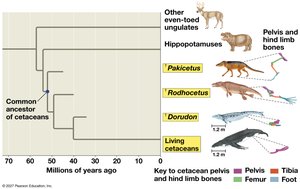
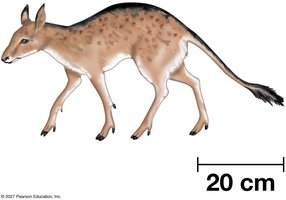
The fossil record documents extinction, origin of new groups, and changes within groups. It supports hypotheses about evolutionary relationships, such as the link between cetaceans and even-toed ungulates.
Biogeography
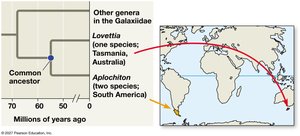
Biogeography studies the geographic distribution of species. Continental drift and modern distributions help explain evolutionary history, such as related freshwater fish separated by oceans.
Summary Table: Key Concepts of Natural Selection
Observation | Inference |
|---|---|
Individuals in a population vary in their heritable characteristics. | Individuals well suited to their environment leave more offspring. |
Organisms produce more offspring than the environment can support. | Favorable traits accumulate in the population over time. |
Key Terms and Definitions
Evolution: The process by which species accumulate differences from their ancestors as they adapt to different environments over time.
Natural Selection: The mechanism by which individuals with advantageous traits survive and reproduce more than others.
Homology: Similarity due to shared ancestry.
Convergent Evolution: Independent evolution of similar traits in distantly related groups.
Biogeography: The study of the geographic distribution of species.
Fossil Record: The collection of fossils that provides evidence for evolutionary change.
Equations and Models
While this chapter is primarily conceptual, mathematical models are used in population genetics and evolutionary biology. For example, the Hardy-Weinberg equation describes allele frequencies in a population:
$p^2 + 2pq + q^2 = 1$
Where p and q are the frequencies of two alleles in a population.
