 Back
Descent with Modification: A Darwinian View of Life (Chapter 22 Study Notes)
Study Guide - Smart Notes
 Tailored notes based on your materials, expanded with key definitions, examples, and context.
Descent with Modification: A Darwinian View of Life
Introduction to Evolutionary Biology
Evolutionary biology explores the mechanisms and patterns that explain the similarities and differences among Earth's diverse species. The concept of descent with modification was introduced by Charles Darwin, marking a scientific revolution in understanding life’s diversity. This chapter examines the unity and diversity of life, the process of evolution, and the evidence supporting evolutionary theory.
Key Observations About Life
Adaptation: Organisms are adapted to their biotic (living) and abiotic (non-living) environments.
Unity: Many shared characteristics among species illustrate the unity of life.
Diversity: Life exhibits remarkable diversity, with species differing in size, shape, and color.

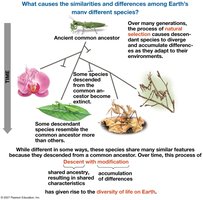
What Causes Similarities and Differences Among Species?
Species share similarities due to common ancestry and differ due to adaptations to various environments. Over generations, natural selection causes descendant species to diverge and accumulate differences.
Pattern: Scientific data reveal that life has evolved over time.
Process: Mechanisms such as natural selection drive evolutionary change.
Intellectual Context of Darwin’s Ideas
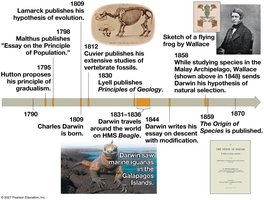
Darwin’s theory was influenced by prior scientific works and his own observations during the voyage of the HMS Beagle. Key contributors included Lamarck, Malthus, Cuvier, Lyell, and Wallace.
Lamarck: Proposed early ideas about evolution.
Malthus: Discussed population growth and resource limitations.
Cuvier: Studied fossils and extinction.
Lyell: Introduced principles of geology and gradualism.
Wallace: Independently conceived natural selection.
Fossils and Sedimentary Rock
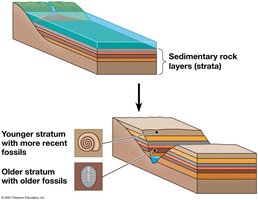
Fossils, the remains or traces of ancient organisms, are often found in sedimentary rock layers called strata. These layers provide a chronological record of life’s history.
Younger strata: Contain more recent fossils.
Older strata: Contain older fossils.
Acquired Traits and Inheritance
Acquired traits, such as those developed during an organism’s lifetime, cannot be inherited. Only genetic traits passed from parents to offspring contribute to evolutionary change.

Darwin’s Voyage and Observations
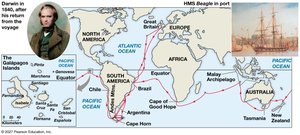
Darwin’s five-year voyage on the HMS Beagle allowed him to collect specimens and observe similarities and differences among species, especially on the Galápagos Islands. He hypothesized that mainland species colonized the islands and diversified.
Galápagos Finches: Example of Adaptive Radiation
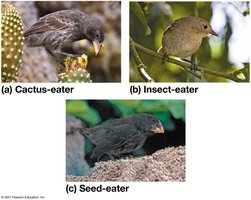
Darwin observed that finches on the Galápagos Islands had different beak shapes suited to their diets, illustrating how new species arise from ancestral forms through gradual accumulation of adaptations.
Cactus-eater: Long, sharp beak for eating cactus.
Insect-eater: Narrow, pointed beak for catching insects.
Seed-eater: Thick, robust beak for cracking seeds.
Darwin’s Theory of Natural Selection
Natural selection is the process by which individuals with certain inherited traits survive and reproduce at higher rates. Darwin and Wallace independently developed this concept, which explains adaptation, unity, and diversity of life.
Descent with Modification and the Tree of Life
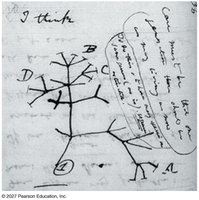
All organisms are related by descent from a common ancestor. Evolutionary history is depicted as a branching tree, with labeled branches representing living groups and unlabeled branches representing extinct groups.
Artificial Selection
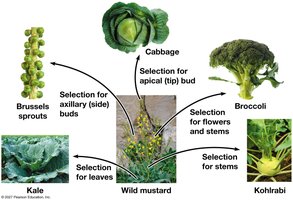
Humans modify species through artificial selection, breeding individuals with desired traits. This process has produced crops, livestock, and pets that differ significantly from their wild ancestors.
Darwin’s Observations and Inferences
Observation 1: Members of a population vary in their inherited traits.
Observation 2: All species produce more offspring than the environment can support; many fail to survive and reproduce.
Inference 1: Individuals with traits that increase survival and reproduction produce more offspring.
Inference 2: Favorable traits accumulate in the population over generations.
Variation and Overproduction
Variation in populations and overproduction of offspring are key factors in natural selection. Only heritable traits can be acted upon by natural selection.
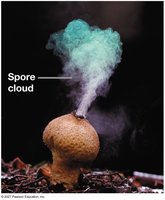
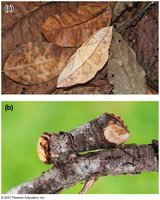
Evolutionary Adaptation: Camouflage
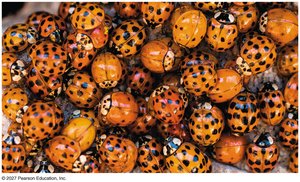
Camouflage is an example of evolutionary adaptation, where organisms develop traits that help them avoid predators or increase survival.
Population-Level Evolution
Evolution occurs at the population level, not the individual. Natural selection acts on heritable variation, and environmental changes can drive adaptation and speciation.
Evidence for Evolution
Four types of data document the pattern of evolution:
Direct observations: Evolutionary change observed in scientific studies.
Homology: Similarity due to common ancestry.
Fossil record: Evidence of extinction, origin of new groups, and changes within groups.
Biogeography: Geographic distribution of species.
Evolution of Drug-Resistant Bacteria
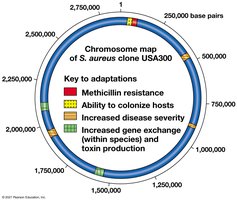
Staphylococcus aureus, including methicillin-resistant strains (MRSA), demonstrates rapid evolution in response to antibiotics. Resistance spreads through gene exchange, and new antibiotics are needed to combat resistant pathogens.
Homology: Anatomical and Embryological Evidence
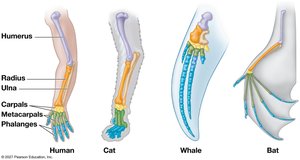
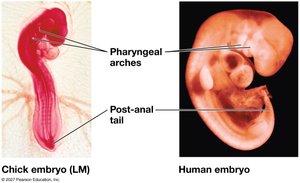
Homologous structures are anatomical similarities that reflect common ancestry. Comparative embryology reveals homologies not visible in adults, such as post-anal tails and pharyngeal arches in vertebrate embryos.
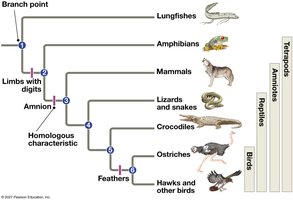
Evolutionary Trees and Nested Patterns
Evolutionary trees are diagrams that hypothesize relationships among groups. Homologies form nested patterns, and relatedness is determined by common ancestry.
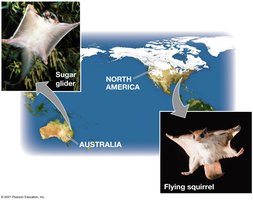
Convergent Evolution and Analogous Traits
Convergent evolution occurs when distantly related groups independently evolve similar traits due to adaptation to similar environments. Analogous traits arise without common ancestry.
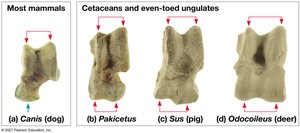
The Fossil Record and Evolutionary History
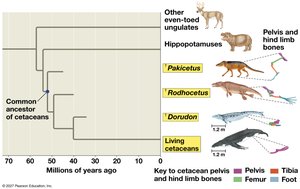
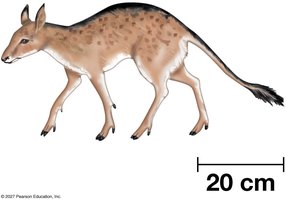
The fossil record documents extinction, origin of new groups, and evolutionary changes. Fossil evidence supports hypotheses about relationships, such as cetaceans and even-toed ungulates.
Biogeography and Continental Drift
Biogeography studies the geographic distribution of species. Continental drift has influenced species distributions and helps predict evolutionary history.
Scientific Theory and Ongoing Research
In science, a theory integrates many observations and data to explain phenomena. Darwin’s theory of evolution by natural selection continues to stimulate research and expand our understanding of biology.
Summary Table: Types of Evidence for Evolution
Type of Evidence | Description | Example |
|---|---|---|
Direct Observation | Evolutionary change observed in real time | Drug-resistant bacteria |
Homology | Similarity due to common ancestry | Mammalian forelimbs |
Fossil Record | Chronological record of extinct and living species | Cetacean fossils |
Biogeography | Distribution of species influenced by continental drift | Galaxiidae fish in South America and Australia |
Additional info: These notes expand on brief points with academic context, definitions, and examples to provide a comprehensive study guide for exam preparation.
