 Back
Descent with Modification: A Darwinian View of Life – Study Notes
Study Guide - Smart Notes
 Tailored notes based on your materials, expanded with key definitions, examples, and context.
Descent with Modification: A Darwinian View of Life
Introduction to Evolutionary Biology
Evolutionary biology explores how species change over time, leading to the diversity and unity of life observed today. The concept of descent with modification is central to understanding how organisms adapt and evolve.
Darwinian Revolution and Historical Context
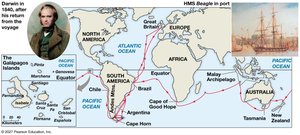
The publication of The Origin of Species by Charles Darwin in 1859 marked a scientific revolution. Darwin's ideas were influenced by earlier works and his own observations during his voyage on the HMS Beagle.
Scala Naturae: Aristotle's scale of increasing complexity, viewing species as fixed.
Linnaean Classification: Carolus Linnaeus developed a nested classification system and binomial nomenclature, still used today.
Gradualism: James Hutton and Charles Lyell proposed that slow, continuous geological processes shape Earth, suggesting an older planet.
Lamarck's Hypothesis: Proposed use and disuse and inheritance of acquired characteristics, but lacked experimental support.
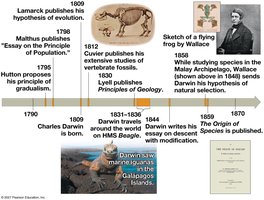
Fossils and Evidence for Change Over Time
Fossils found in sedimentary rock strata provide evidence for the extinction and emergence of species, supporting the idea that life changes over time.
Paleontology: Developed by Georges Cuvier, who observed differences in fossils from different strata.
Strata: Layers of sedimentary rock, with older fossils found in deeper layers.
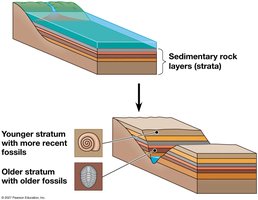
Darwin’s Voyage and Observations
Darwin’s five-year voyage on the HMS Beagle provided critical observations. He noted similarities between fossils and living species, and the unique species of the Galápagos Islands.
Adaptations: Inherited traits that enhance survival and reproduction.
Galápagos Finches: Variations in beak shape illustrate adaptation to different food sources.
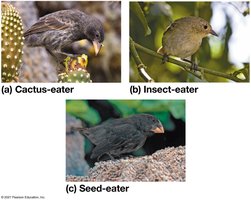
Descent with Modification and Evolutionary Trees
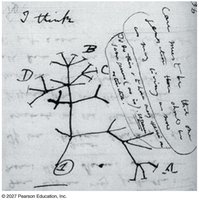
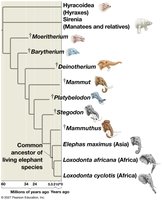
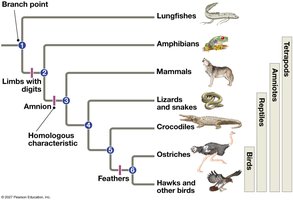
Darwin described life as a branching tree, with all organisms related by descent from a common ancestor. Branching and extinction events explain morphological gaps between groups.
Common Ancestor: All living organisms share a common ancestor.
Evolutionary Tree: Diagram showing relationships and divergence among species.
Artificial Selection, Natural Selection, and Adaptation
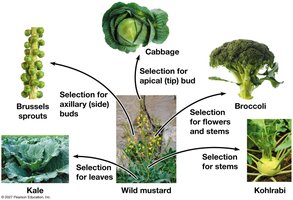
Humans modify species through artificial selection, while natural selection is the process by which favorable traits increase in frequency in a population.
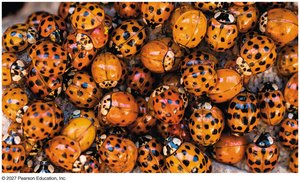
Observations: Populations vary in inherited traits; more offspring are produced than can survive.
Inferences: Individuals with advantageous traits produce more offspring; favorable traits accumulate over generations.
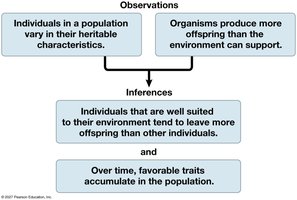
Key Features of Natural Selection
Natural selection acts on heritable traits, increasing the frequency of adaptations favorable in a given environment. Populations, not individuals, evolve over time.
Adaptation: Traits that improve survival and reproduction.
Population Evolution: Evolution occurs at the population level.
Scientific Evidence for Evolution
Multiple lines of evidence support evolution, including direct observations, homology, the fossil record, and biogeography.
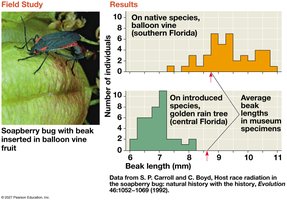
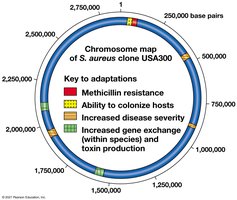
Direct Observations: Examples include natural selection in response to introduced species and drug-resistant bacteria.
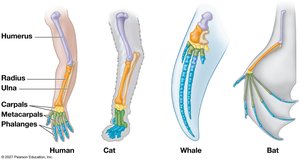
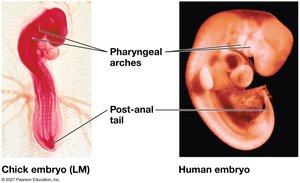
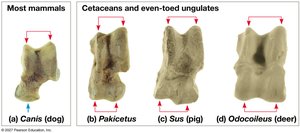
Homology: Similarity due to common ancestry, seen in anatomical and molecular traits.
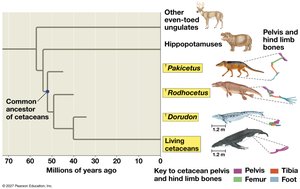
Fossil Record: Documents extinction, origin, and change within groups.
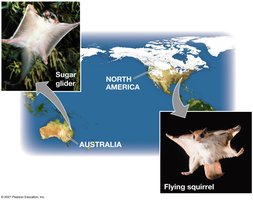
Biogeography: Study of species distribution influenced by continental drift.
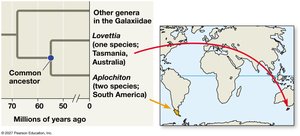
Summary Table: Types of Evidence for Evolution
Type of Evidence | Description | Example |
|---|---|---|
Direct Observation | Evolution observed in real time | Soapberry bug beak length |
Homology | Similarity due to common ancestry | Mammalian forelimbs |
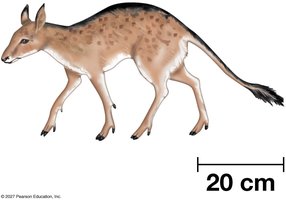
Fossil Record | Extinction and origin of new groups | Transition from land to sea in cetaceans |
Biogeography | Distribution of species | Galaxiidae fish in South America and Australia |
Key Terms and Concepts
Evolution: Change in the genetic composition of a population over generations.
Natural Selection: Process by which individuals with favorable traits are more likely to survive and reproduce.
Adaptation: Inherited trait that increases an organism’s fitness.
Homology: Similarity due to shared ancestry.
Convergent Evolution: Independent evolution of similar traits in distantly related groups.
Biogeography: Study of the geographic distribution of species.
Important Equations
While this chapter is primarily conceptual, the following equation is foundational in population genetics:
Hardy-Weinberg Equation:
Where p and q represent the frequencies of two alleles in a population.
Conclusion
Darwin’s theory of evolution by natural selection provides a unifying framework for understanding the diversity and unity of life. Ongoing research continues to expand our knowledge of evolutionary processes.
