 Back
Descent with Modification: A Darwinian View of Life (Chapter 22 Study Notes)
Study Guide - Smart Notes
 Tailored notes based on your materials, expanded with key definitions, examples, and context.
Descent with Modification: A Darwinian View of Life
Introduction to Evolutionary Biology
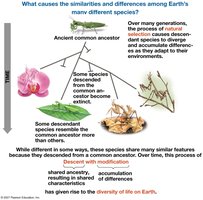
Evolutionary biology explores how species change over time, leading to the diversity and unity of life observed today. The publication of Charles Darwin's The Origin of Species in 1859 marked a scientific revolution, introducing the concept of descent with modification and natural selection as the primary mechanism of evolution.
Key Observations About Life
Adaptation: Organisms are adapted to their biotic (living) and abiotic (non-living) environments.
Unity: Shared characteristics among species illustrate the unity of life.
Diversity: Differences among species demonstrate the diversity of life.
Evolution: The process by which species accumulate differences from their ancestors as they adapt to different environments over time.
Descent with Modification: Darwin's phrase summarizing evolution, where all organisms are related by descent from a common ancestor.
Historical Context of Evolutionary Thought
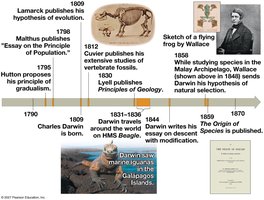
Before Darwin, most scientists believed in a young Earth inhabited by unchanging species. Aristotle proposed the scala naturae, a scale of increasing complexity. Carolus Linnaeus developed a classification system and binomial nomenclature, still used today.
Scala Naturae: A hierarchical arrangement of species based on complexity.
Binomial Nomenclature: The two-part scientific naming system for species (e.g., Homo sapiens).
Fossils and Change Over Time
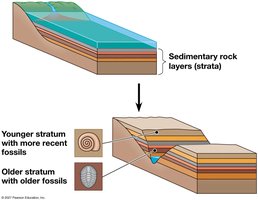
Fossils, found in sedimentary rock strata, provide evidence for the history of life and evolutionary change. Paleontology, developed by Georges Cuvier, revealed that older strata contain fossils less similar to current organisms, and boundaries between strata often represent catastrophic events.
Strata: Layers of sedimentary rock containing fossils.
Paleontology: The study of fossils and ancient life forms.
Lamarck’s Hypothesis of Evolution
Jean-Baptiste de Lamarck proposed that evolutionary change occurs through use and disuse of body parts and inheritance of acquired characteristics. However, this mechanism is not supported by experimental evidence.
Use and Disuse: Body parts used extensively become larger and stronger; unused parts deteriorate.
Inheritance of Acquired Characteristics: Modifications acquired in one’s lifetime can be passed to offspring (not supported).
Darwin’s Research and the Voyage of the Beagle
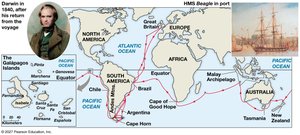
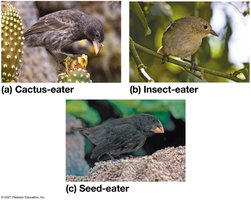
Darwin’s five-year voyage on the HMS Beagle allowed him to collect specimens and observe similarities and differences among species. He noted that species from the mainland colonized the Galápagos Islands and diversified, leading to unique adaptations.
Adaptations: Inherited characteristics that enhance survival and reproduction.
Galápagos Finches: Example of adaptive radiation, where finches evolved different beak shapes to exploit various food sources.
Natural Selection and Adaptation
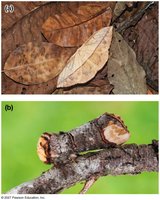
Darwin proposed natural selection as the mechanism for adaptation. Individuals with certain inherited traits survive and reproduce at higher rates, leading to the accumulation of favorable traits in the population over generations.
Natural Selection: Process where individuals with advantageous traits are more likely to survive and reproduce.
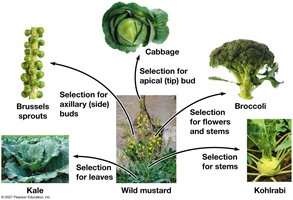
Artificial Selection: Human-driven selection for desired traits in crops and animals.
Key Features of Natural Selection
Population Evolution: Individuals do not evolve; populations evolve over time.
Heritable Traits: Only traits that are heritable and variable in a population can be acted upon by natural selection.
Environmental Influence: The environment determines which traits are favorable.
Scientific Evidence for Evolution
Four main types of evidence support evolution: direct observations, homology, the fossil record, and biogeography.
Direct Observations: Examples include natural selection in response to introduced species and evolution of drug-resistant bacteria.
Homology: Similarity resulting from common ancestry, including anatomical and molecular homologies.
Fossil Record: Provides evidence of extinction, origin of new groups, and changes within groups.
Biogeography: Study of the geographic distribution of species.
Homology
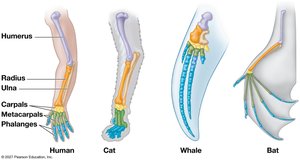
Homologous structures are anatomical resemblances that represent variations on a structural theme present in a common ancestor. Comparative embryology and vestigial structures also provide evidence for common ancestry.
Homologous Structures: Similar anatomical features with different functions (e.g., mammalian forelimbs).
Vestigial Structures: Remnants of features that served a function in ancestors.
Molecular Homologies: Shared genetic code and genes among diverse organisms.
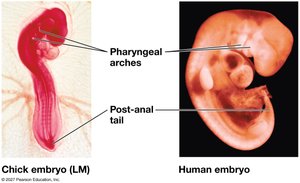
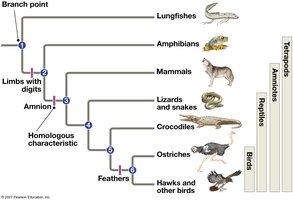
Evolutionary Trees and Tree Thinking
Evolutionary trees are diagrams that reflect hypotheses about relationships among groups. Homologies form nested patterns, and relatedness is determined by the most recent common ancestor.
Tree Thinking: Understanding evolutionary relationships and timing of events.
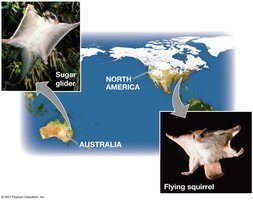
Convergent Evolution
Convergent evolution occurs when distantly related groups independently evolve similar features due to adaptation to similar environments. Analogous traits arise through this process, not common ancestry.
Example: Sugar glider (Australian marsupial) and flying squirrel (North American eutherian) have similar adaptations for gliding.
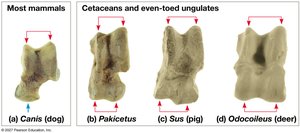
The Fossil Record
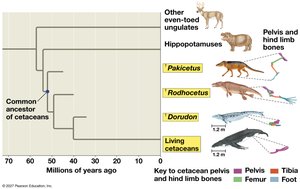
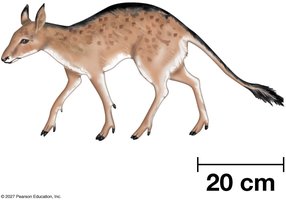
The fossil record documents the extinction of species, the origin of new groups, and changes within groups over time. It supports hypotheses about evolutionary relationships, such as the close relationship between cetaceans and even-toed ungulates.
Transitional Fossils: Fossils that show intermediate forms between groups.
Biogeography
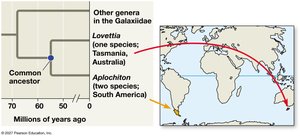
Biogeography examines the geographic distribution of species, influenced by continental drift and historical events. Understanding these patterns helps predict when and where different groups evolved.
Continental Drift: Movement of Earth's landmasses affects species distribution.
Example: Freshwater fish in the family Galaxiidae are found in South America and Australia, reflecting ancient continental connections.
Summary of Natural Selection
Natural selection is a process where individuals with favorable traits are more likely to survive and reproduce, leading to the accumulation of these traits in the population. Evolution is supported by extensive scientific evidence from multiple fields.
Key Terms and Concepts
Evolution: Change in the genetic composition of a population over generations.
Natural Selection: Differential survival and reproduction of individuals due to differences in phenotype.
Homology: Similarity due to shared ancestry.
Convergent Evolution: Independent evolution of similar features in different lineages.
Fossil Record: Chronological collection of life's remains in sedimentary rock layers.
Biogeography: Study of the distribution of species and ecosystems in geographic space and through geological time.
Important Equations
While this chapter is primarily conceptual, the following equation is relevant for population genetics (covered in later chapters):
Where p and q represent the frequencies of two alleles in a population.
Hardy-Weinberg equation for genotype frequencies.
Additional info: These equations are foundational for understanding how allele frequencies change in populations, a key concept in evolutionary biology.
