 Back
Descent with Modification: A Darwinian View of Life (Chapter 22 Study Notes)
Study Guide - Smart Notes
 Tailored notes based on your materials, expanded with key definitions, examples, and context.
Descent with Modification: A Darwinian View of Life
Introduction to Evolutionary Biology
Evolutionary biology explores how species change over time, leading to the diversity and unity of life observed today. The publication of Charles Darwin's The Origin of Species in 1859 marked a scientific revolution, introducing the concept of descent with modification and natural selection as the primary mechanism of evolution.
Concept 22.1: The Darwinian Revolution
Historical Context and Influences
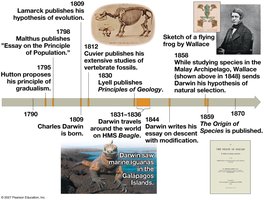
Darwin's ideas were shaped by the works of earlier scientists and his own observations during his travels. The intellectual context included contributions from Aristotle, Linnaeus, Cuvier, Hutton, Lyell, and Lamarck, each influencing the understanding of species and change over time.
Aristotle: Proposed species were fixed and arranged on a scale of increasing complexity (scala naturae).
Linnaeus: Developed a classification system and binomial nomenclature for species.
Cuvier: Founded paleontology, noting differences in fossils across strata.
Hutton & Lyell: Suggested gradual geological processes shape Earth, implying an older planet.
Lamarck: Proposed evolution via use and disuse and inheritance of acquired traits (not supported by evidence).
Fossils and Strata
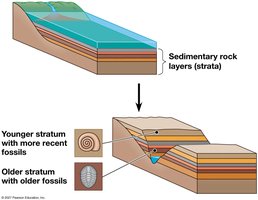
Fossils found in sedimentary rock layers (strata) provide evidence for the history of life and evolutionary change. Older strata contain fossils less similar to current organisms, supporting the idea of gradual change.
Concept 22.2: Descent with Modification by Natural Selection
Darwin’s Voyage and Observations
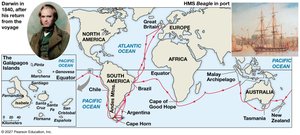
Darwin’s five-year voyage on the HMS Beagle allowed him to collect specimens and observe adaptations in various species, especially on the Galápagos Islands. He noted similarities between island and mainland species, hypothesizing that colonization and subsequent diversification led to unique adaptations.
Adaptation and Natural Selection
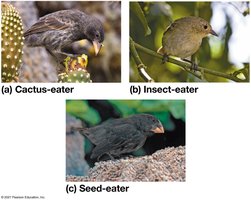
Adaptations are inherited traits that enhance survival and reproduction. Darwin observed beak variations in Galápagos finches, linking them to different food sources and demonstrating how new species arise from ancestral forms through gradual accumulation of adaptations.
Mechanism of Natural Selection
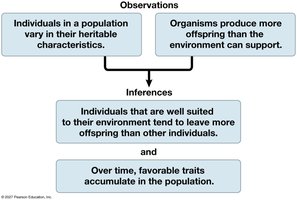
Observation 1: Members of a population vary in their inherited traits.
Observation 2: All species produce more offspring than the environment can support; many fail to survive and reproduce.
Inference 1: Individuals with advantageous traits produce more offspring.
Inference 2: Favorable traits accumulate in the population over generations.
Artificial Selection
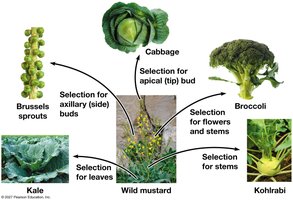
Humans modify species through artificial selection, breeding individuals with desired traits. This process demonstrates the power of selection in shaping species, as seen in crops and livestock.
Key Features of Natural Selection
Natural selection acts on heritable traits within populations, not individuals.
Adaptations increase in frequency if they confer survival or reproductive advantages.
Environmental changes can drive adaptation and speciation.
Concept 22.3: Evidence for Evolution
Direct Observations
Evolutionary change has been documented in numerous studies, such as natural selection in response to introduced species and the evolution of drug-resistant bacteria.
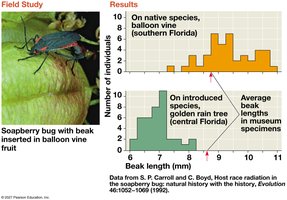
Soapberry bugs: Beak length evolved to match fruit size in different environments.
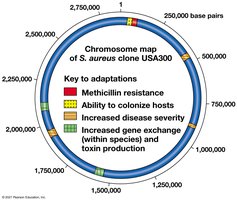
MRSA bacteria: Resistance to antibiotics evolved rapidly due to selection pressure.
Homology
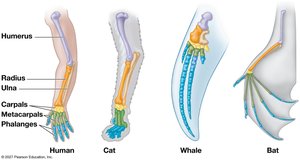
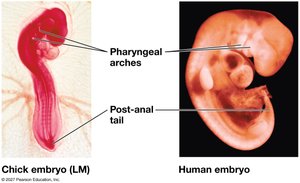
Homology refers to similarities resulting from common ancestry. Anatomical homologies, such as mammalian forelimbs, and molecular homologies, like shared genes, provide strong evidence for evolution.
Evolutionary Trees and Tree Thinking
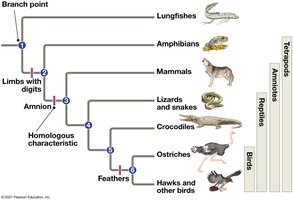
Evolutionary trees illustrate relationships among groups based on shared characteristics and common ancestry. Homologies form nested patterns, and evolutionary trees help predict traits and relationships.
Convergent Evolution
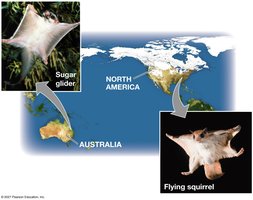
Convergent evolution occurs when distantly related groups independently evolve similar traits due to adaptation to similar environments. These analogous traits do not arise from common ancestry.
The Fossil Record
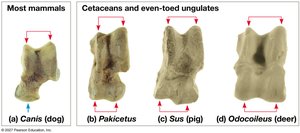
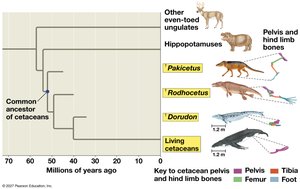
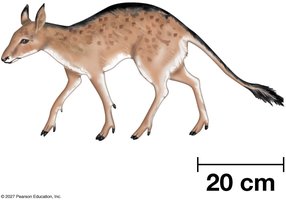
The fossil record documents the extinction of species, the origin of new groups, and changes within groups over time. Transitional fossils, such as those linking cetaceans and even-toed ungulates, provide evidence for evolutionary relationships.
Biogeography
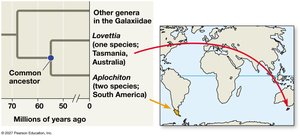
Biogeography studies the geographic distribution of species. Continental drift and the separation of landmasses explain the distribution and evolution of species, such as freshwater fish in South America and Australia.
Summary Table: Key Concepts of Evolution
Concept | Key Points | Example |
|---|---|---|
Natural Selection | Acts on heritable variation; leads to adaptation and speciation | Galápagos finch beak variation |
Homology | Similarity due to common ancestry | Mammalian forelimbs |
Convergent Evolution | Analogous traits in unrelated groups | Sugar glider and flying squirrel |
Fossil Record | Documents extinction, origin, and change | Cetacean evolution |
Biogeography | Distribution explained by continental drift | Galaxiidae fish in South America and Australia |
Conclusion
Darwin’s theory of evolution by natural selection integrates diverse areas of biological study and continues to stimulate new research. The overwhelming evidence from direct observation, homology, the fossil record, and biogeography supports the pattern and process of evolution, explaining the unity and diversity of life on Earth.
