 Back
Descent with Modification and the Evidence for Evolution
Study Guide - Smart Notes
 Tailored notes based on your materials, expanded with key definitions, examples, and context.
Descent with Modification
Introduction to Evolutionary Theory
Evolution is the central unifying concept in biology, explaining both the diversity and unity of life. Charles Darwin's theory of descent with modification describes how species change over time through the process of natural selection, leading to adaptation and speciation.
Descent with modification: The process by which organisms pass traits from parent to offspring, with changes accumulating over generations.
Natural selection: The mechanism by which individuals with advantageous traits are more likely to survive and reproduce, increasing the frequency of those traits in the population.
Adaptation: Inherited characteristics that enhance an organism's ability to survive and reproduce in a specific environment.
Evidence for Evolution
Biogeography
Biogeography is the study of the geographic distribution of species. It provides evidence for evolution by showing how species are distributed in relation to continental drift and historical events.
Earth's continents were once joined in a supercontinent called Pangaea, which later separated, leading to the isolation and divergence of species.
Endemic species are found only in specific locations, such as islands, and often closely resemble species on the nearest mainland, supporting the idea of adaptive radiation.
Darwin's Observations and the Origin of Species
Darwin's Voyage and the Galápagos Islands
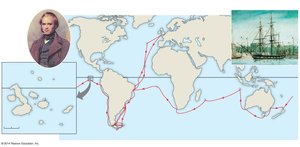
During his voyage on the HMS Beagle, Darwin collected specimens and made observations that led to his theory of evolution. He noted similarities and differences among species on the Galápagos Islands, hypothesizing that they had evolved from mainland ancestors.
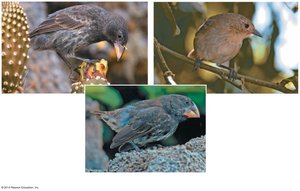
Darwin observed that finches on different islands had different beak shapes, adapted to their specific diets.
He concluded that adaptation to local environments could lead to the formation of new species.
Artificial Selection and Natural Selection
Artificial Selection
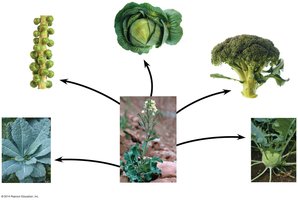
Artificial selection is the process by which humans breed plants and animals for desired traits. Darwin used this as an analogy for natural selection in the wild.
Examples include the breeding of wild mustard into crops like cabbage, broccoli, and kale.
Natural Selection
Natural selection acts on variation within populations. Darwin made two key observations:
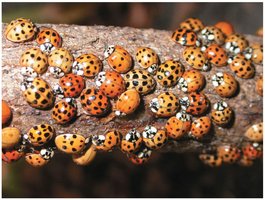
Observation 1: Members of a population vary in their inherited traits.
Observation 2: All species can produce more offspring than the environment can support, leading to competition for resources.
Inference 1: Individuals with advantageous traits are more likely to survive and reproduce.
Inference 2: Over generations, favorable traits accumulate in the population.
Types of Evidence for Evolution
Direct Observations
Evolution can be observed directly in nature. Examples include changes in beak size in soapberry bugs and the evolution of antibiotic resistance in bacteria.
Soapberry bugs have evolved different beak lengths in response to the size of the fruit they feed on.
MRSA (methicillin-resistant Staphylococcus aureus) is an example of bacteria evolving resistance to antibiotics.
Homology
Homology refers to similarities among organisms due to shared ancestry. These can be anatomical, embryological, or molecular.
Homologous structures: Anatomical features that are similar due to common ancestry, even if their functions differ (e.g., the forelimbs of humans, whales, cats, and bats).
Vestigial structures: Remnants of features that served important functions in ancestors but are no longer used in the same way.
Molecular homology: Similarities in DNA and protein sequences among different species.
Convergent Evolution
Convergent evolution occurs when unrelated species evolve similar traits independently, often due to similar environmental pressures. These traits are called analogous structures.
Example: The wings of bats and birds are analogous, not homologous.
The Fossil Record
The fossil record documents the history of life, showing the extinction of species, the origin of new groups, and changes within groups over time. Transitional fossils illustrate evolutionary changes.
Biogeography and Biodiversity Hotspots
Biodiversity Hotspots
Biodiversity hotspots are regions with high levels of species richness and endemism, but also high levels of threat. These areas are crucial for conservation efforts.
Hotspots cover a small fraction of Earth's land but support a large proportion of its species.
Examples include the California Floristic Province and the Amazon rainforest.
Summary Table: Types of Evolutionary Evidence
Type of Evidence | Description | Example |
|---|---|---|
Direct Observation | Changes observed in real time | Antibiotic resistance in bacteria |
Homology | Similarity due to shared ancestry | Forelimb bones in mammals |
Fossil Record | Transitional forms and extinct species | Whale ancestors with legs |
Biogeography | Geographic distribution of species | Endemic species on islands |
Key Terms
Descent with modification: The passing on of traits from parent organisms to their offspring, with changes accumulating over generations.
Natural selection: The process by which organisms better adapted to their environment tend to survive and produce more offspring.
Homology: Similarity in characteristics resulting from a shared ancestry.
Convergent evolution: The independent evolution of similar features in species of different lineages.
Endemic species: Species that are native to and found only within a limited area.
