 Back
BackDescent with Modification by Natural Selection: The Foundations of Evolutionary Biology
Study Guide - Smart Notes
 Tailored notes based on your materials, expanded with key definitions, examples, and context.
Descent with Modification by Natural Selection
Introduction to Evolutionary Thought
In the early 19th century, the prevailing belief was that species were unchanging since their creation. However, observations and scientific inquiry began to challenge this view, culminating in Charles Darwin's revolutionary theory of evolution by natural selection. This concept explains both the adaptations of organisms and the unity and diversity of life on Earth.
Darwin’s Research and the Voyage of the Beagle
Background and Influences
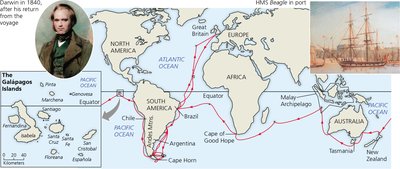
Charles Darwin (1809–1882) developed a keen interest in nature, which led him to study natural history rather than medicine or the clergy.
He became the protégé of botanist John Henslow, who recommended him for the HMS Beagle expedition.
The Beagle's mission was to chart the South American coast, but Darwin spent much time collecting and observing plants and animals on land.
Darwin was influenced by Charles Lyell’s Principles of Geology, which argued for an ancient, dynamic Earth shaped by gradual processes.
Key Observations During the Voyage
Darwin noted that South American species were more similar to each other than to European species, even across different habitats.
Fossils found resembled living South American organisms, suggesting a connection between extinct and extant species.
The Galápagos Islands provided unique examples of species that were similar to mainland forms but had diversified into new species adapted to different islands.
Darwin’s Focus on Adaptation
Adaptation and the Origin of Species
Darwin observed that organisms possess adaptations—inherited traits that enhance survival and reproduction in specific environments. He hypothesized that new species arise from ancestral forms through the gradual accumulation of adaptations to different environments.
Galápagos finches are a classic example: their beak shapes and behaviors are adapted to the specific foods available on their home islands.
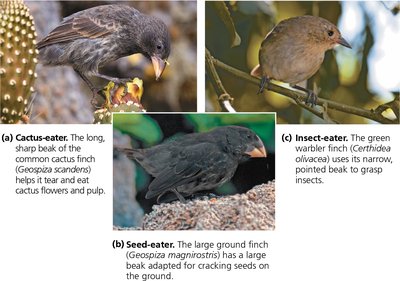
Example: The cactus-eater finch has a long, sharp beak for eating cactus, while the seed-eater has a large beak for cracking seeds, and the insect-eater has a narrow beak for catching insects.
The Development and Publication of Evolutionary Theory
Wallace and the Origin of Species
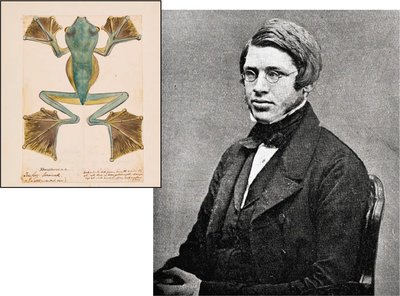
Alfred Russel Wallace independently conceived a theory of natural selection similar to Darwin’s.
Both Wallace’s and Darwin’s ideas were presented jointly in 1858, but Darwin’s extensive evidence and logical argumentation established him as the main architect of evolutionary theory.
Descent with Modification
Unity and Diversity of Life
Darwin described evolution as descent with modification. All organisms share a common ancestor, and as descendants spread into various habitats, they accumulated adaptations that fit them to specific ways of life. This process explains both the unity (shared traits) and diversity (adaptations) of life.
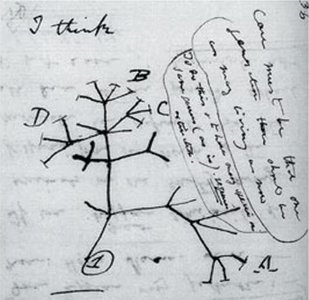
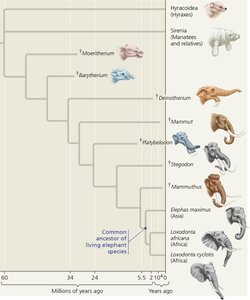
Darwin visualized the history of life as a branching tree, with each fork representing a common ancestor and the tips representing living species.
Example: The evolutionary tree of elephants shows how closely related species diverged from a common ancestor, while many related lineages have gone extinct.
Artificial Selection, Natural Selection, and Adaptation
Artificial Selection
Humans have modified species through artificial selection, breeding individuals with desired traits. This process demonstrates how selection can cause dramatic changes in a species over generations.
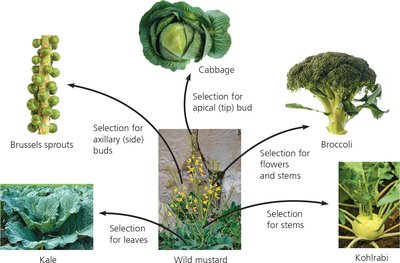
Example: Cabbage, broccoli, kale, and Brussels sprouts all originated from wild mustard through selection for different plant parts.
Natural Selection: Observations and Inferences
Observation 1: Members of a population often vary in their inherited traits.
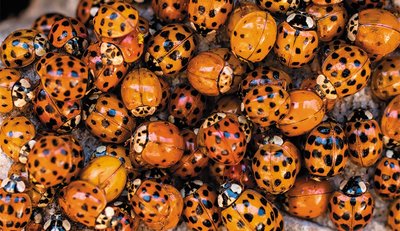
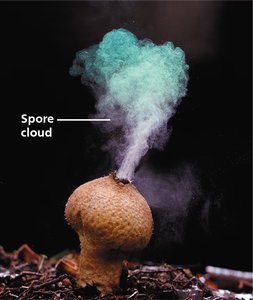
Observation 2: All species can produce more offspring than their environment can support; many offspring fail to survive and reproduce.
Inference 1: Individuals with advantageous traits are more likely to survive and reproduce.
Inference 2: Over generations, favorable traits accumulate in the population.
Key Features of Natural Selection
Natural selection increases the frequency of adaptations favorable in a given environment.
If the environment changes, natural selection may result in adaptation to new conditions, sometimes leading to new species.
Natural selection acts on heritable variation; evolution occurs at the population level, not the individual level.
Environmental factors determine which traits are favorable, and these factors can change over time and space.
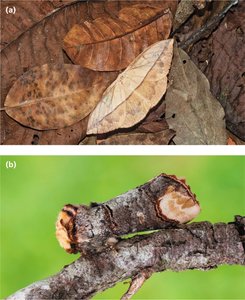
Example: Camouflage in moths demonstrates how natural selection can lead to adaptations that enhance survival in specific environments.
Summary Table: Artificial vs. Natural Selection
Feature | Artificial Selection | Natural Selection |
|---|---|---|
Agent of Selection | Humans | Environment |
Traits Selected | Desired by humans (e.g., yield, appearance) | Increase survival and reproduction |
Speed of Change | Often rapid (few generations) | Usually gradual (many generations) |
Outcome | Domesticated breeds/varieties | Adaptation, speciation |
Key Equations and Concepts
Fitness: The relative contribution an individual makes to the gene pool of the next generation.
Heritability: The proportion of variation in a trait that is genetic and can be passed to offspring.
Population Genetics Equation:
Where p and q are the frequencies of two alleles in a population (Hardy-Weinberg equilibrium).
Conclusion
Darwin’s theory of descent with modification by natural selection provides a unifying explanation for the unity and diversity of life. It demonstrates how adaptations arise and how species diverge from common ancestors, shaping the living world through evolutionary processes.
