Back
Descent with Modification: Evolution and Evidence
Study Guide - Smart Notes
 Tailored notes based on your materials, expanded with key definitions, examples, and context.
Descent with Modification and Evolution
Why Study Evolution?
Evolution is a fundamental concept in biology that explains the unity, adaptation, and diversity of life. It provides a framework for understanding how organisms share common traits, adapt to their environments, and diversify into new species.
Unity: Organisms share characteristics due to common ancestry.
Adaptation: Traits that enhance survival and reproduction are favored.
Diversity: Species change over time, resulting in the variety of life.
Example: Lepidopteran insects (moths and butterflies) demonstrate unity (caterpillar stage), adaptation (mimicry), and diversity (distinct adult forms).

A New Era of Biology
The publication of On the Origin of Species by Charles Darwin in 1859 marked the beginning of modern evolutionary biology. Darwin defined evolution as "descent with modification," viewing it as both a pattern and a process.
Descent with modification: Current species are descendants of ancestral species, accumulating changes over time.
The Darwinian Revolution
Challenging Traditional Views
Before Darwin, most believed species were fixed and Earth was young. Darwin was influenced by earlier thinkers and his own observations.
Aristotle: Species are fixed and arranged by complexity.
Linnaeus: Developed a classification system based on similarities.
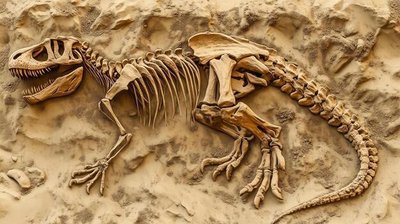
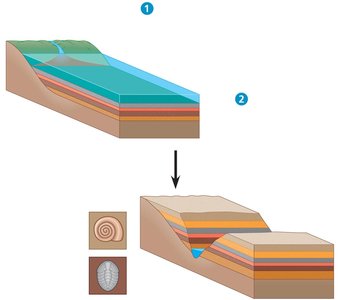
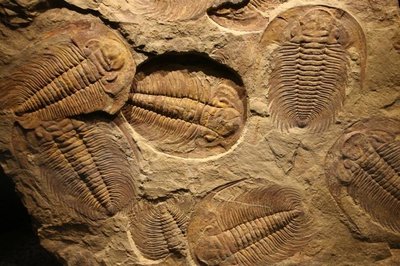
Fossils: Preserved remains found in sedimentary strata, showing changes over time.
Cuvier: Proposed extinctions due to catastrophic events.
Hutton and Lyell: A Changing Earth
James Hutton and Charles Lyell proposed that Earth's features formed through slow, continuous processes, suggesting an ancient Earth.
Ancient Earth: Provided enough time for evolution to occur.
Lamarck's Early Theory of Evolution
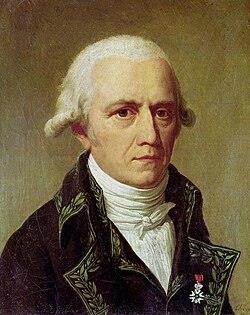
Jean-Baptiste Lamarck suggested that organisms evolve through use and disuse of traits and inheritance of acquired characteristics, though his mechanism was not supported by evidence.
Descent with Modification by Natural Selection
Darwin's Voyage and Observations
Darwin's five-year voyage on the HMS Beagle provided key observations that shaped his theory of evolution.
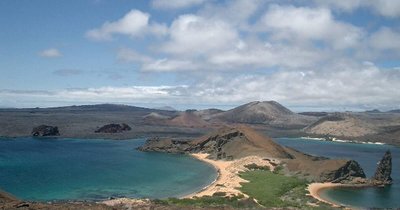
Galápagos Islands: Darwin collected specimens and noted adaptations.
Common ancestry: Galápagos species resembled mainland species.
Darwin's Theory of Natural Selection
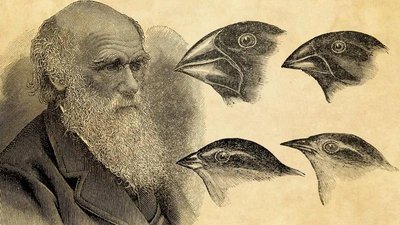
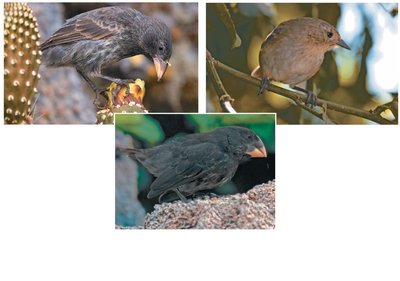
Darwin proposed that evolution occurs through natural selection, where individuals with favorable traits are more likely to survive and reproduce.
Natural selection: Drives adaptation and speciation.
Artificial Selection vs. Natural Selection
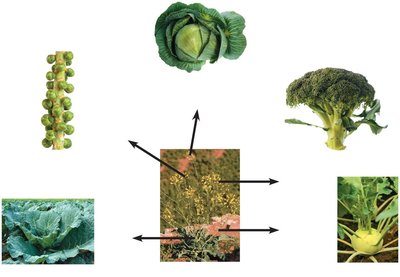
Darwin recognized that humans could change species through selective breeding (artificial selection), and nature could do the same over longer periods (natural selection).
Artificial selection: Humans select traits (e.g., dog breeds, crops).
Natural selection: Environment favors advantageous traits.
Darwin’s Observations and Inferences
Darwin made two key observations and two inferences:
Observation 1: Individuals vary in inherited traits.
Observation 2: More offspring are produced than the environment can support.
Inference 1: Individuals with advantageous traits are more likely to survive and reproduce.
Inference 2: Favorable traits become more common over generations.
Key Principles of Natural Selection
Acts on heritable variation.
Populations evolve, not individuals.
Adaptations depend on environmental conditions.
Evidence for Evolution
Direct Observations
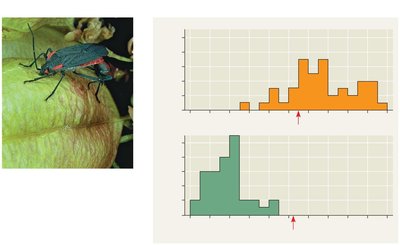
Evolution can be observed in modern populations, such as soapberry bugs adapting their beak length to different food sources.
Evolution of Drug-Resistant Bacteria
Antibiotic resistance in bacteria like Staphylococcus aureus is a modern example of evolution by natural selection.
Homology: Evidence of Common Ancestry
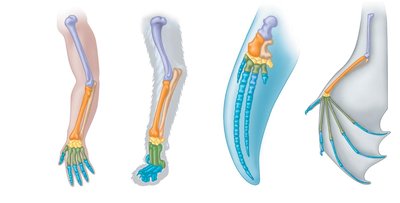
Homologous structures are anatomical features inherited from a common ancestor, though they may serve different functions.
Examples: Human arm, bat wing, whale flipper, cat forelimb.
Embryological and Vestigial Homologies
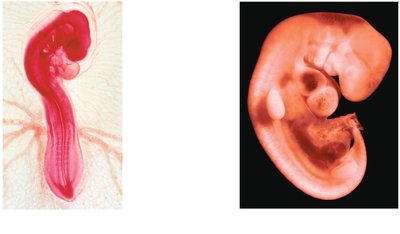
Comparative embryology and vestigial structures provide evidence of evolutionary history.
Embryology: Early vertebrate embryos share features like pharyngeal arches and post-anal tails.
Vestigial structures: Remnants of ancestral features (e.g., pelvic bones in snakes).
Molecular Homology
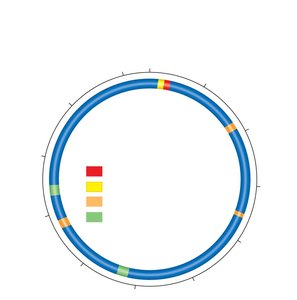
Genetic similarities among organisms indicate common ancestry. DNA sequences provide strong evidence for evolutionary relationships.
Analogous Structures and Convergent Evolution
Analogous structures arise from convergent evolution, where unrelated species independently evolve similar adaptations due to similar environmental pressures.
Example: Sugar glider (marsupial) and flying squirrel (placental mammal).
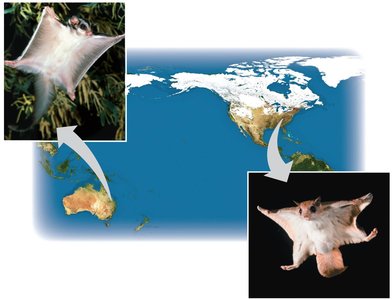
Comparison Table: Homologous vs. Analogous Structures
Homologous Structures | Analogous Structures |
|---|---|
Common ancestry | Independent evolution |
Similar underlying structure | Similar function |
May have different functions | Often perform the same function |
Evidence for evolution and common ancestry | Evidence of convergent evolution |
The Fossil Record
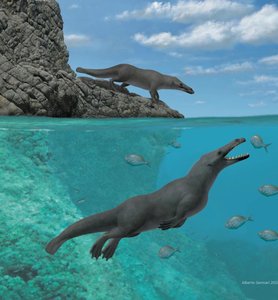
Fossils document changes in species over time and provide direct evidence for evolution. Transitional fossils reveal intermediate forms between ancestral and modern species.
Biogeography
Biogeography studies the geographic distribution of organisms. Continental drift and geographic isolation have influenced evolution, with island species often closely related to nearby mainland species.
Evolution: A Scientific Theory
In science, a theory is a well-supported explanation for a broad range of observations. Evolution by natural selection is supported by multiple independent lines of evidence and remains the unifying framework for understanding the diversity of life.