 Back
Descent with Modification: The Darwinian Revolution and Evidence for Evolution
Study Guide - Smart Notes
 Tailored notes based on your materials, expanded with key definitions, examples, and context.
Descent with Modification: The Darwinian Revolution and Evidence for Evolution
Introduction to Evolutionary Biology
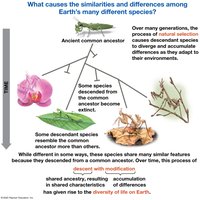
Evolutionary biology seeks to explain the similarities and differences among Earth's many species. The concept of descent with modification describes how species accumulate differences from their ancestors over time, leading to the diversity of life observed today. This process is driven by mechanisms such as natural selection, which acts on heritable variation within populations.
Concept 19.1: The Darwinian Revolution Challenged Traditional Views
Historical Context and Early Ideas
Before Darwin, most naturalists believed that species were fixed and unchanging. Influential thinkers such as Aristotle proposed the scala naturae, a scale of nature with species arranged by increasing complexity. Carolus Linnaeus developed the binomial system for naming species and a nested classification system, but attributed similarities among species to creation rather than evolution.
The Role of Fossils and Geology
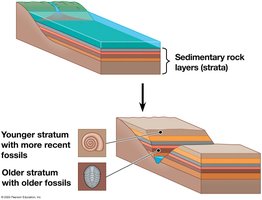
Fossils, preserved remains or traces of organisms, provided evidence that life on Earth has changed over time. Fossils are typically found in sedimentary rock, which forms in layers called strata. The study of fossils, or paleontology, was advanced by Georges Cuvier, who recognized that some species disappeared from the fossil record, indicating extinction events.
Gradualism and the Age of Earth
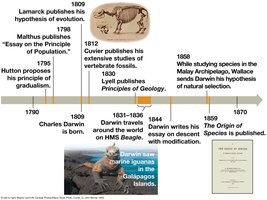
Geologists James Hutton and Charles Lyell proposed that Earth's features formed through slow, continuous processes over long periods. This suggested that Earth was much older than previously thought, providing enough time for substantial biological change.
Lamarck’s Hypothesis of Evolution
Jean-Baptiste de Lamarck proposed that organisms evolve through use and disuse of body parts and the inheritance of acquired characteristics. Although his mechanism was incorrect, Lamarck was the first to offer a testable explanation for adaptation.

Concept 19.2: Descent with Modification by Natural Selection
Darwin’s Research and the Voyage of the Beagle
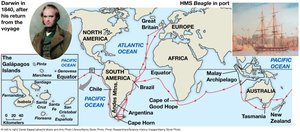
Charles Darwin's observations during his voyage on the HMS Beagle were crucial to the development of evolutionary theory. He noted that fossils in South America resembled living species there more than fossils from other continents, and that island species were similar to, yet distinct from, mainland relatives.
Adaptation and the Origin of Species
Darwin observed that organisms are well adapted to their environments. He hypothesized that new species arise from ancestral forms through the gradual accumulation of adaptations. The finches of the Galápagos Islands, for example, evolved diverse beak shapes suited to different food sources.
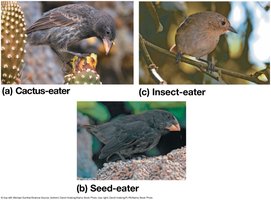
Natural Selection as the Mechanism of Evolution
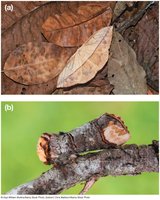
Natural selection is the process by which individuals with favorable inherited traits are more likely to survive and reproduce. Over generations, this leads to the accumulation of advantageous traits in the population. Alfred Russel Wallace independently conceived a similar theory, prompting Darwin to publish his work.
Key Features of Natural Selection
Variation: Individuals in a population vary in their heritable traits.
Overproduction: More offspring are produced than the environment can support.
Differential Survival and Reproduction: Individuals with advantageous traits leave more offspring.
Adaptation: Over time, favorable traits become more common in the population.
Concept 19.3: Evidence for Evolution
Direct Observations of Evolutionary Change
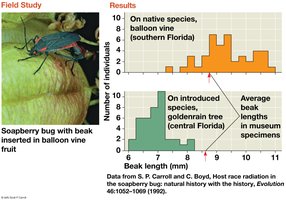
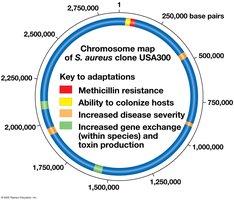
Evolution can be observed directly in nature. For example, soapberry bugs in Florida evolved different beak lengths in response to changes in their food sources, and bacteria such as Staphylococcus aureus have evolved resistance to antibiotics within decades.
Homology
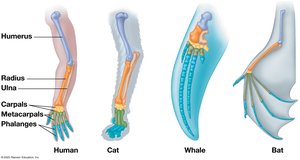
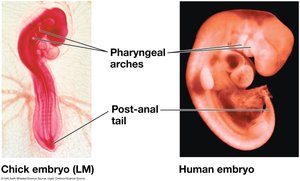
Homology refers to similarities among species due to shared ancestry. Anatomical homologies, such as the similar bone structures in mammalian forelimbs, and molecular homologies, such as shared genes, provide strong evidence for evolution.
Convergent Evolution and Analogy
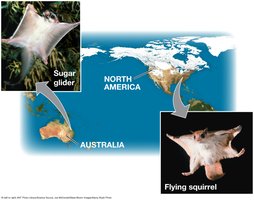
Convergent evolution occurs when unrelated species independently evolve similar traits as they adapt to similar environments. These analogous features have similar functions but do not indicate common ancestry.
The Fossil Record
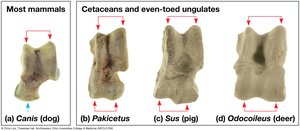
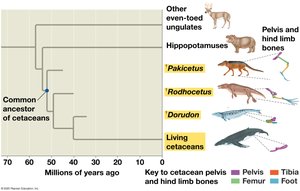
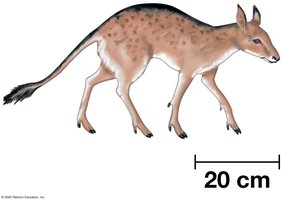
The fossil record documents the pattern of evolution, showing the appearance, modification, and extinction of species over time. Transitional fossils illustrate steps in major evolutionary changes, such as the evolution of whales from land-dwelling ancestors.
Biogeography
Biogeography is the study of the geographic distribution of species. The distribution of organisms on islands and continents supports the theory of evolution, as related species are often found in nearby geographic regions, reflecting patterns of migration and adaptation.
Summary Table: Types of Evidence for Evolution
Type of Evidence | Description | Example |
|---|---|---|
Direct Observation | Evolutionary change observed in real time | Antibiotic resistance in bacteria |
Homology | Similarity due to shared ancestry | Mammalian forelimb bones |
Fossil Record | Fossils showing change over time | Transitional fossils of whales |
Biogeography | Geographic distribution of species | Endemic species on islands |
Scientific Theory and Evolution
The theory of evolution by natural selection is a unifying concept in biology, supported by extensive evidence from multiple scientific disciplines. It explains the unity and diversity of life and continues to be refined as new discoveries are made.
