 Back
Deuterostomes: Echinoderms and Chordates – Structure, Diversity, and Evolutionary Innovations
Study Guide - Smart Notes
 Tailored notes based on your materials, expanded with key definitions, examples, and context.
Deuterostomes: Overview
Major Animal Lineages
Deuterostomes are one of the five major animal lineages, distinguished by their embryonic development and molecular phylogeny. They are monophyletic and include three phyla: Echinodermata, Hemichordata, and Chordata. Most animals are invertebrates, but vertebrates dominate the deuterostome group.
Echinodermata: Sea stars, sea urchins, sand dollars, sea cucumbers, feather stars, and brittle stars.
Hemichordata: Acorn worms and pterobranchs.
Chordata: Lancelets, tunicates, and vertebrates (including fish, amphibians, mammals, reptiles, and birds).
Echinoderms
Body Plan and Synapomorphies
Echinoderms are exclusively marine and are recognized by three key traits:
Radial symmetry in adults: Larvae are bilaterally symmetric, but adults exhibit pentaradial symmetry (five-sided radial symmetry).
Endoskeleton of calcium carbonate: Provides protection and support, formed by secretion of calcium carbonate plates beneath the skin.
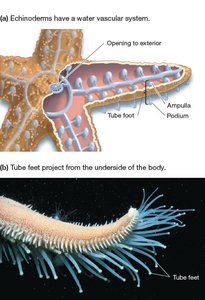
Water vascular system and tube feet: A network of fluid-filled tubes and chambers, with tube feet used for movement and feeding.
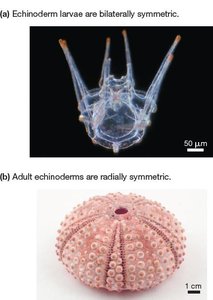
Example: Sea urchins and sea stars display pentaradial symmetry as adults, but their larvae are bilaterally symmetric.
Water Vascular System and Tube Feet
The water vascular system is unique to echinoderms, allowing for movement, feeding, and gas exchange. Tube feet are elongated appendages consisting of an internal ampulla and an external podium.
Function: Tube feet extend and contract, enabling locomotion and manipulation of food.
Structure: Sea water enters the system, filling the ampulla and extending the podium.
Major Echinoderm Lineages
There are five extant lineages of echinoderms:
Crinoidea: Feather stars and sea lilies
Asteroidea: Sea stars
Ophiuroidea: Brittle stars and basket stars
Echinoidea: Sea urchins and sand dollars
Holothuroidea: Sea cucumbers
Example: Sea stars (Asteroidea) and sea urchins (Echinoidea) are common representatives of echinoderms.
Chordates
Chordate Body Plan
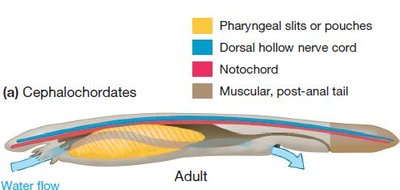
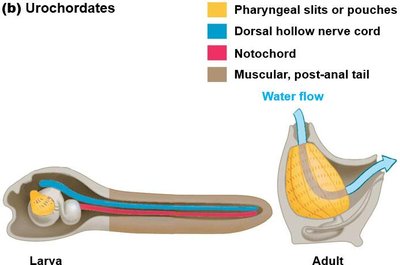
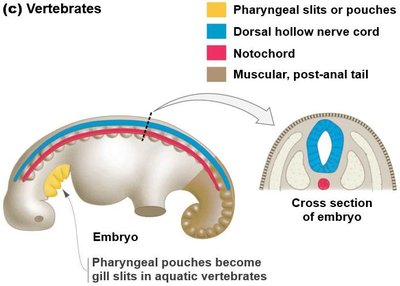
Chordates are defined by four morphological features present at some stage of their life cycle:
Pharyngeal gill slits: Openings in the throat used for filter feeding or gas exchange.
Dorsal hollow nerve cord: Runs the length of the body, formed from projections of neurons.
Notochord: A flexible, supportive rod running the length of the body.
Muscular post-anal tail: Extends beyond the anus, aiding in locomotion.
Chordate Subphyla
Chordata consists of three major lineages:
Cephalochordates: Lancelets, small fish-like suspension feeders.
Urochordates: Tunicates, with a polysaccharide tunic covering the adult body.
Vertebrates: Animals with a vertebral column and cranium, including fish, amphibians, reptiles, birds, and mammals.
Cephalochordates
Cephalochordates are mobile suspension feeders with a notochord and dorsal hollow nerve cord. Muscle contractions on either side of the notochord result in fish-like movement.
Urochordates
Urochordates (tunicates) have a tunic that covers and supports the adult body. Larvae possess all four chordate features, but adults retain only pharyngeal slits.
Vertebrates
Vertebrates are characterized by a vertebral column and cranium, which protect the spinal cord and brain. Embryonic pharyngeal pouches develop into gills in aquatic species. The notochord organizes the body plan during development, inducing somite formation.
Vertebrae: Cartilaginous or bony structures forming a column along the dorsal side.
Cranium: Bony, cartilaginous, or fibrous case enclosing the brain.
Key Innovations in Vertebrate Evolution
Origin of the Cranium and Vertebrae
The cranium and vertebrae are synapomorphies of vertebrates, providing protection for the central nervous system and sensory organs.
Origin of the Jaw (Gnathostomes)
Jaws evolved in vertebrates, allowing for diverse feeding strategies and mass feeding. Jawed vertebrates (gnathostomes) include most living vertebrates.
Origin of Limbs (Tetrapods)
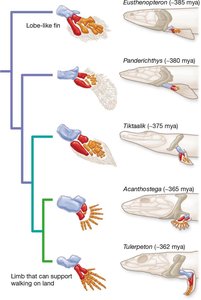
Limbs evolved from fins, enabling vertebrates to transition from aquatic to terrestrial environments. Tetrapods include amphibians, reptiles, and mammals.
Origin of the Amniotic Egg
The amniotic egg is a synapomorphy of reptiles and mammals, providing a protective covering that minimizes desiccation and allows for terrestrial reproduction.
Origin of Scales and Feathers (Reptiles and Birds)
Scales and feathers made of keratin evolved in reptiles and birds, providing protection and insulation. Feathers originally evolved for insulation and mating displays in dinosaurs.
Origin of Lactation and Fur (Mammals)
Mammals are named for their mammary glands, which produce milk. Fur, made of keratin, helps retain heat. Mammals are endotherms and exhibit extensive parental care.
Diversity of Vertebrates
Jawless Fishes
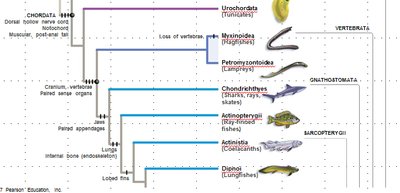
Jawless fishes include hagfish and lampreys, which lack jaws and paired appendages. Hagfish have lost vertebrae.
Jawed Fishes
Jawed fishes are paraphyletic and include:
Chondrichthyes: Sharks and rays (cartilaginous skeleton)
Actinopterygii: Ray-finned fishes (swim bladder)
Actinistia: Coelacanths (lobed fins)
Dipnoi: Lungfishes (lobed fins, functional lungs)
Tetrapods
Tetrapods include amphibians, reptiles, birds, and mammals. Amphibians undergo metamorphosis and lay eggs in water. Reptiles have amniotic eggs and keratinized scales or feathers. Birds are endotherms, and mammals are viviparous (except monotremes).
Summary Table: Key Traits in Deuterostome Evolution
Trait | Group | Adaptive Significance |
|---|---|---|
Radial symmetry | Echinoderms (adults) | Facilitates interaction with environment from all sides |
Endoskeleton | Echinoderms | Protection and support |
Water vascular system | Echinoderms | Movement, feeding, gas exchange |
Pharyngeal gill slits | Chordates | Filter feeding/gas exchange |
Dorsal hollow nerve cord | Chordates | Central nervous system |
Notochord | Chordates | Support and movement |
Vertebrae & cranium | Vertebrates | Protection of CNS |
Jaws | Gnathostomes | Diverse feeding strategies |
Limbs | Tetrapods | Terrestrial locomotion |
Amniotic egg | Reptiles, mammals | Terrestrial reproduction |
Lactation & fur | Mammals | Nutrition & heat retention |
Study Guide Tips
Know where key traits arose in the phylogenetic tree.
Understand the body plan for echinoderms and chordates.
Be familiar with basic info and examples of species in key vertebrate lineages.
For vertebrate innovations, know their adaptive significance.
Consider which traits evolved more than once and which were lost in key lineages.
