 Back
Digestive System, Food Processing, and Cellular Energy: Study Notes
Study Guide - Smart Notes
 Tailored notes based on your materials, expanded with key definitions, examples, and context.
The Digestive System, Food Processing, and Cellular Energy
Introduction to Nutrition and the Digestive System
The digestive system is essential for breaking down food, absorbing nutrients, and eliminating waste. Understanding its structure and function is crucial for evaluating dietary choices and maintaining health.
Obtaining and Processing Food
Animals obtain food in various ways, and their diets can be classified based on the types of food they consume.
Herbivores: Animals that eat plants and algae. Examples include snails and gorillas.
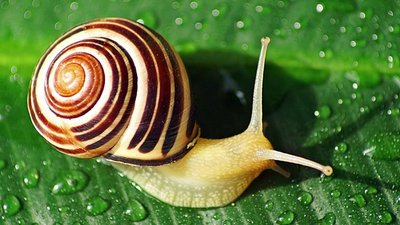
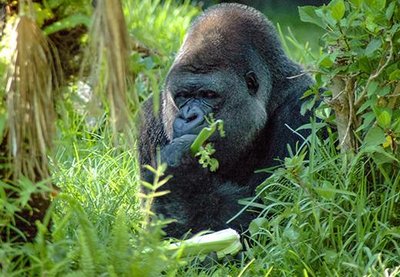
Carnivores: Animals that eat other animals. Examples include lions and whales.
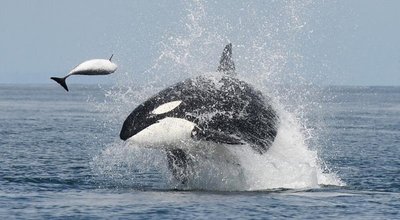

Omnivores: Animals that eat both plants and animals. Examples include humans and crows.

Types of Feeding Mechanisms
Suspension Feeders: Capture food particles from the surrounding medium.

Substrate Feeders: Live in or on their food source and eat their way through it.
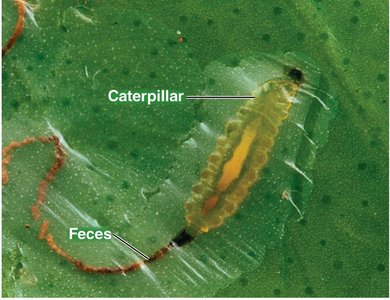
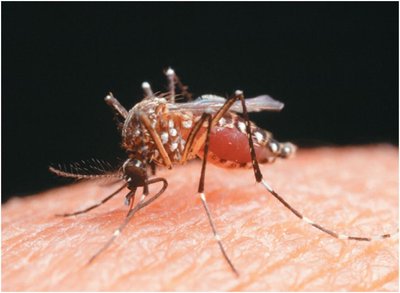
Fluid Feeders: Suck nutrient-rich fluids from a living host.
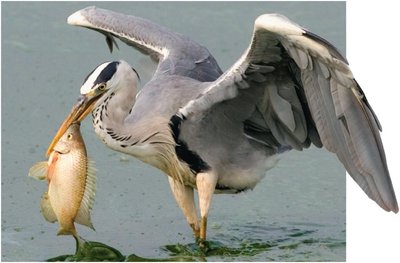
Bulk Feeders: Ingest large pieces of food.
Stages of Food Processing
Food processing in animals occurs in four main stages:
Ingestion: Taking in food.
Digestion: Breaking down food into smaller molecules, both mechanically and chemically.
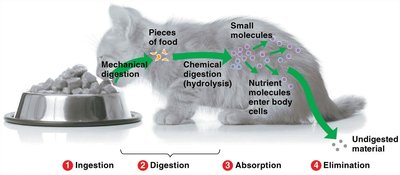
Absorption: Uptake of nutrient molecules into body cells.
Elimination: Removal of undigested material.
Chemical Digestion
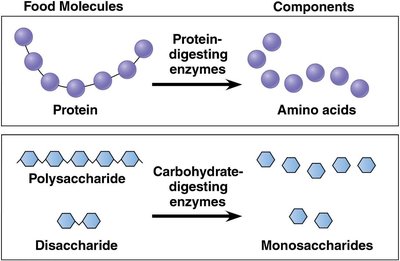
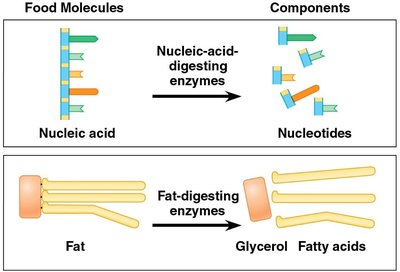
Chemical digestion uses enzymes to break down macromolecules into their components:
Proteins are broken down into amino acids by protein-digesting enzymes.
Carbohydrates are broken down into monosaccharides by carbohydrate-digesting enzymes.
Nucleic acids are broken down into nucleotides by nucleic-acid-digesting enzymes.
Fats are broken down into glycerol and fatty acids by fat-digesting enzymes.
Specialized Compartments for Digestion
Digestion occurs in specialized compartments in animals:
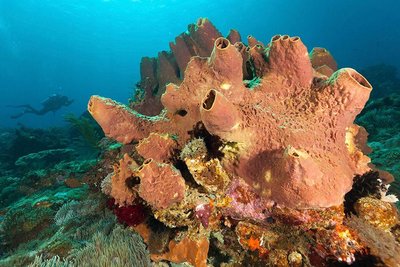
Sponges: Digest food entirely in food vacuoles.
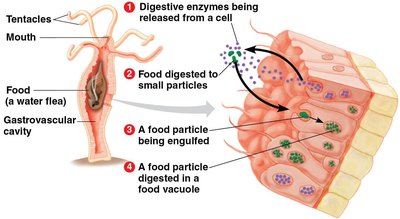
Cnidarians and Flatworms: Have a gastrovascular cavity with a single opening.
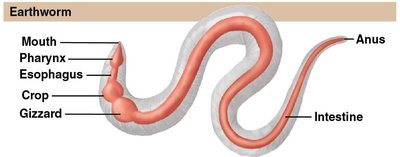
Most Other Animals: Have an alimentary canal running from mouth to anus, with specialized regions for sequential digestion and absorption.
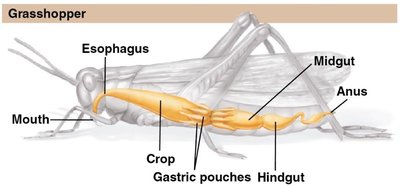
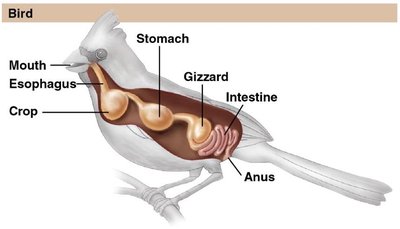
The Human Digestive System
The human digestive system consists of an alimentary canal and accessory organs. Food is ingested, chewed, moved by peristalsis, and digested in specialized regions.
Oral Cavity: Mechanical and chemical digestion begin in the mouth.
Pharynx and Esophagus: Food is moved to the stomach by peristalsis, and sphincters regulate passage.
Stomach: Stores food and begins protein digestion with gastric juice (containing pepsinogen and HCl).
Small Intestine: Major site of chemical digestion and nutrient absorption. Enzymes from the pancreas and intestinal wall digest food; bile emulsifies fats. Folds, villi, and microvilli increase surface area for absorption.
Liver: Processes and detoxifies blood from the intestines, regulates nutrient levels, and synthesizes blood proteins.
Large Intestine: Reclaims water, absorbs vitamins produced by bacteria, and compacts feces for elimination.
Evolutionary Adaptations of Digestive Systems
The length and structure of the digestive tract often correlate with an animal's diet, reflecting evolutionary adaptations.
Animal Nutrition and Energy
An animal's diet must provide sufficient energy, raw materials for biosynthesis, and essential nutrients.
Energy and the Cell
Cells transform energy and matter as they perform work. Energy exists as kinetic (motion) or potential (stored) energy, including chemical energy.
First Law of Thermodynamics: Energy can change form but cannot be created or destroyed.
Second Law of Thermodynamics: Energy transfers increase disorder (entropy), with some energy lost as heat.
Energy Conversion Examples
25% of chemical energy in gasoline is converted to kinetic energy in a car.
34% of chemical energy in glucose is converted to energy for cellular work.
Chemical Reactions and Metabolism
Exergonic Reactions: Release energy (catabolic reactions).
Endergonic Reactions: Require energy and yield products rich in potential energy (anabolic reactions).
Metabolism: Encompasses all a cell’s chemical reactions, organized into metabolic pathways.
Energy Conservation in Cellular Respiration
Some energy extracted from food is stored in ATP; the rest is released as heat.
ATP and Cellular Work
ATP (Adenosine Triphosphate): Composed of an adenosine backbone with three phosphate groups.
ATP powers nearly all forms of cellular work by transferring a phosphate group (phosphorylation).
ATP Recycling Equation
ATP is continuously recycled in cells:
Concept Checks and Applications
Digestive enzymes: Pancreatic amylase aids in digesting starch molecules found in foods such as potatoes and bread.
Acidic chyme: Heartburn is caused by acidic chyme flowing backward into the esophagus.
Summary Table: Types of Animal Diets and Feeding Mechanisms
Diet Category | Example Organisms | Feeding Mechanism |
|---|---|---|
Herbivore | Snail, Gorilla | Bulk Feeder |
Carnivore | Lion, Whale | Bulk Feeder |
Omnivore | Human, Crow | Bulk Feeder |
Suspension Feeder | Manta Ray | Suspension Feeding |
Substrate Feeder | Caterpillar | Substrate Feeding |
Fluid Feeder | Mosquito | Fluid Feeding |
Summary Table: Stages of Food Processing
Stage | Description |
|---|---|
Ingestion | Taking in food |
Digestion | Mechanical and chemical breakdown of food |
Absorption | Uptake of nutrients into cells |
Elimination | Removal of undigested material |
Summary Table: Types of Chemical Digestion
Macromolecule | Enzyme Type | Product |
|---|---|---|
Protein | Protein-digesting enzymes | Amino acids |
Carbohydrate | Carbohydrate-digesting enzymes | Monosaccharides |
Nucleic Acid | Nucleic-acid-digesting enzymes | Nucleotides |
Fat | Fat-digesting enzymes | Glycerol, Fatty acids |
Additional info: These notes expand on the original slides and images, providing academic context and explanations for each topic. All included images directly reinforce the adjacent content and are relevant to the explanation.
