 Back
BackDiversification of Eukaryotes: Protists and Major Eukaryotic Lineages
Study Guide - Smart Notes
 Tailored notes based on your materials, expanded with key definitions, examples, and context.
Chapter 27: Diversification of Eukaryotes
Introduction to Eukaryotes
Eukaryotes, classified under Domain Eukarya, represent a diverse group of organisms ranging from single-celled protists to complex multicellular forms such as plants and animals. They are distinguished from bacteria and archaea by several key features:
Larger cell size and increased complexity
Presence of membrane-bound organelles (e.g., nucleus, mitochondria)
Extensive cytoskeleton
Nuclear envelope
Multicellularity evolved multiple times
Both asexual and sexual reproduction are observed
Protists: Definition and Characteristics
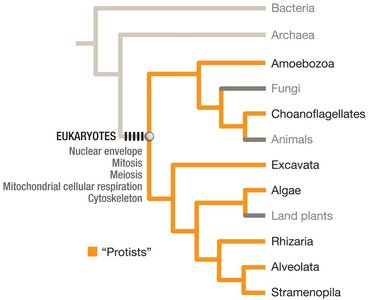
Protists include all eukaryotes except land plants, fungi, and animals. They do not form a monophyletic group and lack unique defining features. Protists are primarily aquatic and are highly diverse in form and function.
Why Do Biologists Study Protists?
Medical importance: Some protists cause diseases in humans and crops (e.g., malaria, Irish potato famine).
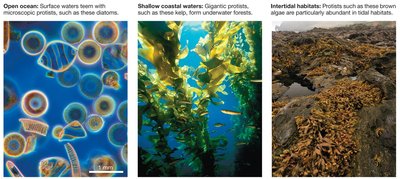
Ecological importance: Protists are abundant in aquatic environments and play key roles as primary producers and in food chains.
Evolutionary significance: Understanding protists is critical for tracing the evolution of plants, fungi, and animals.
Impacts on Human Health and Welfare
Irish potato famine (1845): Caused by Phytophthora infestans, a water mold protist.
Malaria: Caused by Plasmodium species, transmitted by mosquitoes. Each stage of the life cycle is specialized for infecting specific host cells.

Table: Human Health Problems Caused by Protists
Species | Disease |
|---|---|
Plasmodium spp. | Malaria |
Naegleria fowleri | Meningoencephalitis (brain-eating amoeba) |
Toxoplasma gondii | Toxoplasmosis |
Dinoflagellates | Shellfish poisoning via algal blooms |
Trypanosoma spp. | Sleeping sickness, Chagas disease |
Entamoeba histolytica | Amoebic dysentery |
Harmful Algal Blooms
Unicellular, toxin-producing protists called dinoflagellates can cause harmful algal blooms. Toxins accumulate in shellfish, which can poison humans who consume them.

Protists in Aquatic Food Chains
Photosynthetic protists are primary producers that fix carbon dioxide into sugars, forming the base of aquatic food chains. Plankton (e.g., diatoms) are especially important in open oceans and lakes.
Protists and the Global Carbon Cycle
Protists play a key role in the global carbon cycle by acting as carbon sinks. Their remains contribute to sedimentary rocks and petroleum formation. Fertilizing oceans with iron can increase protist populations and enhance carbon sequestration.

Studying Protist Diversity
Microscopy and Cell Structure
Protists are grouped based on cell structure and organelles. For example, Stramenopila have flagella with hollow, hairlike structures.

Major Eukaryotic Lineages
Seven major groups of eukaryotes are identified by morphological and molecular data. Protists are a paraphyletic group (not monophyletic). The main lineages are:
Amoebozoa
Opisthokonta
Excavata
Plantae
Rhizaria
Alveolata
Stramenopila

Table: Distinguishing Features of Major Eukaryotic Lineages
Lineage | Distinguishing Features |
|---|---|
Amoebozoa | Lack cell walls; large lobes for movement |
Opisthokonta | Single flagellum at base; flat mitochondrial cristae |
Excavata | Feeding groove; reduced or absent mitochondria |
Plantae | Chloroplasts with double membrane |
Rhizaria | Lack cell walls; threadlike pseudopodia |
Alveolata | Alveoli (sac-like structures) under plasma membrane |
Stramenopila | Flagella with hairlike projections |
Direct Sequencing
Direct sequencing of environmental DNA has revealed many new protist lineages, including diverse picoplankton.
Themes in Protist Diversification
Morphological Innovations
Earliest eukaryotes were single-celled with mitochondria, nucleus, cytoskeleton, and no cell wall.
Flagella enabled motility.
Endosymbiosis Theory
Origin of Mitochondria
Mitochondria originated via endosymbiosis when a bacterial cell was engulfed by a host cell. Evidence includes:
Mitochondria are similar in size to bacteria
Replicate by fission
Have their own ribosomes and circular DNA
Double membrane structure

Origin of Chloroplasts
Chloroplasts originated when a eukaryote engulfed a cyanobacterium. Some protists acquired chloroplasts via secondary endosymbiosis, resulting in organelles with more than two membranes.
Origin of the Nuclear Envelope
The nuclear envelope likely evolved from infoldings of the plasma membrane, which also gave rise to the endoplasmic reticulum. This separation of transcription and translation allowed for more complex gene regulation.
Structures for Support and Protection
Protists exhibit diverse support structures: cell walls (e.g., diatoms with silica), cellulose plates (dinoflagellates), hard shells, and internal rigid structures.
Multicellularity
Multicellularity evolved independently in several eukaryotic lineages. It began with cells sticking together after division, followed by specialization of cells for different functions.
Protist Nutrition and Movement
How Do Protists Obtain Food?
Ingestive feeding: Engulfing prey or organic debris (phagocytosis)
Absorptive feeding: Uptake of nutrients directly from the environment; includes decomposers and parasites
Photosynthesis: Autotrophic protists use light energy to produce organic compounds
How Do Protists Move?
Amoeboid motion: Sliding movement using pseudopodia (requires ATP)
Flagella and cilia: Swimming via long (flagella) or short (cilia) appendages
Protist Reproduction and Life Cycles
Asexual Reproduction
Based on mitosis and cell division
Produces genetically identical offspring
Sexual Reproduction
Based on meiosis and fusion of gametes
Produces genetically diverse offspring
Sexual reproduction is considered an adaptation to fight disease due to increased genetic variation
Life Cycles: Haploid vs. Diploid Dominance
Protist life cycles vary widely; some are haploid-dominant, others diploid-dominant
Alternation of generations: Multicellular haploid (gametophyte) and diploid (sporophyte) forms alternate
Key Lineages of Eukaryotes
Amoebozoa
Lack cell walls; move via large, lobe-like pseudopodia
Include amoebae, cellular slime molds, and plasmodial slime molds
Important in nutrient cycling and as model organisms
Opisthokonta
Includes fungi, animals, and choanoflagellates
Fungi are decomposers; animals are multicellular heterotrophs
Choanoflagellates are closest living relatives to animals
Excavata
Have an excavated feeding groove
Some lack mitochondria or have vestigial mitochondria
Includes parabasalids, diplomonads, and euglenids
Plantae
Monophyletic group including glaucophyte algae, red algae, green algae, and land plants
All have chloroplasts derived from primary endosymbiosis
Rhizaria
Single-celled, lack cell walls, some with elaborate shells
Move by slender pseudopodia
Important in sediment formation and geological dating
Alveolata
Have alveoli (membrane-bound sacs) under plasma membrane
Include ciliates, dinoflagellates, and apicomplexans
Some are bioluminescent or parasitic
Stramenopila (Heterokonta)
Flagella with hollow projections
Includes water molds, diatoms, and brown algae
Important primary producers and habitat formers (e.g., kelp forests)
