 Back
BackDiversification of Eukaryotes: Protists and Their Evolutionary Innovations
Study Guide - Smart Notes
 Tailored notes based on your materials, expanded with key definitions, examples, and context.
Chapter 27: Diversification of Eukaryotes
Introduction to Eukaryotes and Protists
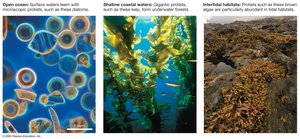
Eukaryotes, classified under Domain Eukarya, represent a diverse group of organisms ranging from single-celled protists to multicellular plants and animals. Protists include all eukaryotes except land plants, fungi, and animals, and are primarily found in aquatic environments. They are unified by the presence of a nuclear envelope, extensive cytoskeleton, and organelles, but do not form a monophyletic group.
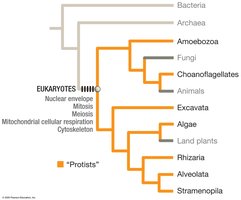
Key Features of Eukaryotes:
Large cell size
Complex organelles
Extensive cytoskeleton
Nuclear envelope
Multicellularity (evolved multiple times)
Asexual and sexual reproduction
Protists: All eukaryotes except land plants, fungi, and animals; highly diverse and primarily aquatic.
Why Do Biologists Study Protists?
Medical, Ecological, and Evolutionary Importance
Protists are studied for their significant roles in human health, ecological systems, and evolutionary biology. Some protists cause diseases in humans and crops, while others are crucial for understanding the origins of plants, fungi, and animals.
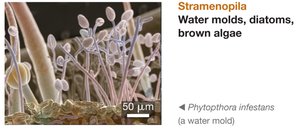
Medical Importance: Protists such as Plasmodium (malaria) and Phytophthora infestans (potato blight) have major impacts on human health and agriculture.
Ecological Importance: Protists are abundant in aquatic environments and play key roles in food webs and nutrient cycling.
Evolutionary Importance: Studying protists helps elucidate the evolutionary history of eukaryotes.
Malaria: A Case Study
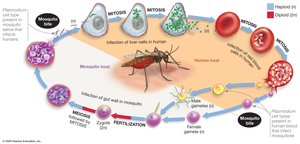
Malaria is caused by five species of the parasitic protist Plasmodium, transmitted by mosquitoes. The life cycle involves specialized stages adapted to infect specific host cells.
Harmful Algal Blooms
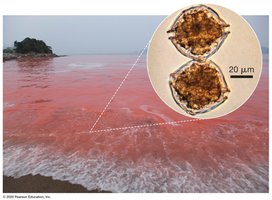
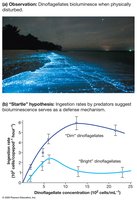
Some protists, such as dinoflagellates, can cause harmful algal blooms, producing toxins that accumulate in shellfish and can poison humans.
How Do Biologists Study Protists?
Microscopy and Molecular Phylogenetics
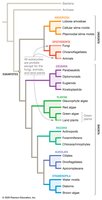
Protists are studied using light and electron microscopy to reveal cell structure and organelles. Molecular phylogenetic analyses of DNA sequences have identified seven major eukaryotic lineages. Protists are a paraphyletic group, lacking shared derived traits (synapomorphies).
Themes in the Diversification of Protists
Morphological Innovations
Protists exhibit remarkable diversity in size, habitat, and morphology. Key innovations include mitochondria, the nucleus, multicellularity, and various structures for support and protection.
Endosymbiosis and the Origin of Mitochondria
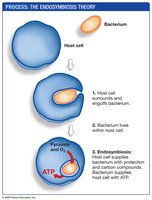
The endosymbiosis theory proposes that mitochondria originated when a bacterial cell was engulfed by a eukaryotic ancestor. Evidence includes similarities in size, replication, ribosomes, double membranes, and circular DNA between mitochondria and α-proteobacteria.
Endosymbiosis and the Origin of Chloroplasts
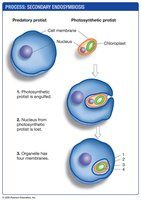
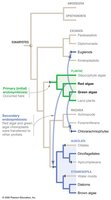
Chloroplasts in photosynthetic protists originated from the engulfment of cyanobacteria. Some protists acquired chloroplasts via secondary endosymbiosis, resulting in organelles with more than two membranes.
Origin of the Nuclear Envelope
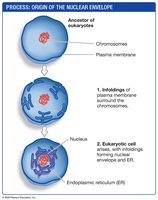
The nuclear envelope likely evolved from infoldings of the plasma membrane, which also gave rise to the endoplasmic reticulum. This innovation separated transcription and translation, allowing for greater complexity in gene regulation.
Structures for Support and Protection
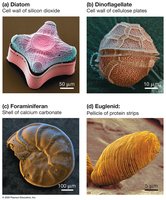
Protists have evolved a variety of structures for support and protection, including cell walls (e.g., diatoms with silica, dinoflagellates with cellulose), hard external shells, and internal rigid structures.
Multicellularity
Multicellularity evolved independently in several eukaryotic lineages. It began with cells sticking together after division, followed by specialization of cells for different functions.
How Do Protists Obtain Food?
Feeding Strategies
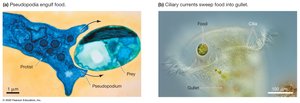
Protists display diverse feeding strategies, including ingestive feeding (phagocytosis), absorptive feeding, and photosynthesis.
Ingestive Feeding: Involves engulfing prey or organic debris using pseudopodia or cilia. Only possible in protists lacking a rigid cell wall.
Absorptive Feeding: Nutrients are absorbed directly from the environment; common among decomposers and parasites.
Photosynthesis: Autotrophic protists use light energy to produce organic compounds from CO2.
How Do Protists Move?
Locomotion Mechanisms
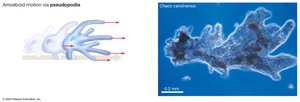
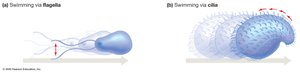
Protists move using amoeboid motion (pseudopodia), flagella, or cilia. Amoeboid motion involves cytoplasmic streaming and is similar to movement in animal cells. Flagella are long and few, while cilia are short and numerous.
How Do Protists Reproduce?
Asexual and Sexual Reproduction
Protists reproduce both asexually (mitosis) and sexually (meiosis and gamete fusion). Sexual reproduction increases genetic diversity, which is advantageous in changing environments and in the evolutionary arms race with parasites and pathogens.
Key Lineages of Eukaryotes
Major Groups and Their Characteristics
The seven major eukaryotic lineages each have distinctive morphological features and lifestyles. These include:
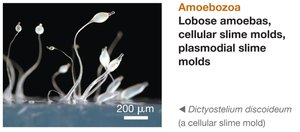
Amoebozoa: Lack cell walls, move via lobe-like pseudopodia, include amoebae and slime molds.
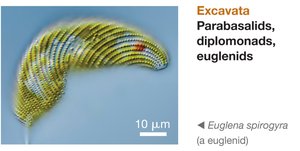
Excavata: Have an "excavated" feeding groove, some lack mitochondria, include parabasalids, diplomonads, and euglenids.
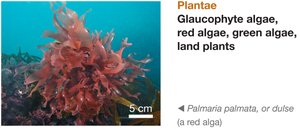
Plantae: Monophyletic group including glaucophyte algae, red algae, green algae, and land plants; all descended from a common ancestor with a cyanobacterial endosymbiont.
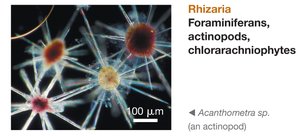
Rhizaria: Single-celled, lack cell walls, some have elaborate shells, move by slender pseudopodia.
Alveolata: Have membrane-bound vesicles (alveoli) under the plasma membrane; include ciliates, dinoflagellates, and apicomplexans.
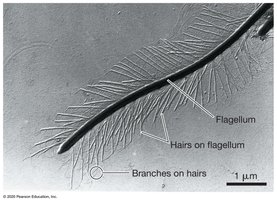
Stramenopila: Possess flagella with distinctive hollow hairs; include water molds, diatoms, and brown algae.
Additional info: The classification and evolutionary relationships among protists are continually refined as new molecular and morphological data become available. Protists are essential for understanding the origins and diversification of complex life on Earth.
