 Back
Divide or Die: Cell Signaling, Cancer, Apoptosis, and Phenotypic Plasticity
Study Guide - Smart Notes
 Tailored notes based on your materials, expanded with key definitions, examples, and context.
Cell Signaling and Division
Growth Factor Pathway and Ras Protein
Cells respond to external signals to regulate division, a process crucial for tissue maintenance and development. The growth-factor pathway is a classic example of signal transduction leading to cell division.
Growth Factor: A protein released by cells to stimulate division in neighboring cells.
Receptor Tyrosine Kinase (RTK): Membrane-bound receptor that initiates the signal cascade upon growth factor binding.
Ras Protein: A small G protein that acts as a molecular switch; active when bound to GTP, inactive when bound to GDP.
Kinase Cascade: Sequential activation of protein kinases, culminating in the activation of transcription factors and division genes.
Division Genes: Genes whose expression drives the cell cycle and division.
Example: In cancer, mutations in Ras prevent it from hydrolyzing GTP, causing continuous cell division regardless of external signals. 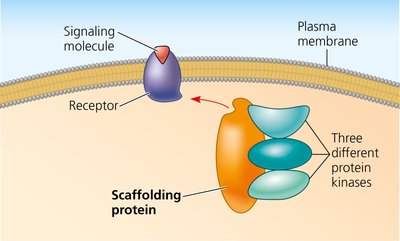
Fine-Tuning Signal Transduction
Signal pathways are modulated by scaffolding proteins, crosstalk, and branching, allowing cells to integrate multiple signals and respond appropriately.
Scaffolding Proteins: Hold kinases together for efficient signal relay.
Crosstalk: Pathways share components, allowing one signal to modify another.
Branching: A single relay can trigger multiple responses.
Example: Scaffolding proteins ensure rapid and localized signal transmission, critical for precise cellular responses.
Cancer: Proto-Oncogenes and Oncogenes
Mutations Leading to Cancer
Cancer arises when normal regulatory mechanisms are disrupted, often through mutations in proto-oncogenes, converting them into oncogenes.
Proto-oncogene: A normal gene promoting cell division.
Oncogene: A mutated proto-oncogene causing uncontrolled division.
Gain of Function Mutation: Mutation that makes a protein active when it should not be; often dominant.
Example: Ras G12C mutation locks Ras in the active state, driving cancer. Targeted drugs like sotorasib bind only the mutant protein, leaving normal Ras unaffected. 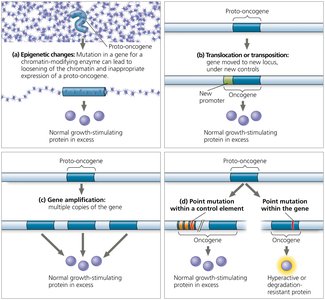
Mechanisms of Proto-Oncogene Activation
Epigenetic Changes: Mutations in chromatin-modifying enzymes can lead to inappropriate expression.
Translocation/Transposition: Gene moved under new promoter control, causing excess protein production.
Gene Amplification: Multiple gene copies increase protein levels.
Point Mutation: Within control elements or the gene itself, leading to hyperactive or degradation-resistant proteins.
Apoptosis: Programmed Cell Death
Mechanism and Regulation
Apoptosis is an orderly process by which cells dismantle themselves in response to specific signals, preventing inflammation and maintaining tissue health.
Triggers: External death signals or internal stress (e.g., DNA damage, mitochondrial cytochrome c release).
Caspases: Protein-cutting enzymes executing apoptosis.
Necrosis: Uncontrolled cell death causing inflammation.
Example: In C. elegans, 131 cells die on schedule during development; mutants lacking the executioner caspase (ced-3) retain these cells. 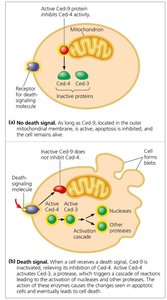
Genetic Control of Apoptosis in C. elegans
ced-9: The brake, inhibits apoptosis.
ced-4: The trigger, activates ced-3.
ced-3: The executioner caspase.
Example: Removing ced-3 prevents programmed cell death; removing ced-9 causes excessive cell death and embryonic lethality.
Phenotypic Plasticity and the Environment
Environmental Signals and Development
Cells and organisms can alter their phenotype in response to environmental cues, a phenomenon known as phenotypic plasticity.
Phenotypic Plasticity: One genotype produces different phenotypes in different environments.
Norm of Reaction: The range of phenotypes a genotype can produce across environments, visualized as a line.
Kairomone: A chemical cue released by one species and used by another (e.g., predator scent).
Example: Daphnia pulex develops neckteeth when exposed to predator scent, demonstrating environmental influence on phenotype. 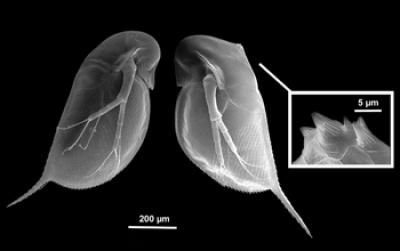
Genotype × Environment Interaction
Different genotypes may respond differently to environmental signals, resulting in crossing norms of reaction.
No single genotype is 'best' in all environments; fitness depends on context.
Example: Siamese cats have temperature-sensitive pigment enzymes, leading to color variation based on body region temperature.
Summary Table: Key Terms and Concepts
Term | Definition |
|---|---|
Growth Factor | Protein that stimulates cell division |
Ras | Small G protein, molecular switch for division |
Proto-oncogene | Normal gene promoting division |
Oncogene | Mutated gene causing uncontrolled division |
Caspase | Enzyme executing apoptosis |
Phenotypic Plasticity | Genotype producing different phenotypes in different environments |
Norm of Reaction | Range of phenotypes across environments |
Practice Questions
What is the effect of blocking the last kinase in the growth-factor pathway in a cell with a Ras G12C mutation?
Why does a worm with no ced-9 die as an embryo, while a worm with no ced-3 is nearly normal?
Draw and interpret norms of reaction for two genotypes whose lines cross.
Key Takeaways
Division and death are signal responses; cancer results from disrupted signaling.
Apoptosis is essential for development and tissue health.
The environment can act as a signal, shaping phenotype through plasticity.
