 Back
DNA and RNA: Structure, Function, and the Origin of Life
Study Guide - Smart Notes
 Tailored notes based on your materials, expanded with key definitions, examples, and context.
Definition of Life and Course Overview
Characteristics of Life
Biology seeks to understand the fundamental properties that define living organisms. The main characteristics of life include:
Replication: The ability to reproduce with high fidelity.
Cells: Presence of cellular borders that separate internal and external environments.
Information: Flow and storage of genetic information.
Energy: Acquisition and utilization of energy for cellular processes.
Evolution: Capacity for change and adaptation over generations.
Nucleic Acids and the RNA World
Course Objectives
This section focuses on the structure and function of nucleic acids, particularly RNA and DNA, and their role in the origin of life.
Recognize and describe the nucleotides that make up RNA and DNA, and their differences.
Explain the primary and secondary structures of RNA and DNA.
List characteristics of RNA that support the RNA world hypothesis.
Describe how RNA and DNA act as information-carrying molecules.
Key Vocabulary
RNA world hypothesis
Nucleotide
Nucleic acid
Purine
Pyrimidine
Ribose
Deoxyribose
Complementary base pairing
Antiparallel
Double helix
RNA World Hypothesis
RNA as the Origin of Life
The RNA world hypothesis proposes that RNA was the first information-carrying molecule, capable of both storing genetic information and catalyzing chemical reactions.
Information processing: RNA can store and transmit genetic information.
Replication: RNA can catalyze its own replication.
Enzyme activity: Some RNA molecules (ribozymes) can catalyze chemical reactions.
Limitations: Proteins are more versatile in structure and function, and DNA is more stable for long-term information storage.

Nucleic Acids as Biological Polymers
Polymerization of Nucleic Acids
Both RNA and DNA are biological polymers composed of nucleotide monomers. Polymerization involves the bonding of monomers to form a growing chain.
Monomers: Nucleotides are the building blocks.
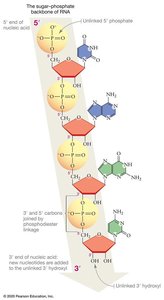
Polymerization: Nucleotides are joined by phosphodiester bonds.

Structure of Nucleotides
General Structure
Nucleotides consist of three main components:
Phosphate group
Five-carbon sugar (ribose in RNA, deoxyribose in DNA)
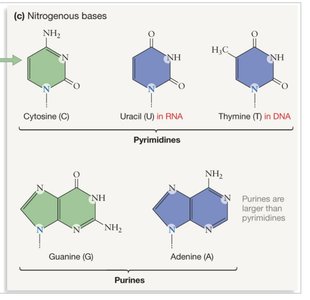
Nitrogenous base (purines: adenine, guanine; pyrimidines: cytosine, uracil in RNA, thymine in DNA)



Differences Between RNA and DNA Nucleotides
RNA: Contains cytosine, uracil, guanine, and adenine.
DNA: Contains cytosine, thymine, guanine, and adenine.
Base pairing: In DNA, A pairs with T, and C pairs with G.

Primary and Secondary Structure of RNA
Primary Structure
The primary structure of RNA is its linear sequence of nucleotides, written from the 5' phosphate end to the 3' hydroxyl end.
Sequence: Determines the function and folding of the molecule.
Secondary Structure
Secondary structure arises from complementary base pairing within the same RNA molecule, forming structures such as hairpins and loops.
Base pairing: Regions of the molecule pair to form double helices.
Unpaired regions: Form loops.

Primary and Secondary Structure of DNA
Primary Structure
The primary structure of DNA is its sequence of deoxyribonucleotides.
Secondary Structure
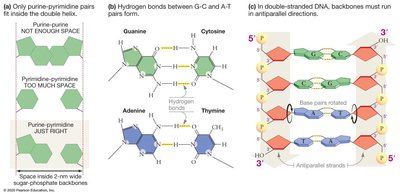
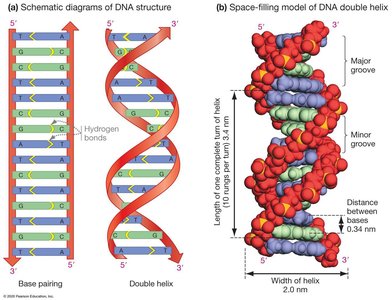
DNA is typically double-stranded and forms a double helix. The two strands are antiparallel and held together by complementary base pairing.
Antiparallel strands: One strand runs 5' to 3', the other 3' to 5'.
Base pairing: A-T and C-G pairs via hydrogen bonds.

Major and Minor Grooves
DNA has major and minor grooves, which are important for protein binding and regulation.

DNA and RNA as Information-Carrying Molecules
Function of DNA
DNA serves as the biological reservoir of information, storing the instructions required for growth and reproduction. The sequence of bases encodes genetic information.
Transmission: Information in DNA can be transmitted to progeny cells during cell division.
Replication: DNA forms a template for its own synthesis.



Summary Table: DNA and RNA Structure
Comparison of DNA and RNA Structure
The following table summarizes the structural differences between DNA and RNA at the primary, secondary, and tertiary levels.
Level of Structure | DNA | RNA |
|---|---|---|
Primary | Sequence of deoxyribonucleotides; bases are A, T, G, C | Sequence of ribonucleotides; bases are A, U, G, C |
Secondary | Two antiparallel strands twist into a double helix | Most commonly, a single strand folds back on itself to form a double helix and an unpaired "loop" |
Tertiary | Double helical DNA forms compact structures by wrapping around histone proteins and/or twisting into supercoils | Secondary structures fold into a wide variety of distinctive three-dimensional shapes |

Historical Context: Discovery of DNA Structure
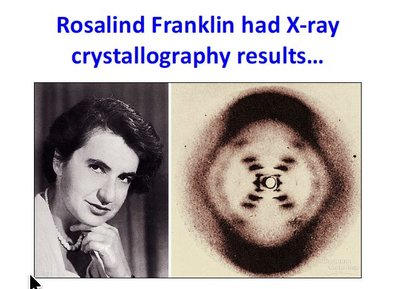
Rosalind Franklin, Watson, and Crick
The discovery of the DNA double helix was a landmark in biology. X-ray crystallography data from Rosalind Franklin was crucial, but the Nobel Prize was awarded to Watson, Crick, and Wilkins.

Conclusion
Understanding the structure and function of DNA and RNA is fundamental to biology. These molecules are central to the storage, transmission, and expression of genetic information, and their discovery has shaped modern molecular biology.
