 Back
BackDNA and the Gene: Synthesis and Repair
Study Guide - Smart Notes
 Tailored notes based on your materials, expanded with key definitions, examples, and context.
Chapter 15: DNA and the Gene
Introduction
This chapter explores the molecular nature of genes, focusing on the structure of DNA, the mechanisms of DNA replication, and the processes that ensure the faithful transmission and repair of genetic information. Understanding these processes is fundamental to molecular biology and genetics.
What Are Genes Made Of?
The Nature of Genetic Material
Genes are the fundamental units of heredity, encoding the instructions for building and maintaining living organisms.
Early hypotheses debated whether genes were composed of DNA or protein.
The Hershey-Chase Experiment
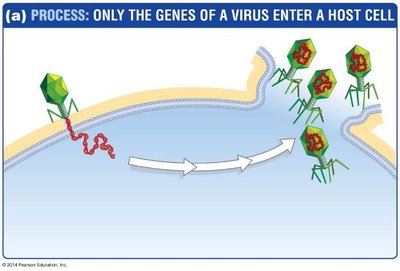
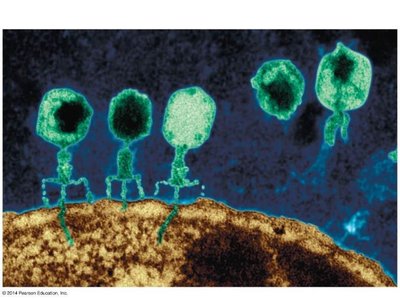
The Hershey-Chase experiment provided definitive evidence that DNA, not protein, is the genetic material in viruses.
Bacteriophages (viruses that infect bacteria) were labeled with radioactive isotopes to distinguish DNA from protein.
Only the viral DNA entered the bacterial cell and directed the production of new viruses, demonstrating that DNA carries genetic information.
Structure of DNA
Nucleotide Structure
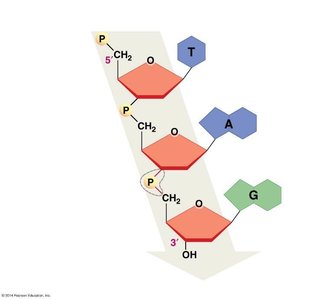
DNA is a polymer of nucleotides, each consisting of a phosphate group, a deoxyribose sugar, and a nitrogenous base (adenine, thymine, guanine, or cytosine).
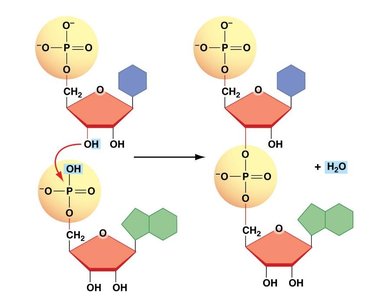
Nucleotides are linked by phosphodiester bonds between the 3' hydroxyl group of one sugar and the 5' phosphate of the next.
Primary and Secondary Structure of DNA
The primary structure of DNA is its sequence of nucleotides.
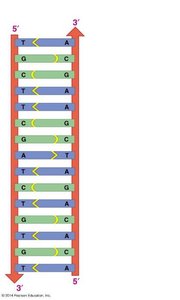
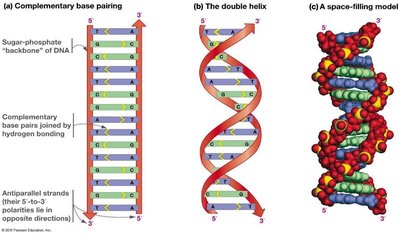
The secondary structure is the famous double helix, with two antiparallel strands held together by complementary base pairing (A-T and G-C) via hydrogen bonds.
The strands run in opposite directions (5' to 3' and 3' to 5').
DNA Replication: Models and Mechanisms
Hypotheses for DNA Replication
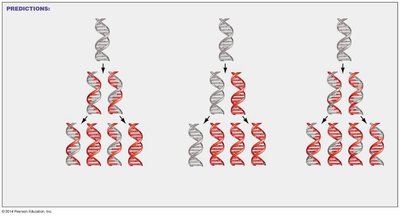
Semiconservative replication: Each new DNA molecule consists of one parental and one new strand.
Conservative replication: The parental molecule is conserved, and an entirely new molecule is made.
Dispersive replication: Each strand is a mix of old and new DNA.
Meselson-Stahl Experiment
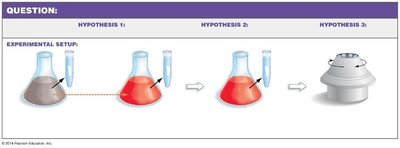
Used isotopic labeling (15N and 14N) to distinguish old and new DNA strands.
Results supported the semiconservative model of DNA replication.
Mechanism of DNA Replication
Replication begins at origins, where the DNA double helix is unwound.
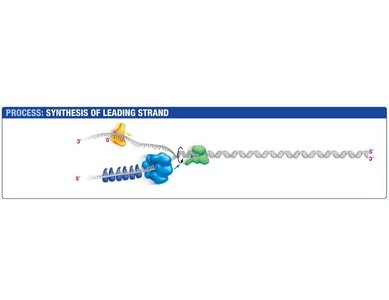
Helicase unwinds the DNA; single-strand binding proteins (SSBPs) stabilize the unwound strands.
Topoisomerase relieves supercoiling ahead of the replication fork.
Primase synthesizes short RNA primers to provide a starting point for DNA polymerase.
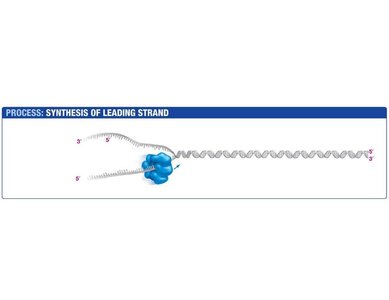
DNA polymerase adds nucleotides in the 5' to 3' direction, using the parental strand as a template.
Leading and Lagging Strand Synthesis
The leading strand is synthesized continuously toward the replication fork.
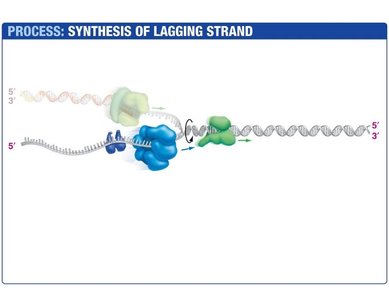
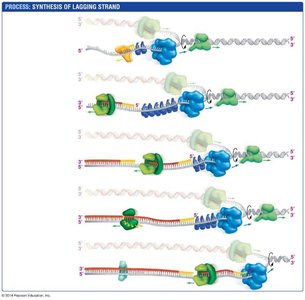
The lagging strand is synthesized discontinuously, forming short Okazaki fragments that are later joined by DNA ligase.
RNA primers are replaced with DNA by DNA polymerase I.
Problems with Replicating Linear Chromosomes
The End-Replication Problem
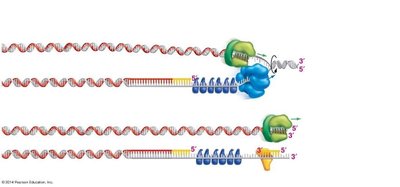
Linear chromosomes face the "end-replication problem" because DNA polymerase cannot fully replicate the 5' ends of lagging strands.
This results in progressive shortening of chromosomes with each cell division.
Telomeres and Telomerase
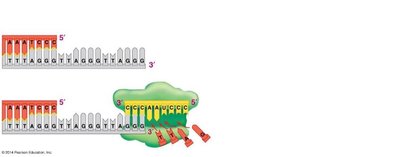
Telomeres are repetitive DNA sequences at chromosome ends that protect genes from erosion.
Telomerase is an enzyme that extends telomeres, using its own RNA template to add DNA repeats.
Telomerase activity is high in germ cells and some stem cells, but low in most somatic cells.
DNA Proofreading and Repair
Proofreading by DNA Polymerase
DNA polymerase has proofreading activity: it can detect and correct mismatched bases during replication, reducing the error rate.
DNA Repair Mechanisms
Nucleotide excision repair removes damaged DNA segments (e.g., thymine dimers caused by UV light) and replaces them with correct nucleotides.
Defects in repair systems can lead to genetic diseases, such as xeroderma pigmentosum (XP), which increases sensitivity to UV-induced DNA damage.
Summary Table: Key Steps and Enzymes in DNA Replication
Step | Enzyme/Protein | Function |
|---|---|---|
Unwinding DNA | Helicase | Separates DNA strands |
Stabilizing single strands | SSBPs | Prevents reannealing |
Relieving supercoiling | Topoisomerase | Prevents overwinding |
Primer synthesis | Primase | Makes RNA primer |
DNA synthesis | DNA polymerase III | Adds nucleotides |
Primer removal | DNA polymerase I | Replaces RNA with DNA |
Fragment joining | DNA ligase | Seals nicks in backbone |
Telomere extension | Telomerase | Extends chromosome ends |
Key Equations
Phosphodiester bond formation:
Energy for DNA synthesis: Hydrolysis of pyrophosphate () drives the reaction forward.
Conclusion
DNA replication and repair are essential for the accurate transmission of genetic information. The semiconservative model of replication, the enzymatic machinery involved, and the mechanisms for correcting errors and maintaining chromosome ends are central to molecular genetics and cell biology.
